
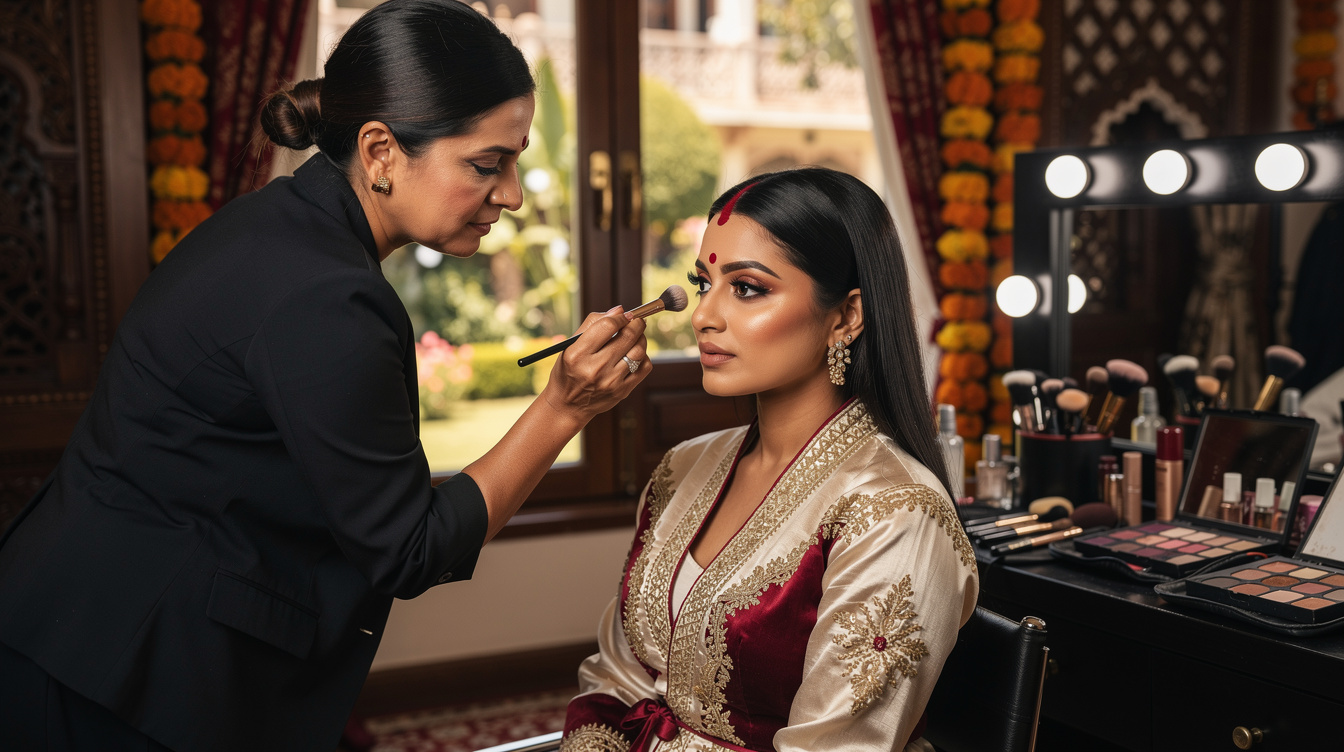
Indian Bridal Makeup Artist in Istanbul — Your Complete Guide
Istanbul has quietly become one of the most requested destinations on our calendar. Over the past two years, the volume of enquiries from Indian families planning weddings on the Bosphorus, in Cappadocia’s balloon-strewn skies, or along the Aegean coast has grown faster than any other international market we serve. The reason is simple — the city offers something no European capital can match: a cultural register that already feels familiar to the Indian eye. Mughal grandeur and Ottoman architecture share a lineage. Hammam-tiled palaces and chandelier-lit ballrooms photograph beautifully against a red lehenga or an emerald sherwani. And the food, the music, the warmth of Turkish hospitality — all of it reads as celebration.
For the broader framework on destination wedding makeup planning — including how brides choose their MUA, the realistic 12-month timeline, multi-event look planning across the wedding week, and logistics for international destinations — see our complete destination wedding makeup guide.
But there is a challenge that almost every bride discovers within the first ten minutes of her vendor research, and it is the reason this guide exists. Istanbul has world-class makeup artists. What it does not have, in any meaningful number, are makeup artists who specialise in Indian bridal aesthetics. That gap is what we have spent the last several years quietly filling — flying in from our Sector 16 studio in Faridabad with our full team, kit in hand, prepared to deliver the bridal look you have been imagining since you were a child.
This guide walks you through everything we have learned from doing this work — why Istanbul keeps choosing Indian families, why local Istanbul artists struggle with our aesthetic register, how we structure a destination wedding from the trial chair in Faridabad to the final reception touch-up overlooking the Bosphorus, and what it actually costs to have a specialist team travel with you. Shivangi has been an Indian bridal makeup artist serving brides since 2012, with international training from Makeup Studio in the Netherlands and over 1000 brides behind her — and Istanbul is now one of the destinations we travel to most often.
Why Istanbul is Trending for Indian Destination Weddings
Five or six years ago, the Indian destination wedding map was dominated by the same five names — Udaipur, Jaipur, Goa, Phuket, and Bali. Istanbul rarely came up in conversation. Today it is one of the top three international requests we receive, and the venues most often mentioned are recognisably the same handful: Four Seasons Bosphorus, Çırağan Palace Kempinski, and Shangri-La Bosphorus.
There are four practical reasons families are choosing Istanbul, and we hear them in every initial consultation.
The first is the venue tier itself. Four Seasons Bosphorus sits on the European waterfront with the strait directly behind the ceremony space — a backdrop that turns golden during the late-afternoon light Indian wedding photographers chase. Çırağan Palace Kempinski occupies a restored Ottoman palace, its ballrooms scaled to a grandeur that mirrors Mughal architecture in a way that flatters traditional Indian decor. Shangri-La Bosphorus offers the same waterfront access with a more contemporary luxury register. All three handle large Indian guest lists with experience that newer destination markets simply do not have.
The second reason is the cultural fusion. Mughal and Ottoman art share roots — domes, arches, tilework, calligraphy, gardens. A bride in a heavy red lehenga standing under the carved arches of Çırağan does not look out of place. She looks as though the building was built for her. That visual coherence is not something we get in, say, a beachfront resort in Southeast Asia or a rustic vineyard in Tuscany. Istanbul photographs Indian weddings as if it were designed for them.
The third reason is logistical — direct flights from Delhi and Mumbai land in Istanbul in roughly five and a half to six hours. That is shorter than Bali, comparable to Dubai, and far easier on elderly relatives than the eight-to-twelve hour flights to Western Europe. Visa processing for Indian passport holders is straightforward. Connectivity from tier-two Indian cities is improving every season.
The fourth reason is value. The Turkish lira’s exchange rate against the rupee makes Istanbul roughly thirty to forty per cent more affordable than equivalent venues in Italy, France, or Greece. Couples who could only just afford a Tuscan villa wedding find that Istanbul gives them a higher-tier venue, a longer stay, and a larger guest list within the same budget envelope.
Together, these four reasons explain why our Istanbul calendar is now booked twelve to fourteen months in advance for peak season dates. Every istanbul wedding makeup artist enquiry we receive is filtered through that calendar, and we hold dates only after the trial in Faridabad is complete.
The Challenge — Finding an Indian Bridal Specialist in Istanbul
Here is the conversation we have with almost every Istanbul bride during her first consultation. She has been online for weeks. She has saved Instagram pages of beautiful local Istanbul artists — talented women whose work is editorial, soft, and distinctively European. And she is asking, very politely, why she should fly her makeup team in from India when there are clearly skilled artists already in the city.
The honest answer is not that local Istanbul artists are not good. They are excellent — for the work they specialise in.
Local Istanbul artists serve Western and Turkish brides. Their portfolios are built around fair-to-medium European skin tones, soft contour, dewy or matte skin in a register that suits white wedding dresses and minimalist gowns, and hair styles built around veils and tiaras. They are masters of their craft within that vocabulary.
But Indian bridal makeup is its own discipline. It is not a variation of Western bridal makeup — it is a separate tradition with its own techniques, its own product knowledge, and its own visual grammar. There are five things, specifically, that Indian bridal work requires and that local Istanbul artists are not trained to deliver.
First, Indian bridal aesthetics. The eye treatment, the lip register, the depth of the eye makeup, the way the brows are shaped, the cheek placement — all of it is calibrated for an Indian face viewed under heavy gold jewellery, against the saturation of a red or maroon or peach-pink lehenga. The proportions are different. The colour temperature is different. We have spent thirteen years inside that visual register, and our eye is trained for it.
Second, lehenga colour matching. A lehenga is not a single colour. It is a base fabric, an embroidery palette, a dupatta tone, and a jewellery temperature, all of which must be read together when choosing eye and lip colour. We routinely arrive at the trial with the bride’s actual lehenga (or a high-resolution photograph and a fabric swatch) and build the makeup around it. Asking a local Istanbul artist to do this from a phone screenshot, in the morning of the wedding, is asking for a mismatch you will see in every photograph for the rest of your life.
Third, kundan and polki jewellery styling. Indian bridal jewellery is not an accessory — it is a structural element of the look. The maang tikka rests against the hairline. The matha patti runs along the parting. The nath sits between the eye and the lip. The choker, the rani haar, the long mala — every piece has a placement that affects the makeup beneath it. An artist who has not styled this jewellery hundreds of times will not know where to recess the eyeshadow, where to keep the highlight, where to soften the contour so the jewellery reads as the focal point rather than competing with the face.
Fourth, dupatta draping. The dupatta is half the look. We have a dedicated drapist on our team because no two brides drape the same way — some want the front fall over both shoulders, some want the cathedral drape pinned from the crown, some want the side drape with the embroidery border showing. The hair has to be set to support the drape. The makeup has to be balanced for the way the dupatta will frame the face. This is a cumulative skill built over hundreds of brides.
Fifth, HD Glass Skin for Indian skin tones. Indian skin has a specific undertone palette — warm yellow, warm olive, neutral peach, deep golden, deep brown — and the products that deliver a luminous skin-like finish on a European bride often look ashy, grey, or chalky on Indian skin. Our HD Glass Skin technique uses specific foundation layers, blurring primers, and finishing sprays calibrated for the Indian skin spectrum. It is not the same product set a local Istanbul artist would carry. You can read more about the technique in our dedicated HD Glass Skin bridal makeup explainer.
The honest answer to the bride’s question, then, is that local Istanbul artists are excellent at their work, but their work is not Indian bridal work. The solution is to bring an Indian bridal specialist with you. That is what we do.
How We Handle Istanbul Destination Weddings
When a bride confirms an Istanbul wedding with us, the work begins long before the flights are booked. Here is the structure we follow on every international engagement.
The first step is the trial. Every bride does her trial in our Sector 16 Huda Market studio in Faridabad before we travel. We will not travel for a bride we have not personally tried in our chair. The trial is a two-to-three hour appointment where Shivangi works through the look from foundation to final spray, the bride wears a sample blouse or top to mimic the lehenga neckline, and the drapist demonstrates the dupatta style she has chosen. The hairstylist sets the hair, the photographer takes documentation shots, and the bride leaves with a written note covering every product used, the order in which it was applied, and the final settings. That document travels with the team to Istanbul and becomes the reference card on the wedding morning.
The second step is team confirmation. For a destination wedding, Shivangi does not travel alone. The full team flies together — Shivangi as lead artist, our hairstylist, our drapist, and an assistant who handles kit organisation, sanitisation between functions, and on-the-day logistics. For multi-function weddings spanning mehndi through reception, the same four people are present at every function. There is no handover, no junior swap, no drop-off in standards from the first event to the last. The bride who saw Shivangi in the trial chair is the bride who will see Shivangi at every function.
The third step is logistics. We handle our own flights, our own visas, our own airport-to-hotel transfers. Our kit is packed in airline-compliant cases, with backup kit shipped separately as insured cargo for high-stakes weddings. The bride is not asked to coordinate any of it — she gives us the wedding date, the venue, and the function schedule, and we tell her our arrival and departure times. Brides have enough to manage in the two weeks before a destination wedding without also project-managing their vendor team.
The fourth step is climate adaptation. Istanbul sits in a Mediterranean-to-temperate transition zone, which means the climate varies sharply by season. Summer weddings (June through September) are warm and humid by the Bosphorus, with afternoon temperatures in the low thirties Celsius and high humidity along the water. Spring and autumn weddings are mild but unpredictable — sudden showers are common in April and October. Winter weddings, increasingly popular for the snow-dusted palace photography, require waterproof and cold-stable formulations. We adjust our product selection accordingly. Summer Bosphorus weddings get our airbrush and high-humidity setting protocol. Winter palace weddings get richer, more emollient bases that hold against indoor-to-outdoor temperature swings during portrait sessions.
We are also accustomed to indoor-outdoor venue transitions, which are a feature of almost every Istanbul wedding. The ceremony might be on the waterfront terrace, the cocktail under a covered pavilion, the dinner inside the ballroom, and portraits scheduled across all three lighting environments. We pre-plan touch-ups around the function flow so the bride is camera-ready at every transition. This is what thirteen years of bridal work and several international destinations — Sri Lanka, Canada, and a steadily growing Istanbul roster — look like in practice. Not a celebrity-style fly-in-fly-out, but a full team operation built around the specific demands of Indian bridal traditions in unfamiliar climates.
Istanbul Wedding Venues and Makeup Considerations
Each major Istanbul venue presents a different combination of light, climate, and architectural register. Here is how we approach the venues that come up most often in our consultations as the chosen istanbul luxury wedding makeup artist on the team.
Four Seasons Bosphorus. This is the most-requested venue on our Istanbul calendar, and most of our four seasons istanbul wedding makeup work happens during the late-afternoon golden hour. The defining feature is the waterfront — ceremonies are held on a terrace directly above the Bosphorus, with the European and Asian shores visible across the strait. The light is the consideration. Late-afternoon sun reflects off the water and creates a warm, almost coppery cast across the bride’s face. We adjust the highlight placement to keep the cheekbone reading sharp without picking up additional shine from the reflected water light. For golden-hour photography sessions — which the venue’s photographers love — we keep the under-eye area slightly drier than usual to prevent low-angle light from catching any product creasing.
Çırağan Palace Kempinski. This is the Mughal-scale grandeur option. The interior ballrooms are lit by enormous chandeliers, and the architectural detail competes for attention with the bride. We respond to this with a slightly heavier eye treatment than we would use for a Bosphorus terrace ceremony — deeper transition shades, more deliberate liner, and a stronger lip — so the bride reads as the focal point even at distance, even under light that washes out lesser makeup. The chandelier light is warm and yellow, which means we cool the foundation by a half-shade to prevent the bride from looking sallow in the wide-frame ballroom shots. NARS, MAC, and Dior bases all have shade ranges that give us this flexibility on Indian skin.
Shangri-La Bosphorus. This is the more contemporary luxury option, with cleaner lines and softer interior lighting than Çırağan. We treat it as a hybrid between the Four Seasons waterfront approach and the Çırağan ballroom approach — slightly lifted highlight for the modern register, but the same waterfront-aware finish to handle the morning and afternoon light bouncing off the strait.
Cappadocia balloon backdrops. A growing number of brides build a separate Cappadocia photo session into the trip, scheduled at sunrise to catch the hot-air balloons in the sky. The light at five in the morning is cold and pink. The climate is dry — much drier than coastal Istanbul. We use a more emollient base for these sessions, set very lightly, and skip the heavier finishing spray that we would use for an evening function. The bride is typically in a different lehenga or in a lighter pre-wedding outfit, and the makeup is calibrated for that lighter register.
Bodrum and Antalya coastal weddings. A small but growing number of clients pair an Istanbul reception with a coastal ceremony in Bodrum or Antalya. The Aegean coast is hotter and more humid than Istanbul itself, especially in July and August. For these weddings we shift entirely to airbrush application, use waterproof everything, and pre-plan touch-up windows around any beach or pool-adjacent photography. Sunset ceremonies on the coast also have a particular orange-pink light register that we account for in shade selection.
We have also been asked about Topkapi Palace photography permits, Hagia Sophia exterior shoots, and Galata Tower rooftop sessions. Each has its own light and climate quirks, and we plan around them in pre-event consultations. The point is not that any of this is improvised — it is that thirteen years of bridal work and a decade of destination weddings have given us a playbook for almost every venue scenario Istanbul can present.
Pricing for Istanbul Destination Wedding Makeup
We are transparent about pricing because most surprises in destination wedding planning come from vendors who are not. Here is what an Istanbul engagement actually looks like in numbers.
The makeup fee. Our outstation per-function rate starts from ₹50,000, the same rate published on our WedMeGood listing. This is the artistry fee — what you are paying for Shivangi’s time, attention, and product application on your face. It does not change because the destination is international. The work is the work.
Travel costs. International flights for the team — Shivangi, hairstylist, drapist, and assistant — are quoted to you separately and at cost. We share the actual booking fares. There is no markup. IndiGo, Vistara, Turkish Airlines, and Emirates all run direct or one-stop routings from Delhi NCR to Istanbul, and we book whichever combination of timing and price works best for the wedding date.
Accommodation. The team needs to be lodged near the venue for the duration of the functions — typically a three-to-five night stay covering arrival, prep day, and the function calendar. The bride or her family covers this. We are not picky — a clean three or four-star hotel within twenty minutes of the venue is sufficient. We do not require luxury accommodation.
Per diem. A fixed daily allowance covering meals, local transport, and incidentals is quoted upfront for the team. This is standard industry practice for outstation engagements and is detailed in your written quote. There are no in-trip top-ups, no surprise expense receipts at the end.
Multi-function packages. Most Istanbul weddings are not single-day events. They typically include some combination of mehndi, sangeet, haldi, wedding ceremony, and reception, often spread across three to five days. We build multi-function packages with bundled pricing that reduces the per-function rate when the team is already on the ground. A four-function Istanbul wedding works out significantly more efficient than four separate engagements.
Family and bridesmaid makeup. We extend party-style makeup pricing (starting from ₹8,000 per face in our standard listing) to family members and bridesmaids during destination engagements, scheduled around the bride’s primary slots. This is one of the most-asked questions, and the answer is yes — we are happy to make sure the mother of the bride, the sisters, and the close cousins are also taken care of without each of them needing a separate vendor.
The total quote is always provided in writing, in advance, with line items separated. There are no surprise charges. If a touch-up requires an additional product run or a function schedule shift creates an extra working day, we tell you before it happens, not after. Transparent pricing is one of the reasons our brides keep referring their friends and sisters to us — there is no anxiety about the bill at the end of a beautiful week.
For brides comparing budgets across markets, we recommend reading our broader destination wedding pricing guide before the consultation. For local Delhi NCR brides who want to do the trial in person before committing, our Faridabad bridal studio booking page has the appointment options.
One thing we want to address openly, because it is the quietest and most common fear we hear during consultations: brides are afraid of looking like someone else on their wedding day. The horror stories on Instagram are real — too fair, too dark, too shiny, too heavy, mask-like, unrecognisable. We have built our whole practice around the opposite philosophy. The reviews our brides leave consistently say the same thing in different words — that the makeup was light enough that it felt like skin, that they looked like the best version of themselves rather than a different person, that family members commented on how much like themselves they still looked under the heavy jewellery and the lehenga. HD Glass Skin and our Skin-like Makeup techniques exist for exactly this reason. You will not look like a different bride. You will look like you, on the best day of your life.
Destination Wedding Makeup · India & International
Discuss Your Destination Wedding
14 years of destination wedding experience across India and internationally. Trial sessions at our Faridabad studio, transparent logistics handling, and a no-surprise pricing structure.
WhatsApp Shivangi directly to discuss your wedding date, destination, and event plan.
Frequently Asked Questions — Istanbul Destination Weddings
How far in advance should we book for an Istanbul destination wedding?
For peak season dates (April–May and September–October), we recommend booking twelve to fourteen months in advance. Our Istanbul calendar fills early because we cap the number of international engagements per quarter to ensure each bride gets the full team and our undivided attention. For off-peak winter dates, six to eight months is usually sufficient. The earliest step is the trial in Faridabad — once we have done your trial and locked your look, we hold the wedding dates with a confirmation deposit and begin the team logistics.
Can your team handle Istanbul’s weather for outdoor ceremonies — and will my makeup actually last?
Yes. Our outdoor protocol is built around two scenarios — humid Bosphorus summer days and unpredictable spring or autumn rain. For humid summer ceremonies we shift to airbrush application, use a long-wear base, and lock everything with a high-humidity setting spray. For cooler months, we use richer formulations stable across indoor-outdoor temperature swings. The team is on-site for touch-ups between every function transition. Reviews from our past destination engagements consistently mention makeup and hair holding through late-night receptions, and we structure every Istanbul engagement around the same standard.
Will I still look like myself? I’m worried about heavy, mask-like Indian bridal makeup.
This is the most common fear we hear, and it is the fear our practice is specifically built around. Shivangi’s signature techniques — HD Glass Skin and Skin-like Makeup — are designed to give you full coverage and the structural definition of bridal makeup without the heavy, painted, unrecognisable quality that the worst Instagram horror stories show. Our brides consistently leave reviews saying the makeup felt light, looked natural, and that family members commented on how much like themselves they still looked. We do a full trial in Faridabad before we commit to the wedding so you see exactly what you are getting before the team gets on a plane. There are no surprises on the wedding morning.
How will my makeup photograph under Bosphorus golden-hour and palace chandelier light?
This is where international training and HD-specific technique matter. Shivangi is certified by Makeup Studio in the Netherlands, and her practice has been built around HD and Ultra HD camera resolutions from the start. We use HD foundations from MAC, NARS, and Dior, and we calibrate finish (matte, satin, or glass) to the specific lighting environment of the venue and the time of day. Our Faridabad portfolio of 215+ bridal photographs on WedMeGood is the most direct way to see how our work reads on camera. For Istanbul specifically, we adjust the foundation temperature for chandelier light and the highlight placement for waterfront reflected light, both of which we cover in detail above.
Do you carry your own products and work with local Istanbul photographers?
Everything travels with us. Our kit covers the full bridal product range from foundation through finishing spray, including HD foundations from MAC, NARS, and Dior, eyeshadow palettes from Huda Beauty and Charlotte Tilbury, lash and brow products from Fenty Beauty and Laura Mercier, primers and setting sprays from Haus Labs, and a deep selection of liners, glitters, and pigments calibrated for Indian bridal looks. We carry duplicates of the most critical products as backup. We do not rely on local sourcing because product availability and shade matching for Indian skin in Istanbul is unpredictable. On the photography side, we work with whoever you have hired — local Turkish photographer, Indian photographer flown in, or a hybrid team. Our drapist and hairstylist coordinate directly with the photography lead during morning prep so the lighting setup, the angle of any prep-shot photography, and the timing of the first-look reveal all fit the photographer’s plan.
Can your team also do makeup for the mother of the bride, sisters, and bridesmaids?
Yes — we routinely cover the bride, the mother of the bride, sisters, and bridesmaids during the same engagement. Family and party makeup is priced at our standard rate (starting from ₹8,000 per face) and scheduled around the bride’s primary slots so nothing competes with her timing. For larger groups we may bring an additional team member, which is quoted upfront. The advantage of having one team for the whole family is consistency — everyone in the wedding photographs reads as part of the same look, with no clash between different artists’ aesthetic registers.
If you are planning an Istanbul wedding and want to talk through dates, venues, and team logistics, the fastest way to start is a WhatsApp message to +91 9354888093. We will reply with availability, send a sample quote structure, and book your trial slot at the Faridabad studio. The earlier the conversation starts, the more flexibility we have on dates — and the more time we have to make your Istanbul wedding everything you have been imagining.