
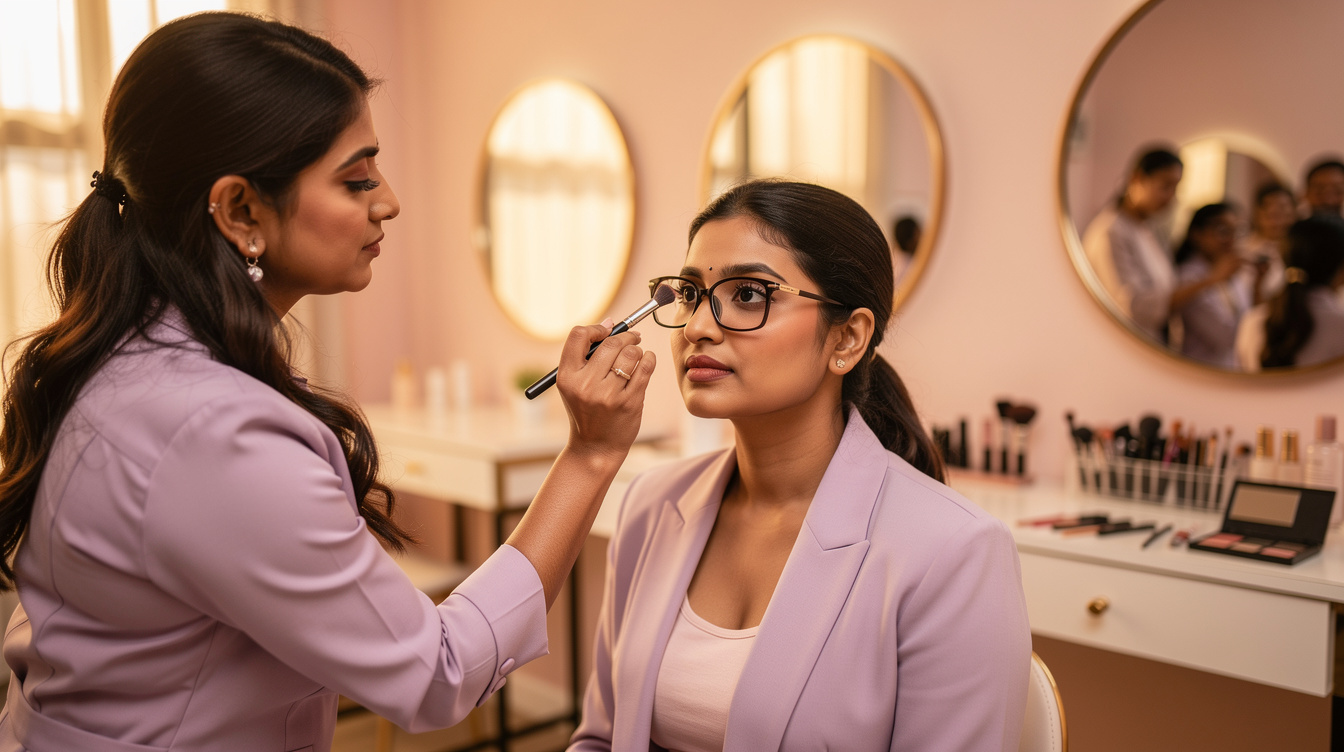
Almost every week, somebody walks into our Sector 16 studio in Faridabad with the same quiet question: when is the right moment to leave my day job and do makeup full-time? They are usually mid-twenties to mid-thirties, holding a steady salary, doing weekend bookings on the side, and living a double life that is starting to feel unsustainable. We understand the weight of that question — it is not just a career switch, it is a complete restructure of identity, income and family expectation. So in this guide, we are going to walk through it the way we walk through it with our students: with real numbers, a real runway plan, a real test phase, and an honest list of who this life suits and who it does not. If, by the end, you decide the leap is for you, our 20-Day Professional Makeup Course in Faridabad is built precisely for the switcher who needs to compress years of trial-and-error into a structured, hands-on residency.
This is the eighth article in our Makeup Academy & Career series, and it is the one we get asked about most often by readers in Delhi NCR. We will not romanticise the freelance life. We have been doing this since 2012, we have served over 1,000 brides, we have travelled to Jaipur, Udaipur, Goa, Jim Corbett, Chandigarh, Kashmir, Sri Lanka and Canada for destination weddings, and we have also seen talented artists burn out in eighteen months because they quit their job before the math worked. The point of this piece is not to convince you to leap. It is to make sure that if and when you do, the landing is soft.
One last note before we start. The reason readers in Faridabad and South Delhi keep writing in about this is that the June 1 batch of our professional makeup course in Faridabad is filling up, and many of those seats are going to working professionals who plan their notice period around the course end-date. So if any of the financial framing below feels uncomfortably specific, that is because it has been written from real conversations with real switchers — not from a textbook.
The financial math — what monthly income makes the switch safe
The single most useful sentence we can give a soon-to-be full-time makeup artist is this: do not quit until your makeup income, averaged over the last six months, has equalled or exceeded your day-job take-home for at least three of those months. That is the safe-switch threshold. Anything earlier and you are not making a career decision, you are making a leap of faith — and faith does not pay your EMI.
Let us put real numbers on it. If your day job pays you Rs. 60,000 in hand each month, you need a six-month rolling makeup average of around Rs. 60,000 to Rs. 75,000 before quitting. The slightly higher band is not greed — it is the cost of being a sole proprietor. Once you go full-time you stop receiving a free pension contribution, free health insurance, and an employer-funded leave policy. You also start paying GST on services, you carry your own studio costs, and you absorb the cost of products, sanitiser, lashes, disposables, transport and assistant fees on every booking. Net of those, a Rs. 75,000 gross is roughly equivalent to your old Rs. 60,000 salary. That is the like-for-like comparison that protects you.
Within that gross figure, plan for honest segmentation. A reasonable Delhi NCR full-time artist in year one will mix bridal functions (somewhere between Rs. 18,000 and Rs. 35,000 per function depending on positioning), engagement and reception work (Rs. 20,000 to Rs. 28,000), party and family makeup (Rs. 6,000 to Rs. 10,000), and outstation bookings at a premium. We list our own bridal-per-function as a starting reference at Rs. 28,000 with custom quotes on top — that is the kind of transparent, range-based pricing you should be ready to defend in a discovery call. If your current side-bookings cluster only at the party-makeup tier, you are not yet earning at a switchable level no matter how many bookings you take. The number of bookings is a vanity metric. The price-per-booking is the survival metric.
Building a 6-month runway before quitting
Even when the income math works, the cash-in-hand math often does not. The Indian wedding market is brutally seasonal. The peak runs roughly October through February with a smaller April-to-June window, and then there are weeks in late July and August where the phone genuinely does not ring. A full-time makeup artist who quits in March, before understanding the off-season, is the most common cautionary tale we see. The fix is a six-month runway sitting in a separate bank account before you submit your resignation. We are not talking about emergency funds in a generic personal-finance sense — we are talking specifically about a war chest that lets you say no to underpriced bookings during the lean months instead of accepting them out of panic. Underpricing in your first off-season is the single fastest way to permanently anchor your rates too low for the rest of your career.
Six months at your current monthly outflow — rent, EMI, groceries, insurance, parents’ contribution, the basic dignified version of your life — is the floor. If you can stretch it to nine months, do. Inside that runway, also reserve a separate kit-and-business line item: roughly Rs. 1.5 to 2.5 lakh in your first eighteen months for a serious working kit. That kit is not optional vanity. It is your manufacturing equipment. Foundations and concealers from MAC, NARS, Dior, Huda Beauty, Fenty Beauty, Laura Mercier, Haus Labs and Charlotte Tilbury will form the core of any honest pro shade range — because real Indian skin spans an enormous undertone band, and you cannot fake your way through a bridal trial with three foundations.
And here is where we want to address one of the biggest fears we hear from switchers: I am going to spend a fortune on training and a kit, and learn nothing useful. That fear is rational. The market is loud. Our answer to it is structural — every student in our programme practises on live models every single day, receives a specially curated set of training products that are theirs during the course, walks out with a professional brush kit that is theirs to keep, completes a final assessment shoot with a professional model, and earns a certification on completion. There is also lifetime alumni support, which in plain language means you can WhatsApp us months later when a difficult bridal brief lands in your inbox and you need a second opinion. The point of that structure is to make sure your training spend converts into earning capacity, not just a certificate to frame.
How to test full-time viability with weekend bookings first
Before the resignation letter, run a six-month live test. Treat your weekends and one weekday evening per week as a parallel business. The point of the test is not just to earn money — it is to discover, under controlled conditions, whether the daily reality of full-time makeup actually agrees with you. Bridal work in particular involves 4 a.m. start times, long humid hours, demanding mothers-in-law, last-minute schedule changes, on-location electricity failures, and the emotional labour of holding a bride steady on the most stressful morning of her life. Some artists love it. Some discover, eight months in, that they preferred the version of makeup that lived only on weekends.
During the test, track three numbers obsessively. First, your booking-to-enquiry ratio — how many WhatsApp enquiries actually convert to a paid booking. A healthy full-timer in Delhi NCR usually converts somewhere in the 25 to 40 percent range once their portfolio matures. Second, your repeat-and-referral ratio — what percentage of next month’s bookings come from a previous client or her family. If that number is climbing month over month, you have product-market fit. If it is flat, your work is not yet creating the kind of word-of-mouth that sustains a full-time practice. Third, your no-show and cancellation rate. Every cancellation in a full-time business is a hole in your monthly income that no salary cushion is filling. You need to be operating booking discipline — advance retainers, written terms — before the leap, not after.
The other thing the test phase exposes is your pipeline source. If every booking in your six-month test came from one Instagram reel that went viral, you do not have a business — you have a lottery ticket. A real full-time pipeline draws from at least three sources: your own social and Google presence, listings on platforms like WedMeGood and WeddingWire and Sloshout, and direct referrals from past clients, photographers, decorators and venues. Build the second and third leg of that stool while you still have the safety of a salary. Once you are full-time, you will not have the bandwidth.
What the 20-Day Professional Course unlocks for switchers
For a working professional planning the switch, the most expensive resource is not money — it is time. You cannot take a one-year diploma. You cannot do a three-month residency. You need a compressed, full-immersion programme that is taught by an active working artist, not a retired theorist, and that drops you out the other side with a portfolio strong enough to start charging the rates we discussed earlier. That is what our 20-day intensive is built for, and it is the reason a meaningful share of every batch is now made up of switchers from corporate, IT, banking and education backgrounds.
The format is deliberate. Twenty days, 12 PM to 5 PM, at our Sector 16 Huda Market studio in Faridabad, in batches capped at ten students. The cap is not a marketing gimmick — it is the only way to give every student real hands-on time on real skin under direct supervision. The curriculum is structured around HD makeup, airbrush, glass-skin techniques, soft glam and bridal work, alongside the parts of the job that almost every short course skips: client handling, pricing conversations, trial management and basic business setup. We deliberately do not publish a day-by-day breakdown — partly because the cohort shapes the pacing, and partly because the value of an intensive is the integration, not the checklist.
The fee structure for switchers matters, so we will be plain about it. The regular price for the course is Rs. 1,50,000 + GST. The current early-bird price, available for a limited window, is Rs. 80,000 + GST, which represents a saving of Rs. 70,000. We frame this honestly as a launch-window rate, not the standard price — if you are reading this in time, take it. Included in the fee are specially curated training products that are yours to use throughout the course, a professional brush kit that is yours to keep, certification on completion, a final assessment shoot with a professional model that becomes a portfolio asset, and lifetime alumni support. To answer the most direct question we receive — will this actually prepare me to leave my job? — the honest answer is that the course gives you the technical and business foundation. The first six months of disciplined practice after the course is what converts that foundation into income.
The trainer matters as much as the curriculum. Shivangi Verma personally leads every batch — there are no junior instructors. She has been operating since 2012, has trained at Makeup Studio in the Netherlands, has served over 1,000 brides, holds a 5-star rating across 62 Google reviews and a 5.0 across 26+ WedMeGood reviews, and is still actively booking and working bridal weddings during course weeks. As one of our recent brides put it in her review, she knows her job very well — totally involved, dedicated and patient, and that involvement is exactly what carries over into the way the course is taught. To enquire, you can WhatsApp us directly on +91 9354888093 or Fill the inquiry form on our site.
Honest take on careers this DOES NOT suit
We promised honesty, so here it is. Full-time makeup is not for everyone, and we would rather you read this section twice than write to us in your first off-season regretting the leap. If your reason for switching is primarily that you are tired of your current job, full-time makeup is not the answer. Freelance makeup is harder than a desk job in almost every operational respect — the hours are unpredictable, the income is lumpy, the physical strain is real, and the emotional labour of holding nervous brides is a daily tax. People who switch to escape are usually back inside two years. People who switch toward something — toward the craft, toward owning their calendar, toward building a personal brand — tend to last.
It is also not the right move if your household genuinely depends on the certainty of your monthly salary right now. There is no shame in this. Run the side-business in parallel for a longer test phase — twelve months, eighteen months — and quit only when the math is overwhelming, not borderline. Similarly, if you cannot afford to either invest in serious training or build a six-month runway, you are too early. Quitting without either is not entrepreneurship, it is risk you have not been compensated to take.
This life also suits a particular temperament. You need to be comfortable with rejection — not every enquiry will book. You need to be comfortable with negotiation — every bridal family will ask. You need to be comfortable with weekend and festival work — your peak season will collide with everyone else’s holidays. And you need to be comfortable being the face of your own business — there is no manager between you and the client. If three or more of those make you flinch, the part-time, weekends-only model may genuinely be the better long-term fit, and there is no failure in that.
FAQ
How much should I be earning from weekend makeup before I quit my day job?
As a safe rule, your six-month rolling average from makeup should equal your day-job take-home in at least three of those months, and ideally exceed it by 20–25 percent to absorb the loss of employer benefits, GST, and self-funded studio costs. If you are not at that threshold yet, extend your test phase rather than leaping early.
Will the 20-Day Professional Course really prepare me for a career?
The course gives you the complete technical and business foundation — HD, airbrush, glass-skin, soft glam, bridal work, plus client handling, pricing and trial management — taught personally by an active working bridal MUA on real models in batches of ten. What it cannot do is the first six months of disciplined practice after the course, which is what converts the foundation into a sustainable income.
Am I too old or too inexperienced to switch to makeup full-time in 2026?
No. Our batches consistently include complete beginners and career-changers from corporate, banking, IT and teaching backgrounds, alongside younger students. The intensive is designed to take a complete beginner from zero to assessment-ready in twenty days, and the alumni network supports you long after that.
What if I do the course and still cannot get clients?
This is the second-most common fear we hear, and it is why the course covers portfolio building, pricing structure, platform listings and the basics of business setup, not just makeup technique. You will leave with a final-assessment shoot that becomes a real portfolio asset, lifetime alumni support, and a clear roadmap for the first six months of building enquiries.
How do I know your academy is reputable enough to bet my career on?
Shivangi Verma has been operating since 2012, holds international training from Makeup Studio in the Netherlands, has personally served over 1,000 brides, and currently holds a 5-star Google rating across 62+ reviews and a 5.0 on WedMeGood. Crucially, she is still an active working bridal MUA — your trainer is the artist whose calendar is full this season, not someone who stopped taking bookings years ago.
Can I do the course without quitting my job first?
Yes — many of our switcher students plan their leave or notice period around the course’s 12 PM to 5 PM, twenty-day schedule at our Sector 16 Faridabad studio. That afternoon timing is deliberately chosen so that working professionals can attend without burning their entire severance on training-time alone.
20-Day Professional Makeup Course · Sector 16 Faridabad
Become a Professional Makeup Artist — Basics to Advanced
Hands-on training on real skin, only 10 students per batch, taught personally by Shivangi Verma — an active working bridal MUA with 14+ years and 1,000+ brides. Products, professional brush kit, certification and final assessment shoot all included.
Rs. 1,50,000 + GST → Early Bird: Rs. 80,000 + GST (save Rs. 70,000 — limited time)
💬 WhatsApp +91 9354888093 | Fill Inquiry Form | View Course Page →
If, after working through the math, the runway, the test phase and the honest fit-check above, you have decided that 2026 is genuinely your year to leave your day job and go full-time, the next move is structured training that compresses years into weeks. Our Basics to Advanced course in Faridabad is open for the upcoming intake, the early-bird window is still active, and Shivangi is personally taking enquiry calls. WhatsApp us on +91 9354888093 — tell us where you are in your switch story, and we will tell you, honestly, whether the next batch is the right one for you.