
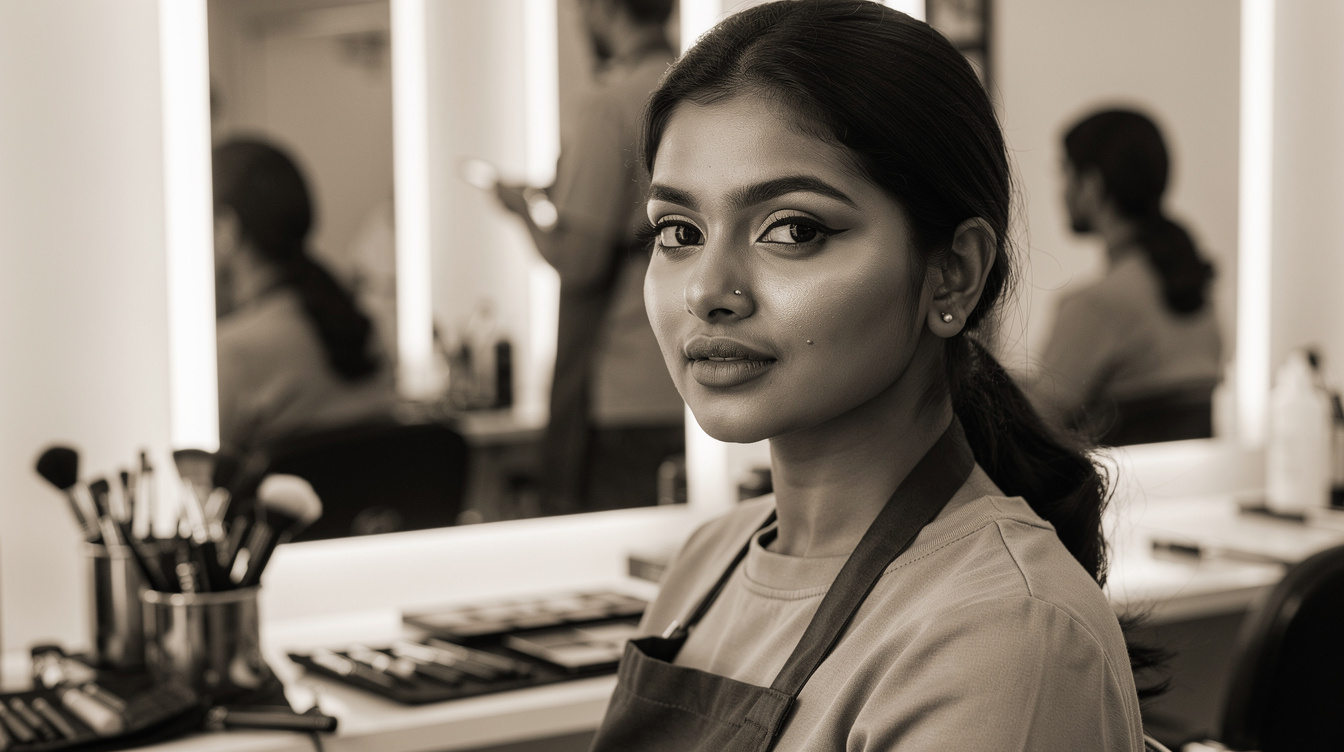
Every few months we get the same message on WhatsApp, almost word for word: “I want to become a professional makeup artist — but I don’t know if a short course is enough, or if I’ll actually learn anything I can use on a real bride.” This article is the long answer. It is a complete overview of our 20-Day Professional Makeup Course in Faridabad — what the format is, who it’s for, what’s included, what the fees are in 2026, and why students are travelling in from across Delhi NCR for the next batch.
We run this programme out of our studio at Booth No 70-71, First Floor, Sector 16 Huda Market, Faridabad, in batches capped at ten students. The course is taught personally by Shivangi Verma — an active working bridal makeup artist with 14+ years in the industry, 1,000+ brides on the books, certification from Makeup Studio Netherlands, and 62 five-star Google reviews from real clients. Nothing is delegated to juniors. The same hands that do bridal trials in the morning teach the practicals in the afternoon.
If you’ve already made up your mind and just want the next-batch link, scroll to the CTA at the bottom or jump straight to our Basics to Advanced course page. If you’re still weighing this against three other academies and a six-month diploma, keep reading — we’ve tried to answer the questions Riya, our typical aspiring-MUA student, actually asks before she signs up.
Why a 20-day intensive format works
The first fear we hear, almost without fail, is that twenty days isn’t enough. It’s a fair worry. The Indian beauty-education market is full of three-month diplomas and six-month certificates, and a shorter format can sound like a shortcut. It isn’t. The 20-day model exists because we ran longer ones for years and watched what actually moved students forward — and what just padded the timetable.
Our course runs five hours a day, 12 PM to 5 PM, every day for twenty days. That’s a hundred hours of contact time, almost all of it on real skin. Compare that to a part-time diploma that meets twice a week for six months: same total hours, but stretched thin, with most of the muscle memory lost between sessions. Skin doesn’t wait. Brushes don’t wait. The reason a working MUA can sit a bride down at 6 AM and produce HD-ready skin in forty minutes is repetition under pressure, not theory recalled from a textbook three months ago.
Twenty consecutive days lets us build that muscle memory in the right order. Week one is foundations — skin prep, base theory, colour reading, brush handling. By the time we’re applying full bridal looks in the second half, the prep work is automatic and the student’s attention is free for the harder, judgement-based parts of the job: matching undertone in poor light, fixing a flashback issue ten minutes before a shoot, reading a bride’s face when she says “I love it” but doesn’t mean it.
The format also matches how this industry actually pays. Most working bridal MUAs in Delhi NCR earn during the wedding seasons — October to February, then April to June. Twenty days is short enough that students can finish before a season starts, take real bookings the same year, and learn the rest of what nobody can teach in a classroom: handling a nervous bride at 5 AM, sharing a getting-ready room with a draping team, and packing a kit that survives a Jaipur summer.
What the course covers at a high level
We deliberately don’t publish a day-by-day curriculum, and students sometimes ask why. The honest answer is that the most important parts of the syllabus are the parts that change based on who’s in the room. A batch heavy on returning students who already understand base work spends more time on advanced bridal techniques. A batch of complete beginners spends more time on prep and brush control before we ever open a foundation bottle. The structure is fixed; the pacing is responsive. That’s the point of capping at ten.
What we will tell you is the shape of it. The course covers HD Makeup, Airbrush, Glass Skin and full bridal techniques — the four pillars of what a Delhi NCR bride is actually asking for in 2026. We work across the brand kit a professional studio would carry: MAC, NARS, Dior, Huda Beauty, Fenty Beauty, Laura Mercier, Haus Labs and Charlotte Tilbury, among others. Students learn how each base behaves on Indian skin tones, in Indian light, under Indian camera flash — not generic Western tutorials adapted with a shrug.
Beyond technique, we spend real classroom time on the things that decide whether a graduate gets booked or not: portfolio building, client handling, pricing, the basics of running a small bridal business, social-media presence, and the etiquette of working alongside hair, draping and photography teams on a wedding morning. None of that is filler. Most of the queries we get from ex-students six months out aren’t about contour — they’re about what to charge a Faridabad client for an outstation function, or how to handle a mother-in-law who wants her daughter “a little fairer”.
The final week culminates in an assessment shoot with a professional model — proper lighting, proper photographer, two finished looks per student. The images go straight into the student’s portfolio. For most of our graduates, those frames become the first three posts on a brand-new Instagram grid.
Who it’s designed for
The course is built for adults who want makeup as a paying career — not as a hobby and not as a soft skill to add to a resume. That said, “adults who want a paying career” covers a much wider range of people than students assume.
The most common profile is a complete beginner — usually someone in her early twenties who has been doing her sisters’ and cousins’ makeup for years, has a small Instagram following, and finally wants to convert it into income. The second most common is a career changer — a teacher, a banker, a homemaker returning to work — who has decided that makeup is what she wants the next ten years to look like. Then there are working freelancers who learnt on the job and want to fill in the parts they faked, especially HD and airbrush. All three groups sit in the same batch. The mix is deliberate; everyone learns faster around people whose blind spots are different from theirs.
What the course isn’t: a one-day masterclass, a self-care workshop, or an evening hobby class. If you’ve never held a brush before, that’s fine — the foundations week is built for you. If you can’t commit to five hours a day for twenty consecutive weekdays, the format won’t work and we’d rather tell you that upfront than take your fee and watch you fall behind in week two.
One fear we hear from older students especially is the “too late to start” worry. We don’t agree, and the alumni track record doesn’t either. Bridal MUAs working today started at every age from nineteen to forty-three. Brides care about whether you can paint, not when you learnt.
Fees, what’s included, batch details
Fees in 2026 are Rs. 1,50,000 + GST at the regular rate, with an Early Bird price of Rs. 80,000 + GST for the next intake — that’s a saving of Rs. 70,000, available only for a limited window before the batch fills. We’re being honest about the framing: the Rs. 80,000 figure is a launch-style early-bird, not the standard fee. Once the seats book up the next batch reverts to the regular price.
What that fee actually pays for, beyond classroom time:
Specially curated training products are provided for the duration of the course — full-size, working stock, the same brands a professional studio carries. You use them every day on real models. A professional brush kit is included and yours to keep at the end. Certification on completion is issued in Shivangi Verma’s name, alongside the studio’s. The final assessment shoot with a professional model is built into the timetable — no extra fee, no “optional add-on”. And lifetime alumni support means you can WhatsApp us about a real-world problem six months or six years after the course ends and get an answer from someone who’s actually working in the industry that week.
Batch size is capped at ten students. That cap exists for one reason: hands-on attention. With ten people in the room and one principal trainer, every student gets watched, corrected and re-watched on every technique. We have run smaller groups; we will not run larger ones. If you’ve already had the experience of being one of forty in a beauty-academy classroom, you know exactly why this matters.
If you’d like to confirm seat availability for the next batch, the fastest path is to WhatsApp us at +91 9873048267 or Fill the inquiry form on the academy page. We respond personally — there’s no agency in the middle.
Why students travel from across NCR for this batch
Faridabad isn’t the obvious choice for a makeup course in Delhi NCR. South Delhi has more academies, Gurgaon has more flash. Yet the students booking this batch are coming in from Greater Noida, Gurgaon, Dwarka, Ghaziabad and as far as Meerut. The pattern is consistent enough that we’ve stopped being surprised by it.
The first reason is the trainer. Shivangi has been working as a bridal MUA out of Faridabad since 2012 — thirteen-plus years, 1,000+ brides, certified from Makeup Studio Netherlands, with destination weddings already executed across Jaipur, Goa, Jim Corbett, Udaipur, Chandigarh, Kashmir, Sri Lanka and Canada. She isn’t a full-time educator who teaches with one hand and books occasional weddings with the other. She is, every weekend, on a bridal job somewhere — and what she teaches on Monday is the problem she solved on Sunday. That’s the kind of currency you can’t fake.
The second is reputation. The studio carries a 5.0 rating across 26+ reviews on WedMeGood and 62 Google reviews, and the language in those reviews repeats: her main goal is to make sure you feel beautiful; totally involved, dedicated and patient; understood my vision and made me look pretty without overdoing it. We mention this because the most common fear we hear from students isn’t about the course — it’s about the academy’s reputation transferring to them. It’s a fair concern, and it deserves a transparent answer instead of marketing copy.
The third is geography, in the unsexy practical sense. Sector 16 Huda Market is well-connected by metro and road, the studio is on the first floor with parking, and the batch timing — 12 PM to 5 PM — is deliberately set so that students travelling from outer NCR don’t have to navigate morning rush hour or post-9 PM safety questions. Several of our 2025 alumni did the entire course on the metro from Noida and Gurgaon. It’s not a glamorous detail, but it’s the kind of thing that decides whether a twenty-day commitment is actually doable.
The honest fourth reason is the absence of bait-and-switch. The fee on the website is the fee in the contract. The trainer in the brochure is the trainer in the room. The products listed are the products on the table. We mention this because the single most repeated complaint we hear from students who came to us after a different academy is that what was promised on the call is not what showed up in the classroom.
20-Day Professional Makeup Course · Sector 16 Faridabad
Become a Professional Makeup Artist — Basics to Advanced
Hands-on training on real skin, only 10 students per batch, taught personally by Shivangi Verma — an active working bridal MUA with 14+ years and 1,000+ brides. Products, professional brush kit, certification and final assessment shoot all included.
Rs. 1,50,000 + GST → Early Bird: Rs. 80,000 + GST (save Rs. 70,000 — limited time)
💬 WhatsApp +91 9873048267 | Fill Inquiry Form | View Course Page →
Frequently Asked Questions
Will the 20-day course really prepare me for a career in bridal makeup?
It’s the question we hear most often, and we’ll answer it the same way we do on a discovery call. Twenty days at five hours a day is a hundred hours of contact time, almost entirely on real skin. The course covers basics through advanced bridal techniques, plus portfolio building, client handling and the business side of the work. What it does not do — what no course can do — is replace the first six months of real bookings, where you learn pace and pressure. What it can do is give you the technique, the portfolio shoot, the certification and the alumni line of support to make those first six months feel survivable instead of terrifying. Students who treat it as the start of their career, not the end of their training, do well. Students who treat any course as a magic certificate that delivers clients, regardless of length, struggle.
I’m worried I’ll spend the fee and not learn anything practical. How is this course actually hands-on?
This is a fair fear and we take it seriously. The simplest answer is the structure: every day involves real-skin practice on live models, not just whiteboard theory or self-application. The training products are full-size and you use them daily. The professional brush kit you get on day one is yours to keep. The final assessment is a real photographic shoot, not a paper exam. And the trainer-to-student ratio is one to ten, not one to forty. If after week one you feel the format isn’t matching what was promised, we want to hear about it directly — that’s what the WhatsApp line is for. Real reviews on Google and WedMeGood describe Shivangi as totally involved, dedicated and patient; that doesn’t change between bridal work and teaching.
What if I’m a complete beginner — will I be left behind?
The course is explicitly designed to take students from basics to advanced, in that order. Week one assumes nothing — skin prep, brush control, colour reading, base theory all start from zero. Most batches are a mix of first-time beginners and freelancers filling in skill gaps, and the small batch size means we pace the harder content based on the room. If you have never touched a foundation brush professionally, you are exactly the student this course was built for.
Will I get clients after the course, or is the bridal market too saturated?
The market is competitive, not saturated — there’s a difference. The bridal calendar in Delhi NCR alone runs across two long seasons a year, and there are not enough trained, dependable artists to cover demand. What gets graduates booked isn’t the certificate; it’s the portfolio shoot, the social-media foundation, and the business basics — pricing, packaging, communication, packaging. All of that is built into the course. What we don’t promise is that bookings will be automatic. The first six months are a hustle. We tell every student that on day one.
Is the certification recognised, and how does it compare to bigger-name academies?
The certification is issued in Shivangi Verma’s name and the studio’s. The honest position on “recognition” in the Indian bridal-makeup industry: brides hire portfolios, not certificates. No client has ever asked one of our alumni which academy issued the diploma. They ask to see ten finished bridal looks. What we provide — and what bigger academies often don’t — is that the portfolio shoot, the alumni network, and the trainer’s own working reputation are baked in. Shivangi is an active working bridal MUA with 1,000+ brides, certified from Makeup Studio Netherlands, with destination weddings completed across India and overseas. The credibility you inherit is the trainer’s, not the building’s.
If after all of this you’d still like to talk it through with a person rather than a website, that’s the right instinct. Reach out on WhatsApp at +91 9873048267, fill in the course inquiry form, or read the full breakdown on Shivangi Verma’s makeup course page. The next batch begins soon, ten seats only, and we’d rather have a long conversation now than a short, regretful one in week two.