
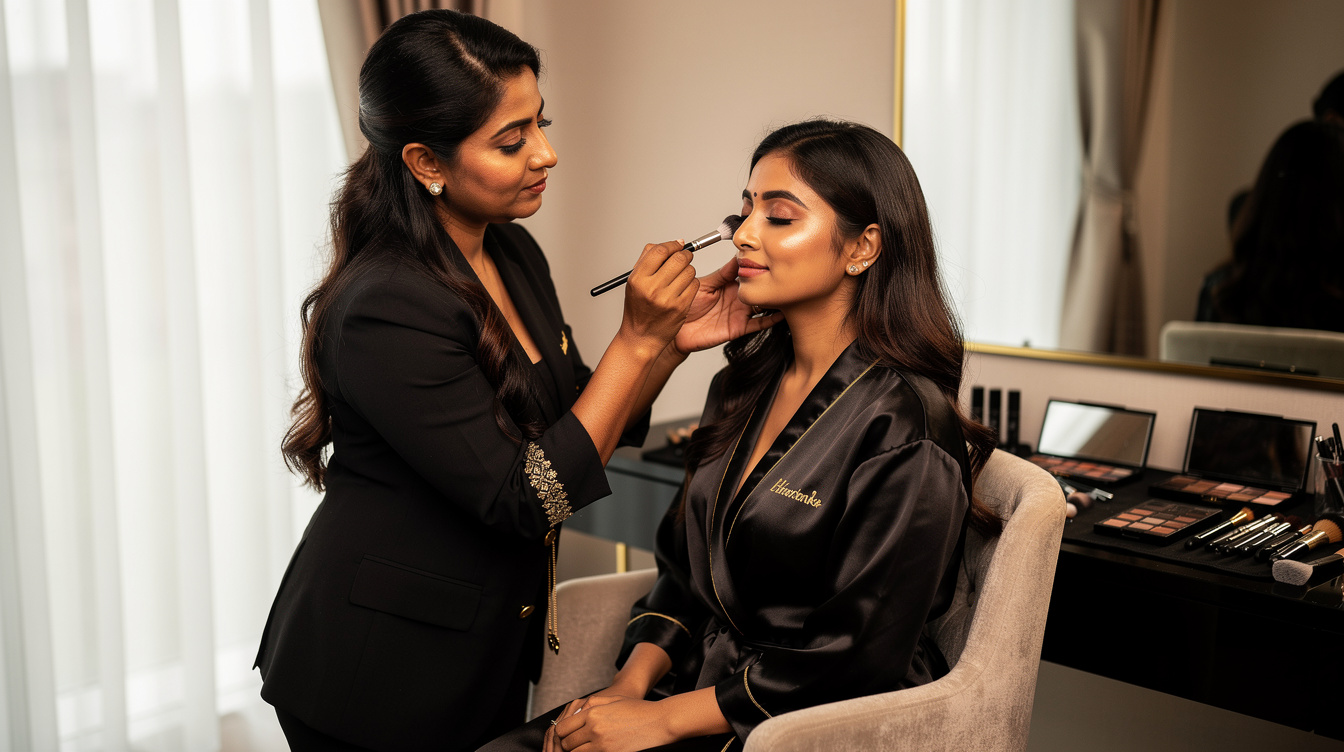
Every week we meet a new MUA at our Sector 16 Huda Market studio in Faridabad who has built a beautiful Instagram grid, takes a few bookings a month through DMs, and then quietly asks the same question: why do the girls with smaller followings keep getting the bigger weddings? Almost always, the answer is the same. They have a real makeup artist website — a clean, fast, search-friendly home base that does the convincing while they sleep. Instagram is the shop window. The website is the shop. If you are serious about turning makeup into a career, you need both, and you need them working together. That is exactly what we teach as part of the practical business module inside our 20-Day Professional Makeup Course at Sector 16 Huda Market, Faridabad.
This guide is the long version of what we cover with our students — the same playbook our trainer Shivangi Verma has used to grow a 1,000+ brides practice over 13+ years, with 25,000+ followers on Instagram, a 5.0 rating across 26+ WedMeGood reviews, 49 portfolio items, 215+ photos and 62 five-star Google reviews backing the studio. We will walk you through the exact stack we recommend, the portfolio structure that actually converts inquiries into trial bookings, how to wire WhatsApp into every page, and how alumni use a self-owned website alongside their WedMeGood, WeddingWire and JustDial listings without cannibalising any of them.
If you would rather learn this hands-on with us in Faridabad — building your portfolio in our studio, on real models, with the website setup, pricing, client handling and business modules built in — the easiest next step is the professional makeup course in Faridabad. The early-bird seat is currently Rs. 1,50,000 + GST → Rs. 80,000 + GST (you save Rs. 70,000), batch is capped at 10 students, runs 20 days, 12 PM to 5 PM. Now, the article.
Why every serious MUA needs a website (not just Instagram)
We love Instagram. We are on it daily. But we have watched the same painful pattern play out for almost every artist who relies on it as the only home for their work — the algorithm changes, a reel underperforms, a hashtag stops working, the inbox goes quiet for ten days, and suddenly an entire bridal calendar feels uncertain. A makeup artist website is the antidote to that anxiety. It is the one piece of digital real estate that you actually own. Nobody can shadow-ban it, throttle its reach, or change its rules overnight. When a bride searches your name on Google after seeing your reel, your website is what reassures her that you are a real, full-time professional and not a part-time hobbyist with a polished feed.
There is a second, sharper reason. Brides researching a 28K bridal trial or a 50K outstation booking do not finalise from a DM. They open your profile, then they open Google, then they open four or five tabs side-by-side — your website, your WedMeGood listing, your Google reviews, your reels, and a friend’s WhatsApp recommendation. The artist whose website looks coherent, fast and well-photographed almost always wins the trial slot. We have seen this in our own studio: brides repeatedly tell us they shortlisted us because the website made it feel “organised” and “safe”. For an aspiring MUA, that is the entire game. Your website is your trust certificate.
The third reason is search. Instagram is not searchable in the way Google is. A bride in Greater Noida typing “bridal makeup artist near me” or “HD glass skin makeup Faridabad” at 11 PM the night before her engagement will land on a website, not a hashtag. If you do not own a page that can rank for those phrases, you are leaving the most intent-rich enquiries on the table. SEO is not magic — it is consistent publishing on a domain you control. Without that domain, there is nothing to rank.
Finally, there is the credibility flywheel for vendor listings. WedMeGood, WeddingWire, Sloshout, JustDial, MagicPin and WhoDoYou all reward artists who can point back to a professional website. Many of their internal trust scores literally factor in whether you have a working domain in your contact card. So even if you treat the website as “just” a back-end asset, it lifts every other listing that already gets you bookings.
Domain, hosting, theme — the no-nonsense setup
The single most common mistake we see new MUAs make is overthinking the tech and underthinking the work. So here is the no-nonsense version of the stack. Domain: buy your own name dot com first. yournamemakeovers.com, yournameartistry.in — pick the cleanest, shortest variant your name allows. Avoid hyphens, avoid numbers, avoid cute spellings. A bride should be able to hear it once on a phone call and type it correctly. Buy it for at least 3 years. It costs less than the auto-renewal you forgot to cancel on a video app.
Hosting: if you are starting out, a managed WordPress host or a basic shared plan from a reputable Indian provider is more than enough. You are not running a marketplace — you are running a portfolio site that serves a few hundred visitors a day. What matters is fast load time on mobile (because 90%+ of brides browse on their phone), an SSL certificate (the little padlock — non-negotiable in 2026), and one-click backups. Spend at most an evening choosing this. Decision fatigue here is the enemy of every page that does not yet exist.
Theme: pick a clean, image-heavy, minimal theme. Dark backgrounds with gold or champagne accents photograph your work beautifully — but anything genuinely uncluttered will do. Avoid themes that demo with twenty animated sliders and stock photos of mountains. Your work is the design. The theme is just the frame. We tell our students: if a stranger lands on your homepage and cannot tell within three seconds that you are a bridal makeup artist, the theme is fighting you. Strip it back until that test passes.
For the page builder, the Gutenberg block editor that ships with WordPress is now genuinely good. You do not need to spend on a heavy paid builder unless you have a specific reason. Add Yoast or Rank Math for SEO basics, an analytics tag (we use a lightweight one — keep it simple), a contact form plugin, and an image-optimisation plugin so your portfolio pictures stay sharp without ever taking 6 seconds to load. That is your stack. Total monthly cost in 2026: less than what you spend on one professional shoot. Total time to set up if you stop researching and start building: a single weekend.
Portfolio structure that converts inquiries
This is where most MUA websites silently lose the booking. A beautiful gallery is not a portfolio. A portfolio is a persuasion architecture — every section is doing a job. Here is the structure we teach, in order. The homepage opens with one strong hero image (your single best bridal close-up — eyes sharp, skin luminous, no busy background) layered with one line that names what you do and where: “Bridal Makeup Artist · Faridabad & Delhi NCR · Available for destination weddings”. Below it, a single button: Book a trial on WhatsApp. Not five buttons. One.
Below the hero, three to five thumbnail tiles linking to dedicated portfolio pages — one per look, not per shoot. Brides do not search for “Riya’s Goa wedding”. They search for HD Glass Skin, soft glam, nude no-makeup makeup, airbrush bridal, engagement looks. Each look gets its own page with 10–15 of your strongest images, captioned with the products and finish (factually — MAC, NARS, Dior, Huda Beauty, Fenty Beauty, Laura Mercier, Haus Labs, Charlotte Tilbury, all fair game where genuinely used). At the bottom of each page, the same WhatsApp CTA — and a one-line internal link to your About page so the visitor flows deeper.
The About page is your trust-builder. Lead with a single first-person paragraph in your own voice. Then the proof: years of experience, brides served, where you trained, signature techniques, and where you are based. If you have international training, name it factually (Shivangi trained at Makeup Studio in the Netherlands — that one line moves brides). If you do not yet, say what you are studying and where. Honesty travels further than embellishment. Add a short, real, paraphrased line from a happy bride — never invent a testimonial — and a clean headshot. That is the page.
Then the Services & Pricing page. This is the page most artists hide. Don’t. Brides who shortlist you on WedMeGood already know your starting prices — the website is just confirming the conversation. Show ranges, not single numbers. Reference the WedMeGood listing format: bridal per function from a stated starting figure, engagement, party / family, outstation per function, and a clear note that custom quotes apply for destination, multi-day or multi-look bookings. Transparent pricing filters out the wrong inquiries before they waste anyone’s time.
Finally, the supporting pages: Destination Weddings (only list cities you have actually worked — Jaipur, Goa, Jim Corbett, Udaipur, Chandigarh, Kashmir, Sri Lanka, Canada are the kinds of real entries that build belief; do not invent destinations), Reviews (embed your WedMeGood and Google ratings), and a Blog / Journal for SEO. Five solid evergreen articles is enough to start ranking — bridal trial checklists, glass-skin explainers, summer-wedding longevity guides. Do not write a hundred thin pieces. Write five excellent ones.
Booking forms and WhatsApp integration
A booking form on its own does not get filled. A booking form plus a WhatsApp button does. Indian brides — and especially their mothers and sisters — overwhelmingly prefer WhatsApp. They want a real human reply within an hour, not a contact form that disappears into an inbox. So your job on every single page is to make the WhatsApp jump effortless. Add a sticky WhatsApp button to the bottom-right corner of every page. Pre-fill the message so the bride does not have to think: “Hi, I’m interested in a bridal trial — wedding date is ___”. We use exactly this pattern at our studio with the link https://wa.me/919354888093 and the conversion lift is dramatic compared to a form-only setup.
Now, the inquiry form still matters — for two specific situations. First, for brides who are researching at 1 AM and don’t want to ping you on WhatsApp until morning. Second, for destination wedding inquiries that need details (dates, city, function count, guest size, hotel) which are easier to type than to dictate. Keep the form ruthlessly short: name, wedding date, city, WhatsApp number, one open box for “anything else”. Five fields. No more. Every additional field cuts conversion. After submission, redirect to a thank-you page that opens WhatsApp automatically — bringing the slower-channel inquiry back into the fast channel.
Two operational habits make this work. One: a written first-reply template for WhatsApp that you can send within an hour during business hours. Two: a calendar link or shared Google Sheet where you log dates the moment a trial is booked, so you never double-book in the wedding season chaos. We teach both as part of the business module — these are the small systems that separate a working MUA from a stressed one. If you would like the templates we use, that is one of the things you walk away with from Shivangi Verma’s makeup course, alongside the technique training itself.
How alumni use it alongside WedMeGood listings
This is the question we get most often from our students after they go independent: “If I’m already on WedMeGood, do I really need my own website?” Yes — and the relationship is complementary, not competitive. WedMeGood, WeddingWire, Sloshout, JustDial, MagicPin and WhoDoYou are discovery channels. Brides who have never heard of you find you there. Your website is the conversion channel. Once they have found you, they leave the marketplace, search your name on Google, land on your homepage, and decide whether to book the trial.
Our alumni who consistently fill their bridal calendars treat the two as a single funnel. Their WedMeGood listing is kept clean, current and stocked with their best 49+ portfolio items, 215+ photos, and a 5-star review streak. Their website then deepens what the listing started — longer photo stories, look-by-look pages, clear pricing, real destination-wedding case studies, an about page with the artist’s actual face and story, and the WhatsApp CTA on every screen. The bride moves from listing → website → WhatsApp without friction. None of the channels needs to fight for the booking.
The same logic applies to your Instagram (25,000 followers is a great target — Shivangi is at 25,000+, and we have watched students cross 5,000 within a year of consistent posting backed by a real portfolio site). Reels build awareness. The website closes. Without the website, even the best reel just produces a like. With the website, the same reel produces an inquiry. That is the entire MUA online presence equation: discovery channels feed a conversion home, and the conversion home feeds a WhatsApp inbox you actually answer.
One word on fears. Many of our students worry that they will spend a lakh on a course, build a beautiful website, and still not get clients. That fear is real and we take it seriously. The honest answer is that technique alone does not get you clients — and neither does a website alone. What gets you clients is the loop: real skill on real skin, captured in real portfolio photos, hosted on a real website, distributed through real listings and reels, and converted on real WhatsApp conversations. Our 20-day course is designed around that whole loop, not just the makeup half. Hands-on training every day, a final assessment shoot with a professional model that gives you usable portfolio images, business and pricing modules, and lifetime alumni support so the questions that come up in your first six months as a working MUA actually get answered. You can Fill the inquiry form if you would like to talk through whether the next batch fits you.
20-Day Professional Makeup Course · Sector 16 Faridabad
Become a Professional Makeup Artist — Basics to Advanced
Hands-on training on real skin, only 10 students per batch, taught personally by Shivangi Verma — an active working bridal MUA with 14+ years and 1,000+ brides. Products, professional brush kit, certification and final assessment shoot all included.
Rs. 1,50,000 + GST → Early Bird: Rs. 80,000 + GST (save Rs. 70,000 — limited time)
💬 WhatsApp +91 9354888093 | Fill Inquiry Form | View Course Page →
FAQ
How much does it cost to set up a basic makeup artist website in 2026?
If you build it yourself on WordPress, expect roughly Rs. 1,000–1,500 a year for the domain, Rs. 3,000–6,000 a year for shared or managed hosting, and zero for the theme and core plugins if you stick to free options that look excellent in 2026. Your real cost is time and good photographs. Plan one focused weekend for the build, and one professional portfolio shoot — the same shoot you would do anyway for your Instagram. We cover the entire setup, including the WhatsApp and inquiry-form wiring, inside the business module of our 20-Day Professional Makeup Course.
Will the 20-Day course really prepare me for a career as a working MUA?
Yes — and we say that carefully. Twenty days, 12 PM to 5 PM, in a 10-student batch is a genuinely intensive format. You practise on real models every session, you finish with a final assessment shoot with a professional model that gives you usable portfolio images, you walk away with the brush kit and the curated training products, and you keep lifetime alumni support for the questions that come up later. What 20 days cannot give you is years of bridal-season experience — that comes only from doing the work. What it can give you is everything you need to start doing the work confidently. We acknowledge the fear that a short course leaves you under-prepared; our answer is the structure of the course itself, plus the active working artist who teaches it.
Do I really need a website if I already have an Instagram and a WedMeGood listing?
Yes. Instagram and WedMeGood are discovery channels — they bring you visibility. Your own makeup artist website is the conversion channel — it closes the booking. Brides almost always Google your name after seeing your reel or your listing, and the artist whose website looks coherent, fast and well-photographed wins the trial slot. The three work together; none replaces the other.
What is the single most important page on a makeup artist portfolio website?
The look-specific portfolio pages — one each for HD Glass Skin, soft glam, nude / no-makeup, airbrush, engagement, etc. Brides do not browse by shoot date; they browse by the finish they want. Each look page should hold 10–15 of your strongest images, factually credit the products you used (MAC, NARS, Dior, Huda Beauty, Fenty Beauty, Laura Mercier, Haus Labs, Charlotte Tilbury are all fair game where genuinely used), and end with a single WhatsApp CTA.
What’s the best way to wire WhatsApp into the website without it feeling spammy?
One sticky WhatsApp button in the bottom-right corner of every page, with a pre-filled message so the bride does not have to compose anything. One inline WhatsApp link inside each portfolio page and the pricing page. That is enough. You are not selling a SaaS subscription — you are inviting a real conversation about a wedding, and brides actively want that channel.
Where is the studio, and how do I visit before enrolling?
Our studio is at Booth No. 70-71, First Floor, Sector 16 Huda Market, Faridabad, Haryana 121002 — convenient from across Delhi NCR. The simplest way to visit is to message us on WhatsApp at +91 9354888093, tell us a few time windows that work for you, and we will block one for an in-person walk-through with Shivangi. You can also fill our short inquiry form at /academy-inquiry/.