
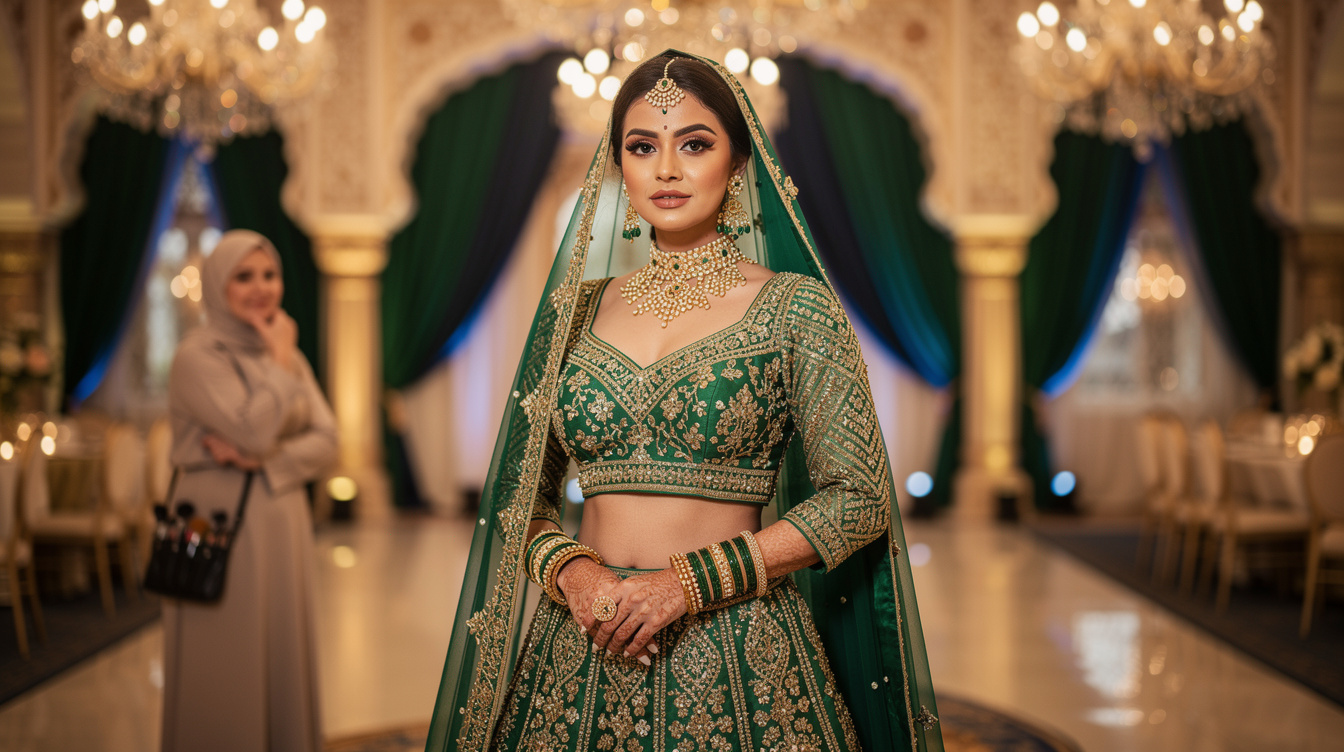
Every working bridal makeup artist has a folder in their head labelled difficult bookings. The mother-of-the-bride who rewrote the brief at 5 a.m. The bride who cried twice during the trial because the foundation looked “too much like skin”. The cousin who arrived uninvited and demanded her own full glam thirty minutes before the varmala. After 14+ years and 1,000+ brides, we have learned that the artists who survive — and grow — are not the ones who avoid these moments. They are the ones who build a system around them. That system is what we teach inside our 20-Day Professional Makeup Course in Faridabad, and it is what this guide is about.
If you are an aspiring MUA reading this — Riya, this is for you — please understand something we wish someone had told us in 2012. Difficult bridal clients are not the exception. They are a recurring feature of the job. A bride is preparing for the most photographed day of her life, often surrounded by competing opinions from family and a Pinterest board built over three years. The pressure compresses into the chair you are standing behind. Treating this as a personal attack is the fastest route to burnout. Treating it as a craft to learn is the route to a sustainable career.
The good news: 80–90% of difficult-client situations are preventable with three things — a written contract, a serious trial, and clear, kind communication. The remaining 10–20% are situations that no amount of professionalism will fix, and we will be honest about those too. Everything below is taught and rehearsed inside our Basics to Advanced course alongside the technical work, because client handling is half the job.
The 4 most common difficult-client scenarios
Across thirteen years of bridal work in Delhi NCR and on destination weddings to Jaipur, Goa, Jim Corbett, Udaipur, Chandigarh, Kashmir, Sri Lanka and Canada, the same four patterns keep appearing. Naming them is the first step to handling them.
1. The reference-image bride who wants someone else’s face
She arrives with a saved folder of forty influencer images. Most are heavily filtered, several are AI-edited, and almost none share her undertone, eye shape or face structure. Her honest fear is not the foundation. Her honest fear is that she will not look enough on her wedding day. The skill is to translate the feeling she is chasing — luminous, sculpted, soft, regal — into a look that actually belongs to her face. We do this on the trial day, with a mirror, side by side. We never argue with the reference image; we redirect it.
2. The committee booking — the bride plus six opinions
The bride is calm. Her mother wants “more traditional”. The sister-in-law wants “more bold”. The best friend has a Reel open. Three voices in your ear, one face in your chair. The fix is structural: the contract names the decision-maker. On the wedding morning, only the bride approves the look. Everyone else may watch — at a polite distance — but the brush listens to one voice.
3. The scope-creep booking — the “quick” family add-ons
You are booked for bride only. You arrive. The bride mentions, casually, that her two cousins and aunt would also like “just a small touch-up”. Each “small” face is forty-five minutes. Suddenly your bride is delayed and your reputation is on the line. The fix lives in the contract: family makeup is a separate line item with a separate fee, booked in advance. On the day, we are warm but firm — additional family members can be accommodated only if pre-booked.
4. The post-trial 2 a.m. message
The trial went well. The bride hugged you. Three days later, a long message arrives at midnight: she has shown the photos to a relative who said the eyes were “too smoky”, the lip was “too brown”, and the skin looked “dewy in a wrong way”. This is rarely about the makeup. It is about pre-wedding anxiety finding a target. We acknowledge the message warmly, schedule a 15-minute call the next morning, and offer one paid mini-trial adjustment. Almost every time, the bride is calmer once she is heard.
How a written contract prevents 80% of issues
If you remember nothing else from this article, remember this: the contract is the kindest tool a bridal MUA owns. A clear contract is not adversarial — it protects the bride as much as the artist. It removes ambiguity, which is where most conflict breeds. Brides who have been through a chaotic vendor experience before will visibly relax when you hand them a one-page agreement.
The non-negotiables we teach students to put in writing — and we use ourselves — are these. Scope: exactly who is being made up, for which functions, with arrival and finish times. Pricing: the agreed fee, what is included, what is not (extra family faces, hairstyling changes mid-event, last-minute look revisions). Travel and outstation: who pays for transport, accommodation and a per-function outstation fee — for reference our outstation per function starts at ₹50,000 with custom quotes for international destinations. Cancellation and rescheduling: what happens if either side has to move dates. Decision-maker: the bride approves the final look — that single line resolves more arguments than anything else in the document. Trial: when, where, how many looks, and what the cost covers.
We have seen new artists try to skip the contract because it “feels awkward to ask”. We promise you it is far less awkward than standing in a hotel room at 6 a.m. negotiating an unbudgeted aunt’s full glam in front of the bride’s mother. Brides do not lose respect for an artist with a contract; they gain it. The conversation about money is uncomfortable for one minute and saves you from an uncomfortable wedding morning that lasts hours.
Trial sessions as the primary expectation-management tool
The trial is not a rehearsal. It is the most important conversation you will have with your bride before the wedding. A serious trial covers four things, in this order: skin, vision, boundaries, and logistics.
Skin. We assess texture, undertone, oiliness, sensitivities, prior treatments, and how her skin behaves under pressure (heat, hours, photography). This is where product choice becomes craft. For an HD Glass Skin finish on a bride with combination skin in Delhi summer, we may layer Laura Mercier translucent powder over a hydrating Charlotte Tilbury base; for a darker, deeply pigmented bride wanting a soft satin, we might reach for Fenty Beauty or Huda Beauty foundations matched precisely to her undertone; for a high-flash sangeet, NARS, MAC and Dior pieces give us the control we need. Brides notice when you talk about their skin, not your kit.
Vision. This is where reference images are translated into something specific. We ask three questions: What do you want to feel?, What do you absolutely not want?, and Whose opinion will matter most when you see the photos? Those answers tell you more than any Pinterest board.
Boundaries. This is where you state, kindly, what is and is not possible. If a bride wants the lip shape changed in a way her natural lip cannot support without overdrawing, you say so at the trial — not on the wedding morning. If she wants a contour level her bone structure cannot honestly carry, you show her a softer version that photographs better. The trial is the safe place to disagree.
Logistics. Arrival time, parking, lighting in the getting-ready room, the order of bride / family / hair / draping. Our team — hairstylist, drapist, photographer and assistant — works as one unit, and at the trial we map the wedding-day timeline minute by minute. A bride who knows what is happening at 7 a.m., 8 a.m. and 9 a.m. is not a difficult bride. She is a calm bride.
How alumni mentorship covers real-case scenarios
This is the part of the job no Reel will teach you, and it is the reason our professional makeup course in Faridabad is built around live cases, not slides. The 20-day course runs 12 PM to 5 PM at our Sector 16 Huda Market studio with a hard cap of 10 students per batch — small enough that every student gets personal attention from Shivangi on every model, every day. Every booking we have ever stress-tested in real bridal seasons becomes part of the curriculum: the contract clauses that saved a destination booking in Udaipur, the trial conversation that prevented a refund request after a Goa wedding, the family politics that nearly derailed a Jaipur shoot.
We hear the same fear from prospective students often: “I’m scared I’ll spend a lakh and learn nothing useful.” It is a real fear and we do not dismiss it. Our answer is structural. The course is hands-on training on live models every day — not theory. Specially curated training products are yours to use during the course. A professional brush kit is yours to keep. Certification, a final assessment shoot with a professional model, and lifetime alumni support are all included. Most importantly, Shivangi personally teaches every batch — you are not handed off to a junior. With 14+ years of active bridal work and 1,000+ brides behind her, plus 62 five-star Google reviews, the person teaching you difficult-client handling is someone still living it every wedding season.
Lifetime alumni support is the part students do not fully understand until six months after the course ends. When a graduate gets her first solo bridal booking and a contract question hits her phone at 11 p.m., she can ask. When she lands her first destination wedding inquiry and is unsure how to price travel, she can ask. The community handles the loneliness of the first year, which is the year most new artists quietly quit. If you would like to ask about cohorts, fees or anything specific, the simplest route is WhatsApp at +91 9873048267 or Fill the inquiry form on the site.
When to walk away from a booking
Most brides are wonderful. A small minority are not, and a sustainable career depends on recognising the difference early. We teach students that walking away — politely, professionally, before the contract is signed — is not failure. It is judgement. There are five honest signals that a booking is not for you.
One: the bride or her family refuses to sign a contract. This is rarely about the document; it is usually a flag for how the rest of the engagement will go. Two: the conversations before booking are already disrespectful — late-night demands, sharp tone, calling you by your work alone (“the makeup girl”) rather than your name. How a client treats you in the inquiry stage is the best version they will treat you in. Three: the brief is technically impossible and the bride will not entertain a trial. If she insists on a face she does not have, with no willingness to test, you are being set up for a disappointment that no skill can prevent. Four: the budget is being negotiated downwards repeatedly after a quote was accepted. Five: something in your gut is wrong. Trust it. We have, several times, and we have never regretted it.
Walking away looks like this: a short, warm message stating that you do not feel you are the right artist for her vision, recommending she find someone whose style aligns better, wishing her well, and refunding any advance immediately. No drama. No long explanation. The brides who matter to your career are the ones for whom you are the right artist — and protecting your energy for them is professionalism, not selfishness.
One review snippet we keep returning to, from a real bride: “She patiently listens to what you need and delivers the best results.” That sentence describes the bride-MUA relationship we are training for. You cannot listen patiently to someone you should not be working with in the first place. Choosing your bookings well is the foundation of everything else.
20-Day Professional Makeup Course · Sector 16 Faridabad
Become a Professional Makeup Artist — Basics to Advanced
Hands-on training on real skin, only 10 students per batch, taught personally by Shivangi Verma — an active working bridal MUA with 14+ years and 1,000+ brides. Products, professional brush kit, certification and final assessment shoot all included.
Rs. 1,50,000 + GST → Early Bird: Rs. 80,000 + GST (save Rs. 70,000 — limited time)
💬 WhatsApp +91 9873048267 | Fill Inquiry Form | View Course Page →
FAQ
How do I handle a bride who keeps changing her mind after the trial?
Acknowledge her warmly, never defensively. Pre-wedding anxiety is real and changes are usually emotional, not technical. Offer one structured follow-up call and, if needed, one paid mini-adjustment session. Document the final agreed direction in writing — even a WhatsApp message confirming the chosen look protects both sides on the wedding morning.
What if my MUA cancels last minute — and how do I avoid being that MUA?
For brides: book artists with a written contract, a verifiable client history (look for Google and WedMeGood reviews, our own profile carries a 5.0 rating across 26+ WedMeGood reviews and 62 Google reviews), and a real backup-artist clause in writing. For MUAs: never accept a booking you cannot honour — your reputation is your business, and one cancellation can undo years of word-of-mouth.
How do I know the trial will match the wedding day?
By treating the trial as a real dress-rehearsal, not a casual sit-down. Wear an outfit close to your wedding palette, do the trial at the time of day closest to your function (morning trial for a morning wedding), photograph the look in natural and flash light, and discuss any single change in writing before the wedding. A serious trial removes nearly all wedding-morning surprises.
Will the 20-Day course really prepare me to handle real difficult clients?
Yes — because client handling is taught alongside technique, not after it. The course covers HD Makeup, Airbrush, Glass Skin and bridal techniques, but equal weight is given to client handling, contracts, pricing and business setup. With Shivangi personally teaching, a 10-student batch cap, and lifetime alumni support, you do not graduate and disappear — you graduate into a network that helps you through your first real bookings.
I’m a complete beginner — am I too inexperienced to start a bridal career?
Not at all. Our students arrive from very different backgrounds — fresh school-leavers, career changers in their thirties, working professionals making a switch. The course is structured for complete beginners through to advanced learners, and the small batch size means we adjust pace to the student in front of us. What matters is the willingness to practise on real skin, take honest feedback, and treat client handling as seriously as the brushwork.
Is it ever okay to refuse a bridal booking?
Yes, and learning when to say no is one of the most valuable skills a bridal MUA develops. If the brief is technically impossible, the engagement is already disrespectful, the budget keeps shifting, or your gut is signalling something wrong — decline politely, refund any advance immediately, and recommend the bride find an artist whose style fits her vision. Protecting the bookings you do take is what allows you to deliver the work you are known for.
If you are at the start of this career — Riya, this last paragraph is for you — the working life of a bridal MUA is genuinely beautiful, and it is genuinely hard. The artists who last are the ones who learn the people side as seriously as the product side. If you would like to learn both, properly, in a small batch, taught personally by an active working bridal MUA with 14+ years and 1,000+ brides behind her, take a look at Shivangi Verma’s makeup course. The studio is at Sector 16 Huda Market, Faridabad, classes run 12 PM to 5 PM across 20 days, and the door is open at WhatsApp +91 9873048267 whenever you are ready.