
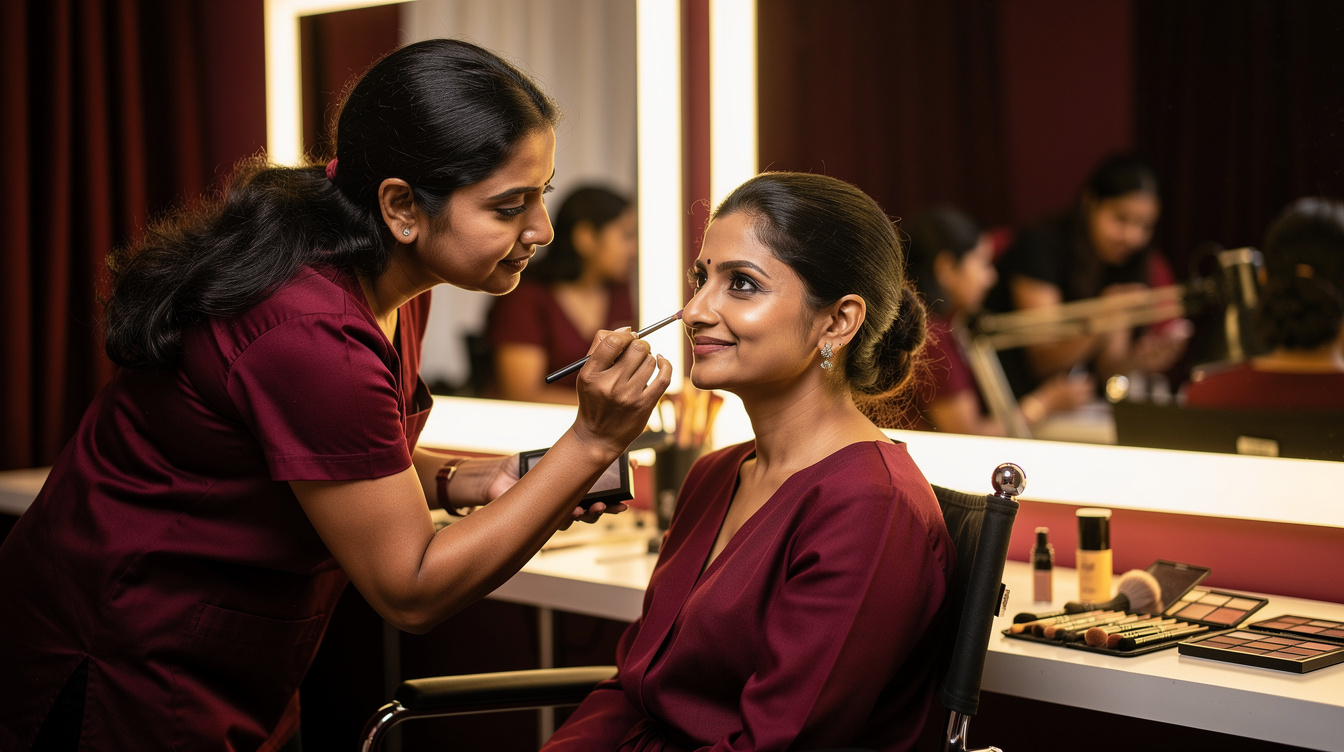
If you have just finished training and your Instagram grid is starting to look like a real portfolio, the next question is the one nobody quite teaches you to answer: how do brides actually find you? In Delhi NCR, the honest answer for a new makeup artist in 2026 is a stack — Instagram for trust, Google for proof, and wedding directories (WedMeGood, ShaadiSaga, WeddingWire, Sloshout, JustDial) for discovery. Of those directories, WedMeGood and ShaadiSaga are the two where bridal traffic genuinely lives, and where your first ten paying brides are most likely to come from if you set the listings up correctly.
We get asked about this almost every week from students enrolled in our 20-Day Professional Makeup Course at our Sector 16 Faridabad studio. The course covers HD Makeup, Airbrush, Glass Skin and Bridal Techniques, plus client handling and business skills — but the listing piece is something almost every new artist gets wrong in their first six months. They either pay for premium too early, photograph their work poorly, or fill the “starting price” field with a number that quietly disqualifies them from the brides they actually want. This guide is the version of that conversation we wish we had written down years ago.
One caveat before we begin. We have been listed on WedMeGood, WeddingWire, Sloshout, JustDial, MagicPin and WhoDoYou for years now, and the playbook below comes from running real listings in a real market — not from theory. Our WedMeGood profile currently sits at a 5.0 rating across 26+ reviews with 215+ photos and 49 portfolio items, so when we talk about what makes a listing convert, we are talking about what we have actually watched move the needle.
How directory listings actually drive bookings (and how they don’t)
The first myth to retire is the one that says “list yourself on WedMeGood and the bookings will come.” They will not. What a directory listing actually does is sit at the bottom of a bride’s research funnel. She has usually already seen your work on Instagram, googled your name, looked at your Google reviews, and then arrived on WedMeGood or ShaadiSaga to do two specific things: confirm that you are real, and compare your starting price and portfolio with three or four shortlisted alternatives. The directory is a trust ladder, not a discovery channel.
This matters because it changes what your listing has to do. It does not need to win her attention — Instagram already did that. It needs to remove the last bit of doubt. That is why the listings that convert best are not the flashiest; they are the ones with consistent imagery, plain-spoken pricing, real reviews with full names and wedding dates, and a portfolio organised by function (bridal, engagement, reception, party, mehendi) rather than by chronology.
Where directories do drive top-of-funnel discovery is for “location + service” searches. A bride who types “makeup artist in Faridabad” or “bridal makeup Delhi NCR under 30k” into WedMeGood’s on-platform search is a high-intent lead — she is not browsing, she is filtering. If your listing is geotagged correctly, has a starting price that fits her filter, and shows up in the first 30 results in your city, you will get inquiries. If any one of those three is off, you will not.
What directories will not do, no matter how much you spend, is replace a working portfolio. We have seen new artists pay for Featured Vendor placement on day one of their listing with twelve photos and zero reviews, and watch the spend disappear into noise. The order of operations matters: build the listing first, earn five or six real reviews ethically, then consider paid placement. Spending before you have social proof is how you teach the algorithm that your profile does not convert.
Profile setup checklist — photos, pricing, reviews
Both WedMeGood and ShaadiSaga have roughly the same listing fields, so the checklist below applies to either. We recommend filling them in this order — name, photos, pricing, services, reviews — and resisting the temptation to publish a half-finished profile just to claim your slot. A listing that goes live with eight photos and no prices is harder to fix later than one that goes live correctly the first time, because both platforms factor “profile freshness” into their internal ranking.
Photos. Upload between 30 and 60 portfolio images on day one. Anything fewer signals you are new; anything over 80 starts to look unfocused. Lead with three or four hero shots — a clean front-facing bridal portrait, a soft-glam reception look, a side profile that shows your hair-and-drape integration, and one detail shot (eye, lip, base). Avoid heavily filtered images, group shots where the bride is not the focus, and anything shot under uncorrected yellow tungsten light. If a photo would not survive on your Instagram grid, it should not be on your listing either.
Pricing. The single biggest mistake new MUAs make is leaving the price field blank or putting an unrealistic “starting from Rs. 5,000” figure to look affordable. Both platforms use that figure to bucket you in filter results, and the brides who filter for Rs. 5,000 are not the brides who book bridal packages. Be honest. For reference, our own WedMeGood listing shows bridal per function at ₹28,000, engagement at ₹25,000, party / family makeup at ₹8,000, and outstation per function at ₹50,000, with a clear note that custom quotes apply for full wedding packages. Even as a brand-new artist, a starting price between Rs. 8,000 and Rs. 15,000 for party makeup and Rs. 18,000 to Rs. 22,000 for bridal will place you in the bucket where serious brides actually look.
Services and specialisations. Tick every service you can genuinely deliver, and write a one-line description for each. If you specialise in HD Glass Skin, Airbrush, Soft Glam or Nude / No-Makeup makeup, say so — these are searched terms on both platforms and they help the algorithm match you to the right brides. Do not tick “destination weddings” unless you have actually travelled for one, because brides reading your reviews will spot the gap immediately.
About section. Keep it short, first-person plural, and specific. Three short paragraphs is the sweet spot — who you are, where you train and work, and what your philosophy is. Avoid the generic “passionate about making every bride feel beautiful” opener; every listing on the platform already says that. Replace it with something concrete: where you trained, the products you work with (MAC, NARS, Dior, Huda Beauty, Fenty Beauty, Laura Mercier, Haus Labs, Charlotte Tilbury are all credibility-anchors brides recognise), and one specific thing you do differently.
Contact and response time. Both platforms penalise slow response times in their ranking. Connect your WhatsApp directly to the listing, and answer inquiries within four hours during waking hours. We respond to most WedMeGood leads within thirty minutes — not because we are sitting on the app, but because we have notifications routed to WhatsApp on +91 9354888093 and a simple template ready for the first reply. New artists who let inquiries sit for two days lose them to faster competitors before the bride has even seen the work.
Free vs paid tier — what’s worth it for new MUAs
This is where almost every new artist either overspends or underspends. WedMeGood and ShaadiSaga both run a free tier that lets you create a profile, upload photos, collect reviews and receive inquiries, alongside a paid tier (variously branded as Premium, Featured Vendor, or Verified) that bumps your placement in search results, adds badges, and unlocks lead notifications. The math on whether to upgrade is simpler than the sales calls make it sound.
If you have fewer than five reviews and a portfolio under 25 images, paid placement is a waste. The bride who clicks on a Featured listing with two reviews bounces in three seconds and clicks the next one. You are paying for an impression that does not convert, and worse, you are training the algorithm that your profile has low click-through-to-inquiry conversion, which makes future paid placement more expensive. Stay on the free tier until you have at least five reviews and ideally ten.
Once you cross that threshold, paid placement starts to make sense, but only seasonally. The two windows that matter in Delhi NCR are October to December (peak winter wedding season) and February to April (spring season). Outside those months, organic traffic on both platforms drops sharply and paid spend bleeds. If your budget is limited, concentrate three months of paid placement into the back half of the year rather than spreading it thinly across twelve.
One more thing the sales reps will not tell you: paid tiers do not change your conversion rate. They change your impressions. If your free-tier profile converts inquiries to bookings at, say, one in eight, paying for ten times more impressions will get you ten times more inquiries, and roughly ten times more bookings — but you also need ten times the response capacity, ten times the trial slots, and ten times the bandwidth. Most new artists who upgrade too aggressively end up burning out their response time, which then tanks their listing rank anyway. Scale the listing in line with what you can actually service.
Building your first 5 reviews ethically
The first five reviews are the hardest, and they are also the ones that decide whether your listing ever leaves the second page. Both platforms weight the first cohort of reviews disproportionately in their ranking — a new profile with five genuine 5-star reviews outranks a six-month-old profile with three lukewarm 4-stars. The good news is that you do not need to do anything clever to get there. You just need to ask, on time, with the right framing.
The single biggest mistake we see is artists asking for a review weeks after the wedding, by which point the bride is back at work, the honeymoon is over, and the emotional peak has passed. Ask within 48 hours of the function, while the bride is still posting wedding photos to her own feed. Send a single, warm WhatsApp message that thanks her, references something specific from her day (her saree colour, the venue, a moment from the trial), and includes a direct link to your WedMeGood or ShaadiSaga review form. Do not ask her to fill multiple forms. Pick one platform per bride and rotate.
Never write a fake review. Both platforms now run pattern-detection on suspiciously similar phrasing, IP overlap, and reviews posted in quick succession from new accounts — and if you get flagged, the listing is suspended, sometimes permanently. The short-term gain is never worth it. There is also a softer version of this problem: artists who write reviews on behalf of clients “to save the bride time.” That is still fake from the platform’s perspective, even if the underlying client is real, and it produces oddly homogenous reviews that brides reading them can sense.
What works instead is asking real brides what they specifically liked, and inviting them to mention that in their own words. The reviews that have converted best for us read like real human beings talking — “She patiently listens to what you need and delivers the best results,” “Totally involved, dedicated and patient,” “She understood my vision and made me look so pretty without overdoing it.” You cannot manufacture sentences like those, but you can ask the kind of question that draws them out: “If you were recommending me to a friend, what would you tell her?”
Finally, respond to every review — including the 5-stars. A short, specific reply (“Loved doing your cocktail look, Aisha — thank you for trusting us with both functions”) signals to future readers that the listing is run by a real, attentive artist. Listings with zero owner responses look abandoned, even when they are not.
How the 20-Day Course alumni handle listings
The students who finish our Basics to Advanced course tend to handle the listing question in a fairly predictable sequence, and it is worth walking through it because it maps onto the realistic first six months of a new MUA’s career. The course itself runs 20 days, 12 PM to 5 PM at our Sector 16 Huda Market studio in Faridabad, with batch size capped at 10 students so that every learner gets personal attention from Shivangi during every session. Among the things students leave with are a professional brush kit (yours to keep), a final assessment shoot with a professional model, certification, and lifetime alumni support — that last part matters here, because the listing setup conversation typically happens four to eight weeks after the course ends, not during it.
What we tell alumni who message us during that window: do not list yet. Spend the first month doing four to six free or heavily discounted family-and-friends shoots, with a photographer if you can pool one with a fellow alumna. That gives you the 30 to 40 portfolio images you actually need to open a credible listing. Without those, the listing goes live looking thin, and you spend the next quarter trying to climb out of a hole you dug on launch day.
The second pattern we see is alumni undervaluing themselves on the pricing field. Twenty days of full-time intensive training — covering HD Makeup, Airbrush, Glass Skin and Bridal Techniques, plus client handling and business skills — puts a graduate well above the “Rs. 5,000 party makeup” tier on either platform. We push every alumna to start at a price that reflects that training, not at a price that reflects her insecurity. Brides do not pick the cheapest listing on WedMeGood; they pick the cheapest one that looks credible, and credibility starts at a believable price.
The third thing we recommend is treating the listing as the third asset in a stack, not the first. Instagram is the portfolio you control. Google Business Profile is the proof layer (reviews, location, contact). The WedMeGood / ShaadiSaga listing is the conversion layer at the bottom of the funnel. Build them in that order and they reinforce each other; build them out of order and each one underperforms. If this kind of sequencing — the business side of being a working MUA, not just the technical side — is the part of the journey that feels least clear to you, that is exactly the gap our professional makeup course in Faridabad is designed to close. Shivangi runs every batch personally, and the business module is taught from 14+ years of running a working bridal practice with 1,000+ brides — not from a textbook. If you want to talk through whether the course fits your stage, you can Fill the inquiry form and we will get back to you the same day.
20-Day Professional Makeup Course · Sector 16 Faridabad
Become a Professional Makeup Artist — Basics to Advanced
Hands-on training on real skin, only 10 students per batch, taught personally by Shivangi Verma — an active working bridal MUA with 14+ years and 1,000+ brides. Products, professional brush kit, certification and final assessment shoot all included.
Rs. 1,50,000 + GST → Early Bird: Rs. 80,000 + GST (save Rs. 70,000 — limited time)
💬 WhatsApp +91 9354888093 | Fill Inquiry Form | View Course Page →
FAQ
How long does it take to start getting bookings from a WedMeGood or ShaadiSaga listing?
Realistically, plan for three to four months from the day your listing goes live before inquiries become steady. The first month is portfolio and review building; the second is when the platform starts surfacing you in filtered searches; by month three or four, if your photos, pricing and response time are tight, you should be averaging five to ten qualified inquiries a week in season. Anyone promising bookings in week one is selling, not advising.
Will the 20-Day course really prepare me for a working MUA career?
It is built to. The format is 20 days, 12 PM to 5 PM, with batches capped at 10 students so every learner gets hands-on time on real skin every day. The syllabus covers HD Makeup, Airbrush, Glass Skin and Bridal Techniques alongside client handling and business skills — the listing-setup conversation in this article is the kind of thing we cover in the business module. Shivangi has 14+ years and 1,000+ brides, and she personally teaches every batch rather than handing it to assistants. You also leave with a professional brush kit, certification, a final assessment shoot with a real model, and lifetime alumni support for exactly these kinds of follow-up questions.
Should I go premium on WedMeGood as a brand-new MUA?
No — not in the first three to six months. Stay on the free tier until you have at least five genuine reviews and a portfolio of 30+ images. Paid placement amplifies whatever your existing conversion rate is; if that rate is low because your listing is still thin, paying simply burns the budget faster. Spend on premium only once organic inquiries have started flowing on their own, and concentrate that spend in the October–December and February–April wedding windows.
Is it okay to offer free or discounted makeup in exchange for a review?
Discounted, yes — free in exchange for a guaranteed positive review, no. The ethical version is straightforward: offer family-and-friends pricing for the first month of work, deliver your best possible service, then ask honestly for a review without conditioning the discount on the rating. Real brides who get a real discount and a great service write better reviews anyway, and the platforms do not penalise discounting. What gets listings suspended is fake reviews, not generous pricing.
What pricing should a new MUA from the 20-Day course list on WedMeGood?
For a graduate of our course in the Delhi NCR market, we recommend starting party / family makeup at Rs. 8,000–12,000 and bridal per function at Rs. 18,000–22,000, with the explicit note that custom packages apply for full weddings. For reference, our own listed bridal-per-function price is ₹28,000 and engagement is ₹25,000, with outstation per function at ₹50,000 — but those numbers reflect 13+ years of work. A new MUA pricing herself at a third of the entry-bridal tier sits in a credible bucket without underselling her training. Pricing too low costs you the brides you want.
The directory listing is not where your career begins — your training is, and your portfolio is. But the listing is where it becomes visible, and visibility is what turns trained MUAs into working ones. If you are still on the fence about whether the structured route is right for you, or if the listing-setup conversation in this article raised more questions than it answered, talk to us. The same early-bird window — Rs. 80,000 + GST against the regular Rs. 1,50,000 + GST — is still open for the next Faridabad batch, and the most useful version of Shivangi Verma’s makeup course is the one where you are already thinking like a working artist before day one.