
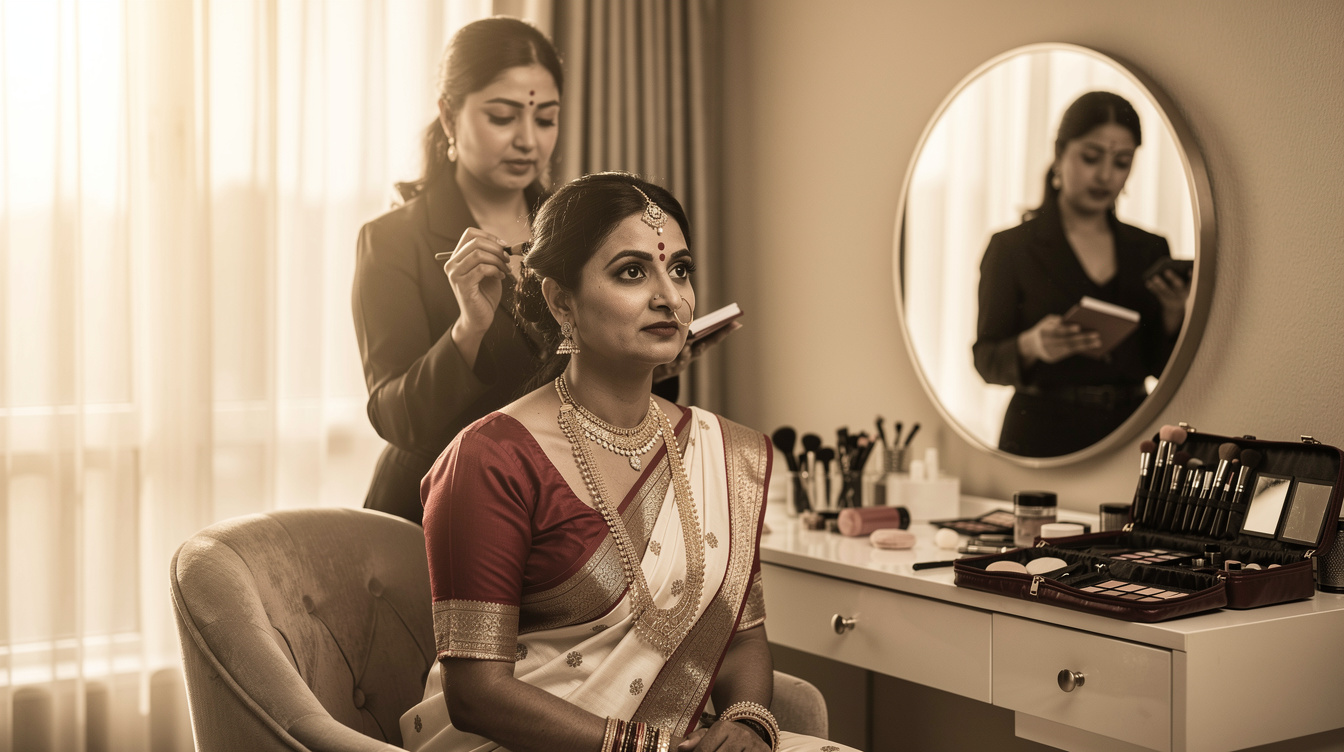
If you have spent even a week researching makeup academies in Delhi NCR, one phrase will have followed you everywhere — “100% placement guarantee”. It appears on banners, in DM auto-replies, on first-call sales scripts. For an aspiring artist trying to choose where to invest a significant fee, it sounds like the safest possible promise. But before you sign anywhere — including with us — we want to talk honestly about what a 20-Day Professional Makeup Course with placement actually delivers in this industry, what it cannot deliver, and why the answer for bridal makeup is genuinely different from what it would be for, say, salon hairdressing or corporate hospitality.
We are Shivangi Verma’s studio in Sector 16 Huda Market, Faridabad. Shivangi has been an active working bridal artist since 2012 — 14+ years on real wedding mornings, 1,000+ brides, an Instagram following of 25,000+ at @shivangiverma_makeovers, and 62 five-star Google reviews. She is not a full-time educator who occasionally takes a bridal client. She is a full-time bridal MUA who personally teaches every batch of our Basics to Advanced course. That perspective — being inside the industry every weekend, not observing it from the academy office — is what shapes everything we are about to say.
If you are Riya — somewhere between deciding to commit and still nervous about the cost — this article is for you. We will not sell you a guarantee we cannot keep. We will explain how the bridal market actually pays artists, why portfolio and alumni network usually outperform a placement letter, and what the included professional makeup course in Faridabad at our studio gives you instead.
What ‘placement guarantee’ actually means in this industry
Let us start with the language. The phrase “placement guarantee” was borrowed from the IT-training and hotel-management worlds, where it has a very specific meaning — a structured campus drive, multiple recruiters, signed offer letters, a defined salary band. When you transplant that phrase into the makeup industry, the meaning quietly changes, and most students do not realise it until orientation week.
In bridal and editorial makeup, “placement” almost always means one of three things. First, an unpaid or near-unpaid assistantship — you carry the kit, set up brushes, do touch-ups while the lead artist works the bride. Useful, but rarely a salary. Second, a salon-floor role — you do walk-in clients at a chain salon for a fixed monthly stipend that often sits between Rs. 12,000 and Rs. 22,000, doing party makeup and basic services rather than bridal. Third, a freelance gig referral — the academy sends a few inquiry leads your way, but you negotiate, deliver, and invoice on your own. The word “guarantee” sits on top of all three, but the economics behind it are very different from a campus placement at an engineering college.
None of those three paths is bad. Assistantships in particular are how most working artists actually build technique under pressure. But you should walk in with eyes open. A “placement guarantee” in our industry is not a salary letter for Rs. 40,000 a month doing bridal work. It usually cannot be, because that job structurally does not exist at scale. Which brings us to the next question.
Why bridal makeup is rarely a salaried-job market
Think about how a bride books her artist. She scrolls Instagram for weeks, sends inquiries to four or five names, compares portfolios, asks for references, often does a paid trial, and then books a specific person — almost never a brand. Even when she walks into a studio, she is choosing the artist she met, not a generic “makeup department”. That single behaviour shapes the entire economics of bridal work.
Because the buyer is choosing a person, the value of that person’s time is not transferable. A senior bridal artist cannot meaningfully delegate a Rs. 28,000 booking to a fresh graduate; the bride did not book the graduate. So studios cannot run on the model where they hire 10 junior artists at Rs. 25,000 a month and rotate them across bookings the way an IT firm rotates engineers across projects. The unit economics simply do not allow it.
The result is a market dominated by independent artists, small two-to-three-person studios, and assistant ecosystems built around a single name. Even the largest household names in Indian bridal makeup are essentially solo practices with support teams. There is no Infosys-scale recruiter pipeline waiting at the gates of any academy, because there is no Infosys-scale employer in bridal. When an academy promises one, what they are really offering is one of the three forms of “placement” we described above — and you deserve to know which one before you enrol.
This is the first big fear we want to address head-on: “I won’t get clients after the course.” It is the most common worry we hear from students like Riya, and it is a completely rational worry. But the answer is not a guarantee on paper. The answer is being trained in a way that makes you bookable on your own — and that is a very different thing from being placed.
Freelance reality — what placement help can and can’t deliver
Let us be fair to the academies that do offer genuine placement support. Real, honest placement help in this industry usually looks like this: warm introductions to working artists who need assistants for the wedding season, occasional referrals when a bride contacts the academy and the senior team is fully booked, photoshoot collaborations to help build your initial portfolio, and the academy’s name on your CV when a salon HR is screening candidates. All of these are real, all of them are useful, and we offer versions of all of them ourselves.
What placement help genuinely cannot deliver — no matter who promises it — is sustained, predictable income from day one of your career. It cannot make a bride choose you over an artist with three years of portfolio. It cannot raise your trial conversion rate. It cannot teach a nervous client to trust your hands. It cannot get your DMs answered when your username is new. Those things only come from your own work, your own portfolio, and your own client conversations.
The honest framing we use with every prospective student is this: a course should give you two things — the technical ability to deliver a Rs. 28,000 booking confidently, and the business literacy to find, price, and close that booking. Placement, in the campus-drive sense, is downstream of both. You do not really want a placement; you want a career. Those are not the same thing, and confusing them is what leads to disappointment six months after graduation.
Why portfolio + alumni network often outperforms placement
If placement is structurally limited in our industry, what actually moves a new artist from “just graduated” to “first paid bridal booking”? Two things, almost always — a credible portfolio and a working alumni network. We see this play out so consistently that we now plan our entire course around it.
A credible portfolio is what convinces a bride who has never met you to send the first inquiry. It does not need to be 100 photos. It needs to show three things clearly — that you can deliver a polished HD or glass-skin finish on real Indian skin tones, that you can match makeup to the bride’s outfit and lighting, and that the photographs were taken professionally enough that a discerning bride will trust the work. This is exactly why our 20-day course closes with a final assessment shoot with a professional model — not as decoration, but because that single shoot becomes the first real entry on your portfolio. You leave with images, not just a certificate.
The alumni network does the second job — it gets you actual hands on actual brides during peak season. When wedding dates pile up in November and February, working artists genuinely need trusted assistants. A graduate the lead artist already knows, has trained personally, and trusts to handle a touch-up unsupervised is worth far more than a CV from a stranger. This is how most of our graduates get their first three or four real bridal mornings — through introductions inside the network, not through a placement cell. And once they have those mornings, they have stories, references, behind-the-scenes content for Instagram, and the confidence to start quoting their own brides.
This brings us to a related fear we hear constantly: “I’ll waste the fee and learn nothing useful.” The honest defence against this is not a placement promise — it is the structure of the training itself. Hands-on practice on live models every single day, premium products from brands like MAC, NARS, Dior, Huda Beauty, Fenty Beauty, Laura Mercier, Haus Labs, and Charlotte Tilbury that you actually use during the course, a professional brush kit you take home, and Shivangi personally teaching every session rather than handing you to a junior trainer. If you are paying for a course, what you should be auditing is the inside of those 20 days, not the page that follows them.
If you want to talk through how a typical alumna’s first six months unfold — first paid trial, first wedding, first repeat client — message us on WhatsApp +91 9354888093 and we will walk you through real examples in our network.
20-Day Course’s lifetime alumni support — what it covers
Because we have argued that alumni network outperforms placement on paper, it is fair to be specific about what our lifetime alumni support actually means in practice. We do not call it “placement” because we do not want to mis-sell the word. We call it lifetime alumni support, and it covers the realities of starting a career — not a single moment of being placed.
Practically, lifetime support looks like this. You stay in touch with Shivangi and the studio after graduation, not just for 30 days. You can reach out about products, technique questions, problem skin types, difficult bridal asks, and pricing decisions. When peak season hits and the studio team needs trusted assistants, alumni are the first people we call. When a bridal inquiry lands in our inbox for a date or a region we cannot serve, we forward it to alumni who are a good fit. When you are unsure how to quote your first Rs. 50,000 outstation booking, you can ask. When your portfolio needs a second pair of eyes before you publish, you can send it.
The course itself is built around the same realism. Twenty days, 12 PM to 5 PM at Sector 16 Huda Market in Faridabad. Batch capped at 10 students so every person actually gets eyes-on attention from Shivangi rather than learning from the back of a 30-person room. The training kit is curated specifically for the techniques you will be tested on — HD Makeup, Airbrush, Glass Skin, and bridal techniques alongside the client handling and business skills that working artists actually need. The professional brush kit is yours to keep. Certification is on completion. And the final assessment shoot with a professional model becomes the cornerstone of your starter portfolio.
On the third common fear — “the academy isn’t reputable enough” — our answer is the same one we would want any honest academy to give. Shivangi is internationally trained at Makeup Studio in the Netherlands, has been actively working since 2012, has served 1,000+ brides, and has done destination weddings across Jaipur, Goa, Jim Corbett, Udaipur, Chandigarh, Kashmir, Sri Lanka, and Canada. The 62 five-star Google reviews and the WedMeGood track record are public. None of this proves your course will be the right fit for you — only a real conversation with us can do that — but it should at least answer the credibility question on its own terms.
On fees, the 20-day course is currently running with an early-bird seat at Rs. 80,000 + GST, against the regular fee of Rs. 1,50,000 + GST — a saving of Rs. 70,000 that is genuinely time-bound rather than a permanent rate. If you are weighing this against another academy that quotes a placement guarantee, ask the comparison question we suggested earlier — what does “placement” actually mean inside their offer, and would you rather have that or a portfolio shoot, lifetime alumni support, and 20 days of personal training from a working bridal artist? You can also Fill the inquiry form if you would prefer we reach out to you instead of the other way around.
20-Day Professional Makeup Course · Sector 16 Faridabad
Become a Professional Makeup Artist — Basics to Advanced
Hands-on training on real skin, only 10 students per batch, taught personally by Shivangi Verma — an active working bridal MUA with 14+ years and 1,000+ brides. Products, professional brush kit, certification and final assessment shoot all included.
Rs. 1,50,000 + GST → Early Bird: Rs. 80,000 + GST (save Rs. 70,000 — limited time)
💬 WhatsApp +91 9354888093 | Fill Inquiry Form | View Course Page →
FAQ
Does the 20-Day Professional Makeup Course offer a placement guarantee?
We do not promise a campus-style placement letter, because in bridal makeup that promise rarely matches the actual market. Instead we offer lifetime alumni support — assistantship opportunities during peak wedding season, referrals when bridal inquiries are forwarded to alumni, ongoing technique and pricing guidance from Shivangi, and a final assessment shoot that gives you real portfolio images on day 20.
Will the 20-Day course really prepare me for a paying career?
The course is intensive — 12 PM to 5 PM, every day, hands-on practice on live models from week one, with a batch capped at 10 students so every person gets direct attention from Shivangi. You finish with technical command of HD Makeup, Airbrush, Glass Skin, and bridal techniques, plus the client handling and business skills needed to quote and close paying bookings. Whether you earn from it depends on the work you put in afterwards, but the course gives you the real toolkit to start.
What is the difference between a course with placement and one without?
A course “with placement” usually means assistantships, salon-floor roles, or referral-based gigs — not salaried bridal jobs, because those barely exist in our industry. A course “without placement” can either mean genuinely no support after graduation, or — like ours — lifetime alumni support that does the same job under a more honest name. Always ask the academy to describe what placement looks like in practice before you decide.
I am worried I will spend Rs. 80,000 and learn nothing useful — how do I avoid that?
That fear is reasonable, and the way to avoid it is to audit the inside of the course rather than the placement page. Confirm three things — that you will practise on live models every day, that the trainer themselves is an actively working artist (not only an educator), and that you finish with portfolio-grade photographs in hand. Our course meets all three, and you are welcome to visit the Sector 16 Faridabad studio before enrolling to verify in person.
Is the academy reputable enough compared to bigger names?
Reputation in bridal training is best judged by the trainer’s own active client work, not the chain’s size. Shivangi has been a working bridal artist since 2012, is internationally trained at Makeup Studio Netherlands, has served 1,000+ brides, has 62 five-star Google reviews and a 5.0 WedMeGood rating across 26+ reviews, and has done destination work in cities including Jaipur, Goa, Udaipur, Sri Lanka, and Canada. You are learning from the person on the wedding morning, not from a curriculum binder.
Can I visit the studio in Faridabad before enrolling?
Yes, and we strongly recommend it. The studio is at Booth No 70-71, First Floor, Sector 16 Huda Market, Faridabad, Haryana 121002. Message us on WhatsApp at +91 9354888093 to schedule a visit, meet Shivangi, see the training space, and ask any question — including the difficult ones — before you decide.
Choosing between a makeup course with placement and one without is, in the end, a question of what you actually want from the year ahead. If what you want is a piece of paper that says “placed”, several academies will sell you that. If what you want is to walk out in 20 days with technical skill on real skin, a portfolio shoot you can publish on day one, lifetime access to a working bridal artist, and a network that calls you when bookings need help — that is what Shivangi Verma’s makeup course is built to give you. When you are ready to talk it through, message us on WhatsApp at +91 9354888093 or fill out the inquiry form, and we will take it from there.