
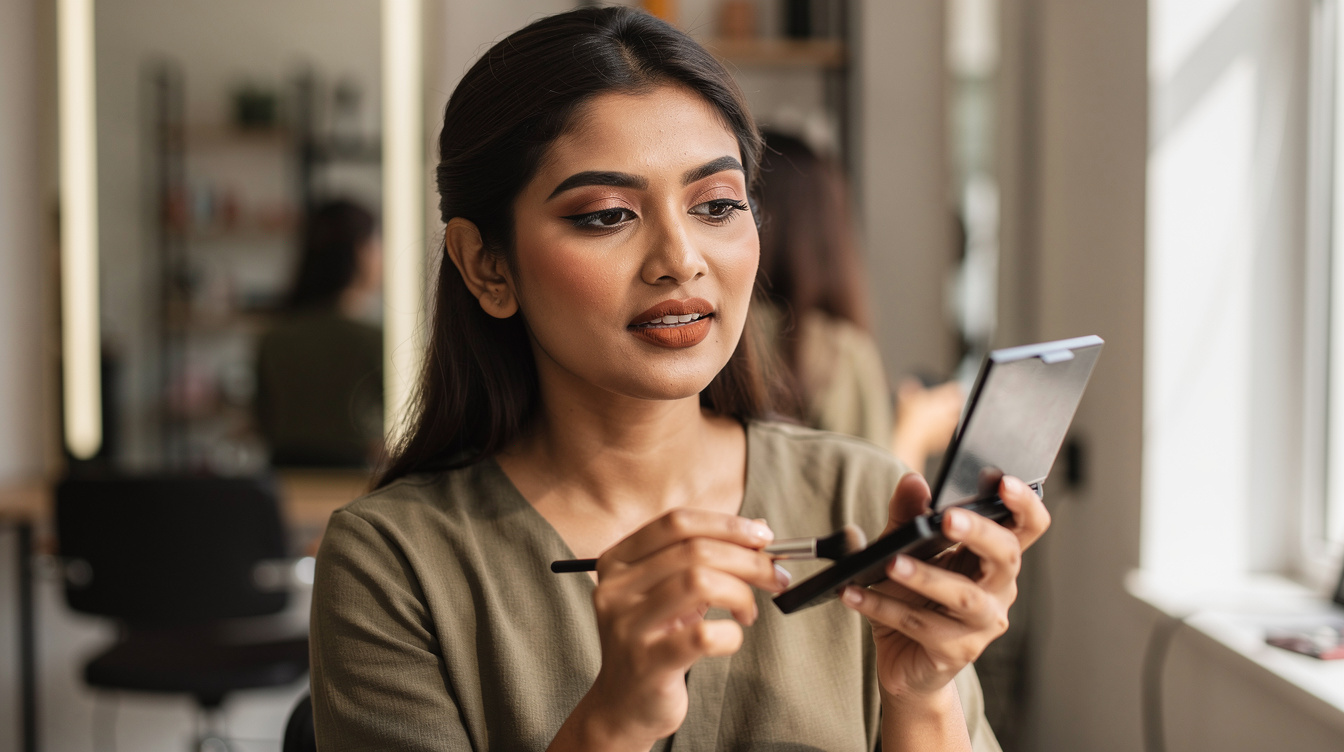
Almost every aspiring makeup artist we meet at our Sector 16 Huda Market studio in Faridabad arrives carrying the same quiet question. They have already watched hundreds of hours of free tutorials. Their phones are full of saved reels, bookmarked breakdowns, blush placement diagrams. And still — somewhere between the screen and their own kit — the face in front of them refuses to look like the face on YouTube. So they ask, gently: do I really need a course, or can I just keep watching? It is a fair question, and the honest answer is the reason we built the 20-Day Professional Makeup Course in the first place.
YouTube is an extraordinary library. We are not here to dismiss it — we use it ourselves to keep up with new launches, new techniques, new colour stories from MAC, NARS, Dior, Huda Beauty, Fenty Beauty, Laura Mercier, Haus Labs and Charlotte Tilbury. The problem is not the content. The problem is the format. A tutorial is a finished product filmed in optimal light on a model whose skin behaves. Your client’s skin will not behave. Your bride’s lehenga will reflect colour you did not predict. Your Faridabad summer humidity will lift a base you set perfectly indoors. None of that lives inside a video — and that is precisely the gap our Basics to Advanced course is designed to close.
Before we go further, the practical context matters. The course we are referring to throughout this article is a 20-day intensive, 12 PM to 5 PM, capped at only 10 students per batch, taught personally by Shivangi Verma — an active working bridal MUA with 14+ years behind the chair and 1,000+ brides on record. It runs out of our Sector 16 Huda Market studio in Faridabad and includes specially curated training products yours during the course, a professional brush kit yours to keep, certification on completion, a final assessment shoot with a professional model, and lifetime alumni support. Pricing currently sits at Rs. 1,50,000 + GST → Rs. 80,000 + GST as a limited-time early-bird rate, a Rs. 70,000 saving against the regular fee. With that on the table, let us look honestly at what YouTube does well — and where it stops.
What YouTube can teach (and what it absolutely can’t)
YouTube is genuinely brilliant for three things. First, vocabulary — you can learn the names of products, the difference between a fluffy blender and a pencil brush, what “baking” means, what “draping” looks like as a finishing step. Second, inspiration — saved references for soft glam, HD glass skin, nude-on-nude bridal, the shimmer-on-the-lid trend that arrives every season and changes slightly. Third, exposure — you watch hundreds of faces, hundreds of finishes, hundreds of choices. By the time you walk into our studio you are not starting at zero, and we love that.
What YouTube cannot teach is the part that decides whether someone pays you twenty-eight thousand rupees for a wedding function. It cannot teach you what a primer feels like when it has gone tacky too soon. It cannot teach you the specific weight of a Dior cushion against the cheek of a bride who has been crying. It cannot teach you to read the undertone of a face that is half-warm, half-neutral, with a pigmented under-eye that needs peach correction before any concealer goes anywhere near it. It cannot tell you that the foundation you just chose looks correct in your ring light but will flash back like chalk in a flagship banquet hall lit by tungsten and a videographer’s panel. These are not exotic edge cases. These are Tuesday at our studio.
This is the first fear we hear from students like Riya — “I will spend money on a course and learn nothing I could not have learned for free.” We understand the worry, genuinely. A lakh-plus is a serious commitment. But what you are paying for is not the information. The information is mostly free. You are paying for the conversion of information into reflex — and that conversion only happens through a structured environment where you do the work and someone qualified watches you do it. If you would like to ask us anything about that conversion before enrolling, the fastest way is a quick message on WhatsApp +91 9873048267.
Why hands-on real-skin practice has no online substitute
Skin is the single most under-discussed variable in online makeup education. Tutorial creators almost always work on a face they know — their own, or a model whose texture, oil pattern and pigment they have shot a hundred times. They have already chosen products that flatter that face. They have already chosen lights that flatter that face. By the time you press play, the result is half-baked into the conditions. You are watching a problem that has been pre-solved.
Real-skin practice is the opposite. Across our 20-day course you will sit in front of dozens of different faces — different ages, different undertones, different hair patterns at the temple, different eyelid hoods, different scarring or pigmentation histories, different reactions to silicone primers, different hydration levels because someone slept four hours the night before. You will be confused. You will, on day three, mix a base that looks correct in your tray and grey on the cheek. We want that to happen — early, repeatedly, while a trainer is standing next to you — because every one of those small failures is information your hands need.
Hands-on practice is also the only way to build product intuition. There is a moment, usually around week two, where students stop thinking in terms of “what brand should I use” and start thinking in terms of “this skin needs this finish.” That shift is unteachable through a video because it is not visual — it is tactile and pattern-based, built in your nervous system through repetition. We curate the kit you train on for exactly this reason. The training products are yours during the course so you can experiment without flinching at every swatch, and the professional brush kit is yours to keep at the end so the muscle memory you have built does not reset on day twenty-one.
If you want a sense of the range of finishes we cover — HD Glass Skin, Airbrush, Soft Glam, nude-on-nude bridal — the professional makeup course in Faridabad page lists the high-level treatment. We deliberately do not publish a day-by-day curriculum, and we will explain why a little later in this article.
Trainer feedback in real-time — the fundamental gap
Here is the single most important difference between YouTube and a real course, and it is the one most students underestimate before they enrol. A tutorial cannot see your hands. It cannot see the angle at which you are loading your beauty blender. It cannot see that you are pressing too hard at the apex of the cheek and pulling pigment into the under-eye. It cannot see that you have stopped breathing while you are doing winged liner — which, by the way, is why your line is shaking. It cannot tell you that you are working too far from the face, or too close, or that your light source is in the wrong place for the type of finish you are aiming for.
A trainer can. And not at the end of the look — that is too late. A trainer corrects in real time, while the mistake is still small and reversible. We treat this as the central pedagogical responsibility of our course. Shivangi personally watches every student work, every day. She does not delegate to juniors. She is not a teacher who used to do makeup — she is an active working bridal MUA with 1,000+ brides served, 62 Google reviews at a 5-star rating, and a portfolio that grows every weekend. The corrections you receive are not theoretical. They are the same corrections she would make in her own kit on a Saturday bride.
Real-time feedback also resolves a deeper anxiety we hear often: am I actually getting better, or am I just getting more confident at making the same mistakes? On YouTube, you have no calibration. You finish a look, you photograph it, you compare it to a reference, you mostly conclude you did okay. In a small-batch room of ten students, the feedback loop is brutal in the best way. You see your work next to nine others. You hear corrections given to a peer that suddenly explain a flaw in your own technique you had not even noticed. By the end of the arc, when we run the final assessment shoot with a professional model, the difference between you on day one and you on day twenty is no longer a feeling — it is documented in photographs you can use to start booking.
Why a structured 20-day arc beats two years of random tutorials
This is the part of the conversation where we want to be most honest. We have met aspiring artists in Faridabad, in Delhi NCR, who have been “learning on YouTube” for two years. They are talented. They have taste. They can tell you which lipstick is which by swatch. And yet they are still not booking, still not confident on real skin under real timelines, still doing makeup for cousins at home. Two years. The reason is not effort — it is sequencing.
YouTube has no curriculum. The algorithm shows you whatever is performing. So one week you are watching an advanced cut-crease, the next week a basic primer review, the next a viral trend that will be irrelevant in three months. You build skill in patches. There are gaps you do not know you have because the algorithm never surfaced the foundational thing that should have come first. We have had students join our 20-day course who could already do a stunning smoky eye but had never been taught how to actually colour-correct an Indian under-eye properly — because no tutorial they had watched had bothered to start there.
A structured arc fixes this. Twenty days, twelve to five, in sequence. Skin first, always — because everything else is built on it. Then eyes, then bridal architecture — HD Makeup, Airbrush, Glass Skin, traditional and modern bridal techniques. Then the parts almost no tutorial ever covers: client handling, consultation language, how to price yourself, how to manage a difficult bride’s mother, how to set up a small business and not undercharge yourself out of the industry in your first year. By the end you are not a person who knows things about makeup. You are a person who has done the things, in order, on real skin, under guidance, with the receipts to prove it. That is the version of you that books clients.
This also addresses the second fear we hear from students like Riya — “what if I finish the course and still cannot get clients.” The course is intentionally designed so that the last week is not just technique. It is the bridge into the industry. Portfolio building, certification, the final assessment shoot, lifetime alumni support after you leave — these are not bonuses, they are the part that converts skill into livelihood. If you are weighing this seriously, the Course inquiry form is the cleanest way to get a written response covering exactly which doubts you have.
How to combine YouTube prep with formal training
We are not, despite everything above, anti-YouTube. We think the most successful students we have trained are the ones who use YouTube intelligently as a complement, not a substitute. Here is what that actually looks like in practice, and what we recommend to every Riya before she walks in on day one.
Use YouTube to widen your visual library. Spend an evening a week studying finishes you do not personally find easy — if you naturally gravitate to soft glam, deliberately watch heavy bridal; if you love drama, watch nude-on-nude. Use it to learn product vocabulary so that on day one of the course you are not asking what a setting spray does, you are asking the more advanced question of why one setting spray sits flatter than another on dehydrated skin. Use it to look at international finishes — referencing Charlotte Tilbury’s editorial breakdowns, Pat-McGrath-style runway looks, Haus Labs colour theory — so that when we cover Indian bridal, you have a frame of reference for why our techniques have evolved the way they have.
Stop using YouTube the moment it starts replacing real practice. The trap is that watching feels like learning, and watching is much, much easier than doing. If you find yourself on hour four of a tutorial binge with your kit untouched on the table, you are not training — you are consuming. Close the laptop, sit a friend down, and apply on real skin. Photograph the result in three different lights, including unflattering ones. That single hour will teach you more than the four hours you just spent.
And then — when the gaps in your self-teaching start to feel structural rather than fixable, when you can tell that what you need is not another video but an experienced pair of eyes on your hands — that is when formal training pays for itself. That is precisely the moment Shivangi Verma’s makeup course is built for. Until that moment, keep watching. After that moment, come and train with us.
FAQ
Will the 20-day course really prepare me for a career?
The 20-day intensive runs 12 PM to 5 PM with a maximum of 10 students per batch, which is roughly 100 hours of focused, supervised, hands-on practice on real skin. It covers basics through advanced bridal — HD Makeup, Airbrush, Glass Skin, traditional and modern techniques — alongside client handling, pricing and business setup, plus a final assessment shoot with a professional model. It is designed to turn complete beginners into bookable artists. It is not a substitute for the months and years of real client work that follow, but it gives you the foundation, the portfolio and the certification to start earning.
If YouTube is free, why should I pay for a course at all?
The information on YouTube is largely free, yes. What is not free is the conversion of that information into reflex on real skin under real time pressure. You are paying for live correction by an experienced trainer, supervised practice on dozens of different faces, curated training products and a professional brush kit, structured sequencing of skills in the right order, and the post-course infrastructure — certification, assessment shoot, alumni support — that bridges learning into earning.
I am a complete beginner — am I too inexperienced for this course?
Not at all. The course is built for complete beginners through to intermediate learners. We have trained students with no prior makeup background and students who came in already booking small jobs — both groups finish ready for the industry because the small-batch format lets us calibrate to where each student actually is. Genuinely the only prerequisite is willingness to do the work.
Why does the course not publish a day-by-day curriculum?
Because the sequencing is calibrated to each batch. We move faster on topics where the cohort is already solid and slower on topics that need extra attention, which is one of the real advantages of a 10-student cap. Publishing a fixed Day 1, Day 2, Day 3 outline would misrepresent how the course actually runs. We are happy to discuss the high-level arc — skin, eyes, bridal architecture, business — over WhatsApp at +91 9873048267 before you enrol.
Is the academy reputable enough? How is it different from large national chains?
Shivangi Verma has been operating since 2012 — over 13 years in the industry — with international training certified from Makeup Studio, Netherlands, and 1,000+ real brides served. She personally teaches every batch rather than delegating to junior instructors, which is a genuine difference from larger institutional models. The course issues certification on completion. We would gently encourage you to compare not on brand size but on who is actually standing next to you while you train.
What is the fee, and what is included?
The regular fee is Rs. 1,50,000 + GST and the current early-bird rate is Rs. 80,000 + GST, a limited-time saving of Rs. 70,000. Included: specially curated training products yours during the course, a professional brush kit yours to keep, certification on completion, the final assessment shoot with a professional model, and lifetime alumni support. The studio is at Booth No 70-71, First Floor, Sector 16 Huda Market, Faridabad. For the latest availability and to confirm the early-bird window, message us on WhatsApp at +91 9873048267.
If you have read this far and you recognise yourself in Riya — talented, self-taught, hours-deep into tutorials, and quietly unsure whether you are getting better — that is the most useful signal you will get this year. The gap between watching and doing is real, and it is closeable. Come and close it with us. The early-bird window for our 20-Day Professional Makeup Course at Sector 16 Huda Market, Faridabad is open now, and the next batch is filling. WhatsApp us on +91 9873048267 or fill the inquiry form linked in the CTA below — we will reply personally.
20-Day Professional Makeup Course · Sector 16 Faridabad
Become a Professional Makeup Artist — Basics to Advanced
Hands-on training on real skin, only 10 students per batch, taught personally by Shivangi Verma — an active working bridal MUA with 14+ years and 1,000+ brides. Products, professional brush kit, certification and final assessment shoot all included.
Rs. 1,50,000 + GST → Early Bird: Rs. 80,000 + GST (save Rs. 70,000 — limited time)
💬 WhatsApp +91 9873048267 | Fill Inquiry Form | View Course Page →