
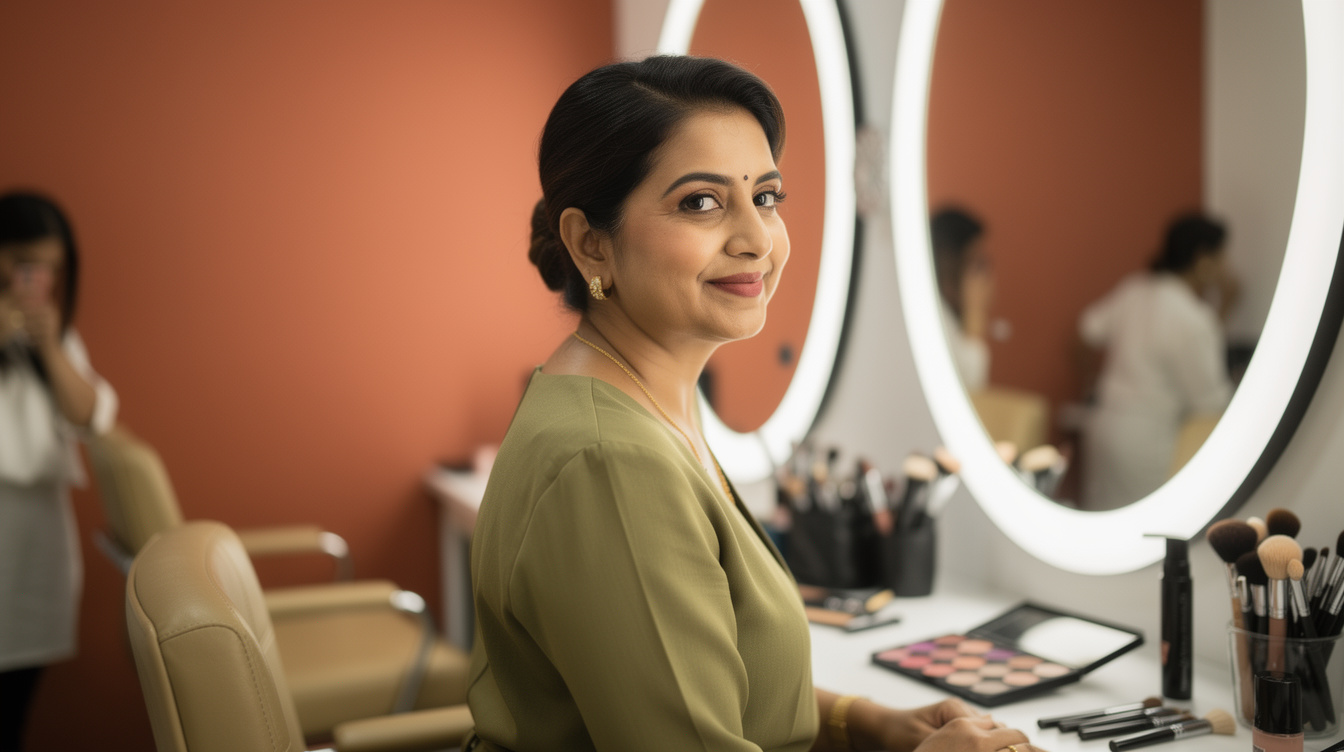
Every week we sit across from a young woman in our Sector 16 Faridabad studio who asks the same question in slightly different words: should I do a makeup course, or should I do a beauty / skin course? Sometimes she frames it as makeup vs cosmetology. Sometimes she has already paid an advance somewhere and is hoping we tell her she made the right call. Almost always, what she really wants to know is simpler — which one pays better in 2026, and which one gets her to a real career fastest?
We have answered this hundreds of times across 14+ years of running a bridal studio and now an academy, so we want to lay it out properly. Not as marketing for our own 20-Day Professional Makeup Course, but as the honest version we wish someone had given us when we were 22 and choosing between paths. Both are valid careers. They simply lead to very different income ceilings, very different daily lives, and very different timelines to your first paycheck.
Riya — the persona we are writing this for — is somewhere between 19 and 32, often from Delhi NCR, sometimes a college graduate looking for a creative escape from a corporate role, sometimes a homemaker restarting after kids. She has a budget of roughly one to two lakhs, six months of patience, and a strong instinct that she wants to work with her hands and with people. The choice she is being sold is usually framed as makeup vs cosmetology, or as the broader beauty course vs makeup course debate. We will treat both seriously, then show where the money actually sits in 2026.
Career-track differences — what each leads to
A beauty / skin course — what most academies still call a cosmetology or beauty therapy diploma — is a broad qualification. You learn facials, cleanups, threading, waxing, manicure, pedicure, basic hair, body massage, sometimes basic skincare chemistry, and a small unit on day or party makeup. The format is usually 3 to 9 months, classroom-style, with a salon internship attached. The output is a beauty therapist or salon technician — someone qualified to work the floor of a salon, run a home-service skincare business, or take a junior role in a chain.
A makeup course is narrower and deeper. You are not learning to do facials. You are learning to read a face, build a base for HD and 4K cameras, understand undertones across Indian skin, master eye architecture, do flawless airbrush, build glass-skin finishes, do bridal hair integration, and — in any serious programme — manage your own clients, pricing, and brand. The output is a makeup artist: freelance, studio-based, or eventually academy-running. The job lives in weddings, fashion shoots, editorial, content, film, and personal branding work.
The first practical difference is who hires you. A beauty therapist’s natural employer is a salon — a fixed salary, fixed hours, and fixed price ceiling because the salon owns the client. A makeup artist’s natural client is a bride, a brand, a stylist, or a photographer — variable, but uncapped. The second practical difference is product authority. Beauty courses rarely train deeply on prestige makeup houses. A serious makeup course trains you on the brushes, formulas, and finishes that brides actually request — MAC, NARS, Dior, Huda Beauty, Fenty Beauty, Laura Mercier, Haus Labs, Charlotte Tilbury — because that vocabulary is what separates a professional from a hobbyist on a consultation call.
Income comparison: bridal MUA vs beauty therapist
This is the part most academies dance around. We will not. The numbers below are drawn from what our own students earn, what we see on real bookings across Delhi NCR, and what salon owners we collaborate with quote when they hire fresh diploma holders in 2026.
Beauty therapist (post 6-month diploma): a fresh hire in a mid-tier Delhi NCR salon earns roughly Rs. 12,000 to Rs. 22,000 per month, plus a small commission on services upsold. After two to three years of consistent work, a senior therapist or skin specialist in a premium salon can reach Rs. 35,000 to Rs. 55,000 a month. Independent home-service therapists who build a steady client book can clear Rs. 60,000 to Rs. 90,000 in a strong month, but income flattens because each service — a facial, a cleanup, a wax — has a hard ceiling of what a customer will pay.
Bridal makeup artist (post serious 20-day intensive + portfolio): the unit of work is a function, not a service. A single engagement can pay Rs. 18,000 to Rs. 35,000. A bridal function can pay Rs. 25,000 to Rs. 80,000 depending on positioning. A destination wedding adds 50–100% on top. A trained MUA who lands four bridal functions a month — very achievable in season — is at Rs. 1,00,000 to Rs. 2,50,000 a month within the first 18 months. A specialist with a polished portfolio, a defined finish (HD, glass skin, soft glam, airbrush), and a small studio presence can sustain Rs. 3,00,000 to Rs. 6,00,000 monthly in peak season after three to four years.
The honest caveat: beauty therapy income is steadier and starts faster. Bridal income is seasonal and lumpy — October to February is heavy, summer is thinner — and you carry your own marketing cost. But the ceiling is dramatically higher, and crucially, every booking compounds your portfolio, which is the asset that pulls in the next booking. A facial does not compound. A flawless bride photographed by a good photographer does, for years.
Why specialisation pays better than generalisation
The second most common version of the makeup vs cosmetology question is whether to do everything — a combined beauty + makeup diploma. The pitch is appealing: you can earn from facials in low season and from makeup in wedding season. We have watched this play out for over a decade, and the pattern is consistent. Generalists earn a moderate, stable income. Specialists earn a much larger, slightly less stable one. The reason is not effort — it is positioning.
A bride paying Rs. 60,000 for her wedding-day makeup is not buying twenty minutes of foundation application. She is buying confidence, judgement, and a portfolio that proves you have done this a hundred times before. The moment you also offer threading, facials, and party hair on the same Instagram grid, the perceived authority drops. The bride starts comparing you to a salon, not to other bridal artists. The price drops with her perception.
This is why our advice to almost every Riya who walks in is the same: choose one craft, train deep on it, and bolt complementary services on later only if the demand is already pulling you. If your goal is the upper end of the income range, specialisation is not a preference — it is the mechanism. Our Basics to Advanced course is built around this single belief: 20 days of focus on one craft will out-earn 6 months of breadth, almost every time.
How the 20-Day Professional Course positions you
We need to address the fear honestly before we describe the course, because we hear it in every consultation: what if I spend a lakh on a course and learn nothing useful? It is the single biggest reason aspiring artists hesitate. We understand it. A makeup course is a meaningful investment for a young woman, especially one paying out of her own savings, and the market is full of certificates that do not translate into a single booking.
The structure of our 20-day programme is designed against exactly that fear. The course runs 20 days, 12 PM to 5 PM, at our Sector 16 Huda Market studio in Faridabad. Batches are capped at 10 students — not as a marketing line, but because anything larger means the trainer cannot personally watch every brush stroke, and personal observation is what fixes habits that books cannot. Shivangi personally teaches every batch. She is not a full-time educator who left the industry — she is an active working bridal MUA with 1,000+ brides behind her, 62 Google reviews and a 5-star rating, currently shooting brides every weekend. The techniques you learn on Monday are techniques she used on a real client on Saturday.
The curriculum is treated at a craft level, not a calendar level — we do not publish a day-by-day breakdown because the real value is in the responsiveness of the teaching, not the syllabus on paper. At a high level, you cover HD makeup, airbrush, glass skin and full bridal techniques, plus the business and client-handling layer that turns a trained artist into a booked one — pricing your work, running a trial, managing a wedding-day timeline, and presenting yourself online. Included in the fee: specially curated training products (yours to use throughout the course), a professional brush kit you keep, certification on completion, a final assessment shoot with a professional model for your portfolio, and lifetime alumni support — meaning when you have a tricky bride next October, you can still message us.
The fee structure: regular price is Rs. 1,50,000 + GST. The early-bird rate is Rs. 80,000 + GST — a saving of Rs. 70,000 — for a limited time as we onboard the next batch. We are deliberate about not pricing it lower long-term, because the cost reflects the small batch size, the products, the kit, and the trainer’s personal time. If you want to talk through fit before deciding, the simplest path is to WhatsApp us on +91 9873048267 or fill the inquiry form.
Combined-skills professionals — when both make sense
We promised an honest answer, so here is the case for doing both. There are situations where the makeup vs cosmetology debate is genuinely a false binary — usually when geography, family circumstance, or business model push you toward a hybrid practice. A few examples we have seen succeed in Delhi NCR.
The home-studio entrepreneur in a tier-2 town. If you are setting up a small studio in a town where bridal demand is real but seasonal, a parallel skincare or pre-bridal service line keeps the studio cash-positive between weddings. In this case the beauty side is a base load, not a career.
The pre-bridal specialist. A small but growing category — artists who own the bride’s six-month skincare journey leading up to the wedding, then deliver the makeup on the day. This requires real depth on both sides, but the bundled package can sell at a premium because the bride does not have to coordinate two vendors.
The salon owner. If your end goal is owning a multi-chair studio that employs other artists, generalist understanding is genuinely useful — not because you will be doing facials yourself, but because you will be hiring, pricing, and managing them.
Outside these specific business models, our recommendation stands: pick the craft you actually want to spend your week doing, train deep on it first, then add the second skill from a position of strength. The reverse — diluting yourself across both before you are excellent at either — is what produces the modest, ceilinged income that most beauty diploma graduates eventually settle for and quietly resent.
20-Day Professional Makeup Course · Sector 16 Faridabad
Become a Professional Makeup Artist — Basics to Advanced
Hands-on training on real skin, only 10 students per batch, taught personally by Shivangi Verma — an active working bridal MUA with 14+ years and 1,000+ brides. Products, professional brush kit, certification and final assessment shoot all included.
Rs. 1,50,000 + GST → Early Bird: Rs. 80,000 + GST (save Rs. 70,000 — limited time)
💬 WhatsApp +91 9873048267 | Fill Inquiry Form | View Course Page →
FAQ
Will a 20-day makeup course really prepare me for a paying career?
Yes, when the format is intensive and small-batch. Twenty days at five working hours per day on live faces, with personal correction from a working bridal MUA, is roughly 100 hours of supervised practice — more deliberate hands-on time than most six-month diplomas deliver, because in larger formats the contact hours per student get diluted across the batch. Pair that with a portfolio shoot at the end and lifetime alumni support, and the structure is designed to send you out booking-ready, not just certified.
How is a makeup course different from a cosmetology or beauty diploma?
A cosmetology or beauty diploma is broad — facials, threading, waxing, manicure, pedicure, basic hair, with a small unit on makeup — and it qualifies you to work in a salon. A makeup course is narrow and deep — base, eyes, finishes for HD camera, bridal hair integration, client handling — and it qualifies you to work as an independent or studio-based makeup artist. The income ceiling is meaningfully higher on the makeup side because each booking is priced as a function, not as a per-service rate.
I’m worried I won’t get clients after the course. How is that addressed?
Genuinely — this is the second-biggest fear after fee anxiety, and it is a valid one. Our course treats the business layer as part of the curriculum, not a footnote: how to price your work, how to run a trial, how to present your portfolio, how to handle inquiries, how to set up your social presence, and how to convert a consultation into a booking. The certificate alone never books anyone. The portfolio shoot, the lifetime alumni support, and the business training together are what make the difference in the first six months out.
What’s actually included in the Rs. 80,000 + GST early-bird fee?
The full fee covers 20 days of training (12 PM to 5 PM) at our Sector 16 Huda Market studio in Faridabad, taught personally by Shivangi Verma in a batch capped at 10 students. Included in the fee: specially curated training products you use throughout the course, a professional brush kit that is yours to keep, certification on completion, a final assessment shoot with a professional model for your portfolio, and lifetime alumni support. The regular price for this same course is Rs. 1,50,000 + GST — the Rs. 80,000 rate is a limited early-bird window.
I’m a complete beginner — am I too inexperienced to start with a professional course?
No. The course is named Basics to Advanced for a reason — it is built to take a complete beginner from foundation theory through to advanced bridal work over the 20 days. We have trained homemakers restarting careers in their thirties, college graduates pivoting from corporate roles, and 19-year-olds with no prior experience. What matters is the discipline to attend every session and practise between them, not your starting point.
Is the academy reputable enough to be worth the investment?
Shivangi Verma has been an active bridal MUA since 2012, with international training from Makeup Studio Netherlands, 1,000+ brides, and 62 five-star Google reviews. She personally leads every bridal appointment and personally teaches every academy batch — there are no junior trainers stepping in. The combination of a working artist’s current craft and small-batch personal teaching is the specific reason graduates emerge booking-ready rather than merely certified.
If you are still weighing the makeup course vs beauty course question for yourself, the most useful next step is a short conversation rather than more research. Tell us where you are starting from and what you want your week to look like in two years, and we will tell you honestly whether Shivangi Verma’s makeup course is the right fit for you — or whether a different path would serve you better. WhatsApp +91 9873048267 or use the inquiry form linked above.