
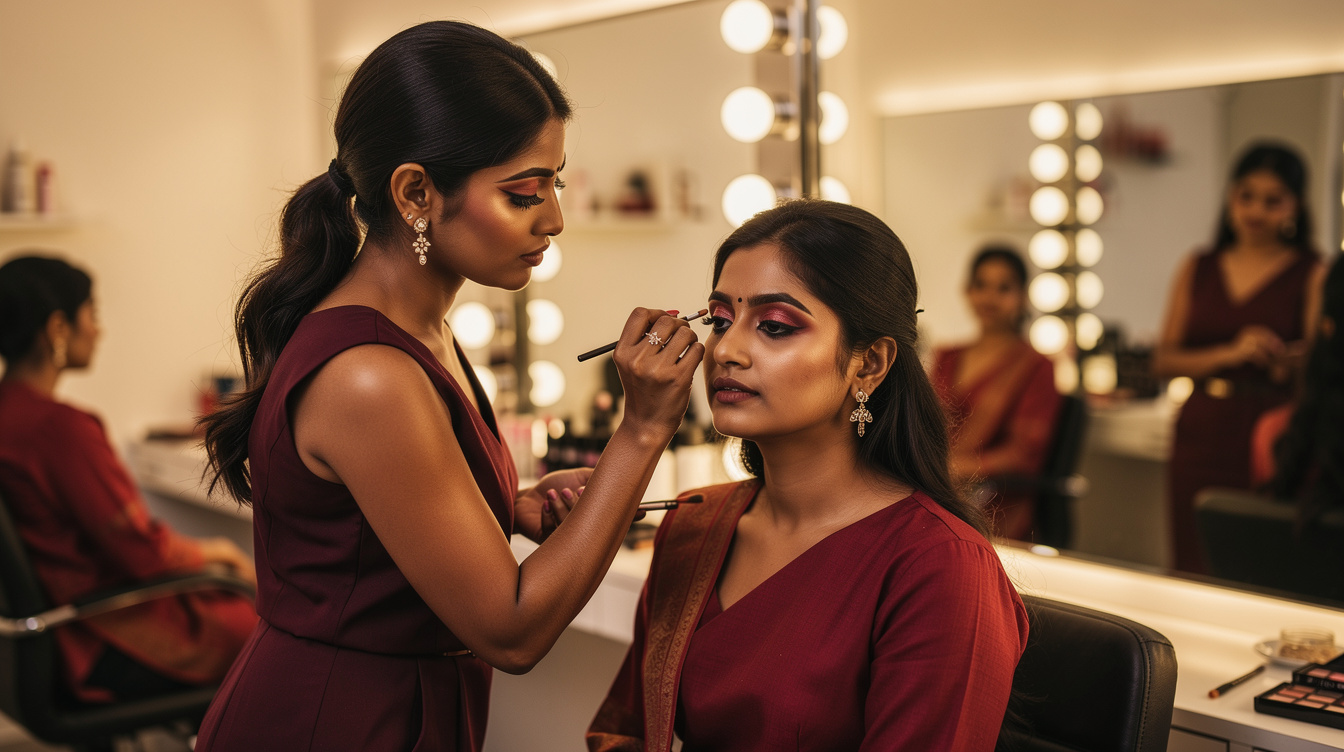
“How much can I actually earn after a makeup course?” is the first question almost every aspiring artist asks us. It is a fair question — and an unusually hard one to answer with a single rupee figure. We have trained graduates who started booking bridal projects in their second month, and we have met certified students from other programmes who, two years on, are still doing party makeup at ₹3,000 a face because nobody taught them how to price, package or present their work. The gap between those two outcomes is rarely about talent. It is almost always about what the course actually included, and what the artist did in the first ninety days after graduation.
This article is the honest version of that conversation. We are going to walk through what new graduates of a serious programme like our 20-Day Professional Makeup Course in Faridabad can realistically charge per bridal project, what active alumni report earning in their first year, why two graduates from the same batch can end up at very different income levels, and how portfolio quality plus an active alumni network compress the ramp from “hopeful freelancer” to “fully booked artist.” We will keep the numbers grounded in the Delhi NCR and broader North India market in 2026, since that is where most of our students begin working.
One framing note before we go in. The headline figure most aspiring artists fixate on is the bridal main-day rate — the ₹25,000 or ₹30,000 number on a senior artist’s WedMeGood listing. That number is real, but it is the destination, not the starting line. The number that actually matters in your first year is your monthly take-home across all the project types you are willing to do, and the speed at which your average per-project rate climbs. We will treat both of those carefully below.
Average per-bridal-project earnings for new graduates
In the Delhi NCR market in 2026, a freshly certified makeup artist with a real, photographed portfolio — not just a certificate — can charge between ₹8,000 and ₹15,000 for a party or pre-wedding function in their first three to six months. A bridal main-day booking, in the same window, typically lands between ₹18,000 and ₹30,000 per look. These are not aspirational figures. They are what our graduates and their peers are actively pricing at on Instagram and on WedMeGood listings, and what brides in this market are demonstrably willing to pay a new artist who has visible work to show.
The dispersion inside that range is almost entirely about portfolio. A graduate who walked out of our Basics to Advanced course with the included final assessment shoot — which we run with a professional model on the closing days of the programme — starts conversations with brides at the upper half of the band. A graduate without polished imagery has to discount aggressively to win the first three or four bookings, because brides are evaluating the photos, not the paperwork. The certificate gets you taken seriously by other artists. The portfolio gets you taken seriously by clients.
For reference, our own studio’s listed bridal-per-function rate sits at ₹28,000, engagement at ₹25,000, and party makeup at ₹8,000, with outstation per-function bridal at ₹50,000. We share these numbers not as a promise — every graduate has to earn into them — but as a ceiling that is reachable with the right body of work. Brides pay these rates to Shivangi Verma because thirteen-plus years of consistent delivery, 1,000-plus brides, a 5.0 WedMeGood rating across 26-plus reviews, and a 62-review 5-star Google profile all underwrite the price. Your job after graduation is to begin building the same kind of evidence at your own scale — not to copy the rate, but to copy the discipline that earned the rate.
How much active alumni earn in their first year
The honest first-year picture for an actively working graduate looks something like this. Months one and two are mostly portfolio and trial work — paid trials, friend-and-family discounted shoots, one or two “real” party bookings as warm referrals come through. Income in this window is typically ₹15,000 to ₹40,000 a month, and most of that should be reinvested in product, photography and content. Months three through six is when bookings start compounding. Two to four party-and-engagement projects a month, plus the first one or two paid bridal main-days, can place a committed graduate in the ₹60,000 to ₹1,20,000 monthly band. Months seven through twelve, with a clean Instagram grid and the first Google reviews trickling in, the strongest alumni cross ₹1,50,000 in a peak wedding month.
That word “actively” is doing real work in the previous paragraph. The single biggest predictor we see, watching alumni a year out, is not talent — talent is fairly distributed. It is whether the graduate is posting two to three pieces of work a week, replying to every inquiry within an hour, and treating client management as a discipline rather than an afterthought. Our small-batch format — capped at 10 students, running 12 PM to 5 PM for 20 days at our Sector 16 Huda Market studio in Faridabad — is deliberately built so that this discipline gets coached in alongside the technique itself: pricing logic, packaging of services, client handling, follow-up systems, content cadence. The makeup is the easier half of the job. The business is what most short-format courses forget to teach.
We will say the obvious thing here, because new students worry about it. Yes, the early-bird course fee of Rs. 80,000 + GST — against a regular fee of Rs. 1,50,000 + GST, a saving of Rs. 70,000 for this batch — is a meaningful amount of money. The question is not whether the fee is small. The question is how many bridal main-days at ₹20,000 to ₹28,000 it takes to recover. For most of our graduates that answer is somewhere between four and seven paid bookings, generally inside the first six months and often inside the first three. We address this fee-recovery question directly with every prospective student — you can WhatsApp us at +91 9873048267 and we will walk you through the maths against your specific city and starting point.
Why earnings vary so widely (city, niche, marketing)
Three variables explain almost all of the variance we see in alumni income. The first is city and circuit. A graduate working primarily in South Delhi, Gurugram and Faridabad has access to a price ceiling that a graduate working in a tier-3 town simply does not. The same bridal look that pays ₹25,000 in Faridabad pays ₹12,000 in some smaller circuits. The destination-wedding tier — Jaipur, Goa, Jim Corbett, Udaipur, Chandigarh, Kashmir, and increasingly Sri Lanka and Canada from our own studio’s travel history — pays the highest per-project rates of all, but it requires a portfolio that travel-planners will accept and the operational maturity to coordinate hair, drape and timing alongside the makeup itself.
The second variable is niche. Bridal is the highest-paying segment in India by a long margin. Editorial and party makeup pay less per project but cycle faster, which can be useful in the early months. Within bridal itself, the artists who specialise visibly — HD Glass Skin, Ultra HD, soft-glam, airbrush, skin-like nude finishes — out-earn generalists, because brides search by aesthetic on Instagram, not by city alone. A graduate who can demonstrably deliver three of these signature finishes in their portfolio is almost always pricing at the upper end of the bands we described earlier. Working with respected products — MAC, NARS, Dior, Huda Beauty, Fenty Beauty, Laura Mercier, Haus Labs, Charlotte Tilbury — matters less than knowing why each finish needs the formulation it needs, which is what the technical half of the course teaches.
The third variable is marketing, and this is the one most graduates underestimate. The market is full of Instagram-trained artists. What is rare is the artist who treats their feed like a working catalogue, replies promptly on WhatsApp, sends a clear written quote within an hour, and arrives at the trial with a documented look-plan. We coach this explicitly. The course’s client-handling and business module is not a soft add-on — for most graduates it ends up being the part of the training that actually moves their income. Two artists with identical technical skill will end up at very different annual incomes if one of them runs a tight inquiry-to-booking process and the other does not.
City, niche, marketing — that is roughly the order of importance for a new graduate, but it is also worth saying that you have far more control over niche and marketing than you do over city. A graduate who builds a recognisable HD Glass Skin signature in Faridabad will out-earn a generalist in Mumbai. The variable you can move is almost always the variable worth moving.
How a strong portfolio and alumni network compress the ramp
We need to talk about the fear that sits underneath every enrolment conversation we have, because it deserves a direct answer. Aspiring artists tell us, often quietly, that they are scared they will spend a lakh on a course and walk out with nothing useful. That fear is genuinely reasonable. There are short-format programmes in India where it is the correct fear. We do not dismiss it — we acknowledge it openly with every prospective student, because the only way to disprove the worry is to show what is actually included and what alumni do with it.
The two compounding levers that close the gap between “certified” and “earning” are portfolio and alumni network. Portfolio is the more visible of the two. Every student in the programme practises on real models throughout the course, and the final assessment shoot is run with a professional model so that every graduate leaves with editorial-grade imagery rather than phone selfies. That single asset is what lets a graduate quote ₹20,000 instead of ₹8,000 in their first month. The included specially curated training products (yours to use throughout the course) and the professional brush kit (yours to keep) mean you are not learning on inferior tools and then having to relearn on real product after graduation.
The alumni network is the quieter lever and the more underestimated. Our alumni share overflow bookings with each other when their dates clash. They refer party clients sideways to graduates who specialise in that segment. They WhatsApp each other before destination jobs to find draping help, hair help and assistant help. Lifetime alumni support is part of the included programme, and it matters most in exactly the months when a new graduate is still building their own pipeline — the months where one well-placed referral can change the trajectory of a quarter. The course is taught personally by Shivangi Verma — an active working bridal MUA with 14-plus years and 1,000-plus brides — not delegated to juniors, which means the network you graduate into is anchored by a working artist, not a teaching brand.
A practical note for students who wonder whether 20 days is “enough.” It is intensive, full-time, hands-on, on real skin every day — covering HD Makeup, Airbrush, Glass Skin and Bridal Techniques alongside client handling and business setup. The format is built around the logic that you do not need six months of theory; you need 20 concentrated days of doing the work correctly under direct supervision, then a working network to lean on while you build a clientele. If you would like to talk through the format in detail before committing, you can Fill the inquiry form and we will reply with a structured walk-through of the course and what to expect after.
Realistic month-by-month projection for a committed graduate
Here is what a realistic ramp looks like for a graduate who finishes the programme, posts consistently, replies promptly and uses the alumni network. The numbers are illustrative — every artist’s curve is slightly different — but the shape is what we see most often among committed alumni working the Delhi NCR market.
Months 1–2. Portfolio expansion, paid trials, friend-network shoots, first one or two real party bookings. Roughly one to three paid jobs per month. Take-home in the ₹15,000 to ₹40,000 range. Most of the work this period is investment, not yet revenue, and that is the correct way to think about it. Treat content production as a job in itself; two to three considered posts a week with clean before-after framing builds the search-and-save base that will feed the next quarter.
Months 3–4. First bridal main-day inquiries arrive, usually from Instagram saves or early WedMeGood listings. Two to four projects a month, typically a mix of party, engagement and a single bridal. Take-home moves into the ₹50,000 to ₹90,000 band. This is the window in which most committed graduates see the course fee fully recovered — often in a single bridal booking once main-day pricing crosses ₹25,000.
Months 5–8. Repeat clients, referrals from earlier brides, and the first Google reviews start arriving. Three to six paid projects a month, with bridal main-days now 30–50 per cent of the mix. Peak wedding-season months touch ₹1,20,000 to ₹1,50,000. This is also the window where the alumni network starts paying back — overflow referrals from senior alumni begin to land, especially around the November to February peak.
Months 9–12. For graduates who have invested seriously in the marketing side, the year closes with a stable monthly average above ₹1,00,000 and clearly visible peak months. Some alumni hit ₹2,00,000 in November to February peak months by their first wedding season. None of this is luck. It is what disciplined posting, fast inquiry response, transparent pricing and a high-quality portfolio compound into across twelve months.
We are deliberately not promising these numbers — we are describing the curve we see most often among graduates who do the work. A graduate who treats the certificate as the finish line earns very little. A graduate who treats Day 20 as Day 1 of a business almost always earns into the figures above.
FAQ
Will the 20-Day Professional Makeup Course really prepare me for a career?
Yes, when paired with consistent post-course work. The format is full-time, hands-on, and runs from 12 PM to 5 PM for 20 days at our Sector 16 Huda Market studio — that is roughly 100 hours of supervised practice on real skin, plus client handling, pricing and business setup. Graduates who post consistently, reply promptly and use the alumni network typically begin booking paid bridal work inside their first three months. The course is the foundation; the first ninety days after graduation is where most of the income trajectory is set.
How long does it usually take to recover the course fee?
For most committed graduates working the Delhi NCR market, the early-bird fee of Rs. 80,000 + GST is recovered within four to seven paid bookings, generally inside the first six months and often inside the first three. A single bridal main-day at ₹25,000 plus a handful of party-and-engagement bookings at ₹10,000 to ₹15,000 each is the typical recovery path. Graduates who specialise in a recognisable signature look (HD Glass Skin, soft-glam, skin-like nude) tend to recover faster because their per-project rate climbs sooner.
What if I have zero prior experience with makeup?
The programme is designed for complete beginners through to advanced learners. The 10-student batch cap means you get personalised attention from Day 1, and the curriculum starts from foundation skills before progressing to advanced bridal techniques. We have had successful graduates who walked in with no prior practical experience — what matters far more than starting skill is willingness to put in the hours of supervised practice during the 20 days, and to keep practising on real models after.
Is the small batch size really 10 students, and why does it matter?
Yes — the batch is firmly capped at 10 students. It matters for two reasons. First, every student gets direct demonstration and direct correction from Shivangi Verma during every technique, instead of watching a far-off teacher across a room of 30. Second, the batch becomes a peer cohort that continues to support each other long after graduation through the lifetime alumni network. A 10-student room is the difference between a course you attended and a course you are part of.
Will I get help finding clients after I graduate?
Lifetime alumni support is included with the course. That covers ongoing technique queries, business and pricing questions, overflow-booking referrals from senior alumni, and informal help on hair, draping or assistant needs for destination jobs. We do not promise to hand you clients — no honest course can — but we do promise that you graduate into an active network of working artists who help each other, and that the trainer is an active working bridal MUA, not a retired teacher.
What is included in the course fee?
The early-bird fee of Rs. 80,000 + GST (regular Rs. 1,50,000 + GST) covers all 20 days of training, the specially curated training products you use throughout the course, a professional brush kit that is yours to keep, certification on completion, the final assessment shoot run with a professional model so that you graduate with editorial-grade portfolio imagery, and lifetime alumni support. There are no hidden material charges added later.
20-Day Professional Makeup Course · Sector 16 Faridabad
Become a Professional Makeup Artist — Basics to Advanced
Hands-on training on real skin, only 10 students per batch, taught personally by Shivangi Verma — an active working bridal MUA with 14+ years and 1,000+ brides. Products, professional brush kit, certification and final assessment shoot all included.
Rs. 1,50,000 + GST → Early Bird: Rs. 80,000 + GST (save Rs. 70,000 — limited time)
💬 WhatsApp +91 9873048267 | Fill Inquiry Form | View Course Page →
If you have read this far, you are exactly the kind of student we built the programme for — the one who wants honest numbers before committing to a fee, not the one who wants to be told what they want to hear. The earnings curve we described is reachable, but it is reachable only with a portfolio you are proud of, a working network to lean on, and the business discipline to treat your post-graduation months seriously. That is the entire premise of Shivangi Verma’s makeup course: 20 concentrated days of doing the craft correctly under direct supervision, then a network and a portfolio you graduate into the market with. When you are ready to talk through the format, the trainer or the timeline against your specific situation, message us on WhatsApp at +91 9873048267 and we will reply with a candid, no-pressure walk-through.