
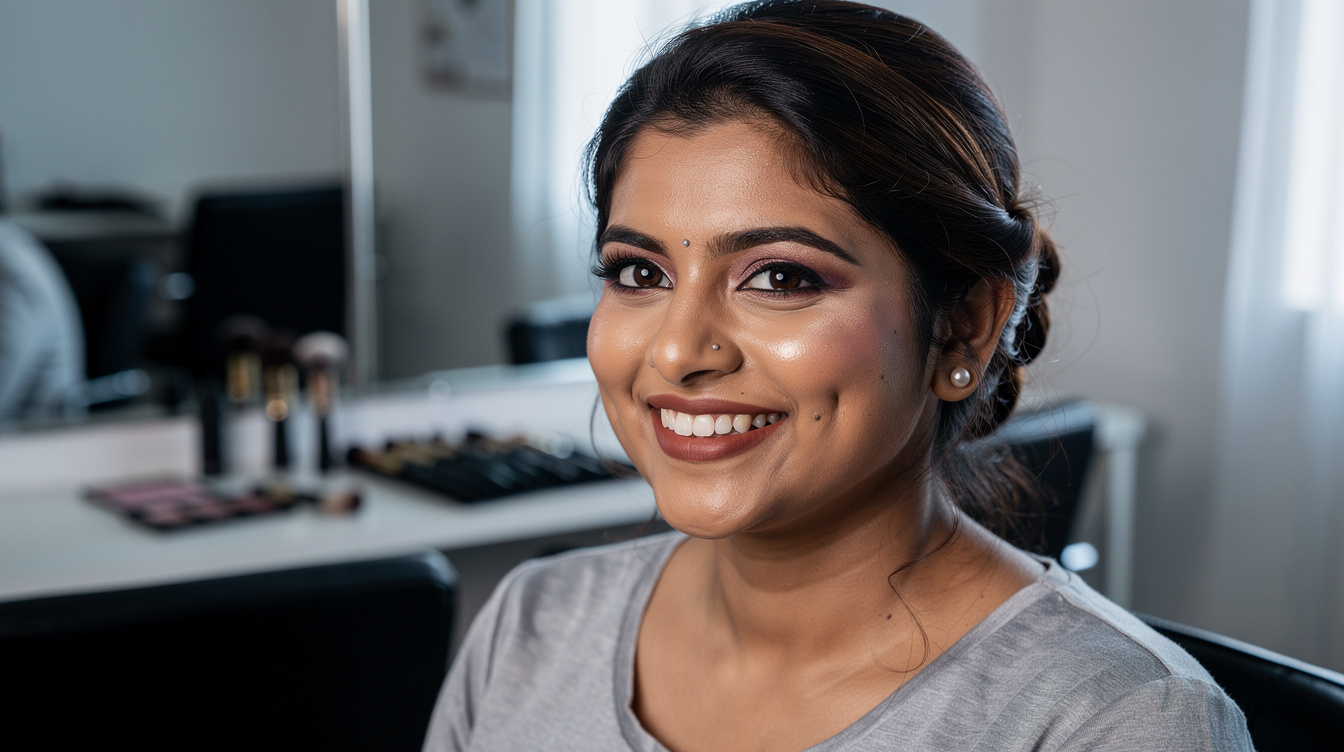
You finish the course. Certificate in hand, brush kit packed, portfolio shots edited — and then comes the question almost nobody is honest with you about: where do the brides actually come from? This is the gap most beginner artists fall into. The technique is solid. The Instagram grid looks clean. The phone, though, stays quiet for longer than they expected.
We have watched hundreds of students walk out of our 20-Day Professional Makeup Course at Sector 16 Huda Market, Faridabad, and the artists who built a real bridal clientele within their first year did not get there because they were technically the most gifted. They got there because they understood the booking pipeline before the course ended — not after. The first ten bookings are not a marketing problem. They are a sequencing problem.
This guide walks you through the realistic mix of channels that produce those first ten paid bookings, why your final-assessment shoot is the single most leverageable asset you leave the course with, why alumni networks quietly accelerate the curve in a way self-taught artists rarely catch up to, and how the lifetime support around the Basics to Advanced course we run in Faridabad is designed precisely for this transition.
Where your first 10 bookings actually come from
The honest answer is that your first ten bookings almost never come from cold Instagram traffic. They come from four warm circuits every working bridal artist in Delhi NCR uses, in roughly this order — referrals from people who already know you, photographer-driven cross-bookings, the WedMeGood and WeddingWire listings you set up in your first thirty days, and trial-priced sessions for friends-of-friends that you convert into portfolio-grade content.
Riya, the artist this article is written for, asked us a version of this question on WhatsApp last month. She had just finished a different short course in Delhi and her honest concern was the second of the two big enrolment fears we hear constantly: I won’t get clients after the course. The first being I’ll waste a lakh and learn nothing useful. Both are legitimate. We hear them from almost every prospective student who messages +91 9873048267 before signing up. The reason we built the curriculum the way we did is because both fears trace back to the same root cause — courses that teach makeup but never teach the booking pipeline.
So the first ten bookings, in real numbers: expect three to five from family and family-friends who want a small-function rate, two to three from a photographer who likes your portfolio shoot enough to recommend you to a budget-conscious bride, one or two from your initial WedMeGood inquiries (which take six to ten weeks to start humming), and one or two from a friend-of-a-friend trial that you quietly turn into your first three reels. That is the realistic shape. Anything more aggressive than that in your first six months is either an outlier or a paid-ads spend you do not yet need to be making.
The mistake we see most often is artists trying to skip the warm circuits and go straight to cold acquisition — running ads, buying followers, paying for shout-outs. None of it converts at the volume needed to justify the spend in year one. Warm circuits convert at six to ten times the rate of cold ones, and they cost nothing other than the time it takes to send a thoughtful WhatsApp message to twenty people in your existing network.
Instagram, WedMeGood, photographer collaborations — the realistic mix
Once your first ten bookings are out of the way, the channel mix matures into something more sustainable, and this is where artists either compound or stall. Instagram is the front-of-house, WedMeGood is the conversion engine, and photographer collaborations are the multiplier. None of the three works alone. Most struggling artists over-invest in one and ignore the other two.
Instagram for a bridal artist in 2026 is not a content-creator game. It is a portfolio-and-credibility game. You need fifteen to twenty grid posts that are technically clean — even lighting, no harsh phone-flash, the bride’s full look in three angles, and at least one close-up that shows skin texture rather than hiding it. Reels matter, but a single well-edited trial-to-final-look transition reel does more than thirty trend-chasing ones. We tell every alumna the same thing on the last day of the course: post the four looks from your final-assessment shoot, then stop posting until you have a real bride to feature. Empty content damages credibility faster than silence does.
WedMeGood and WeddingWire are where the actual budget conversations happen. Brides shortlisting on those platforms have already decided to spend, and they are filtering on price band, location, and review count. The single highest-leverage action a new artist can take is to populate the listing with twelve to fifteen real shoot images (your final-assessment shoot is enough to start), set the bridal-per-function rate at a realistic entry band, and respond to inquiries within two hours for the first ninety days. Brides notice response speed more than they notice price.
Photographer collaborations are the long game and they reward patience. The model is simple — you offer a styled shoot at a reduced rate, the photographer gets fresh portfolio content, and when the photographer is briefing a budget-tier bride who has not yet booked an MUA, your name comes up first. We routinely see students from our course in Faridabad cross-book through three or four photographers within their first year, and those cross-bookings tend to be the highest-margin work because there is no platform commission and no discount expectation baked into the conversation.
The product side matters too, even if it is rarely talked about in business terms. Brides ask which brands you use during their trial. Being able to speak fluently about MAC and NARS for base, Charlotte Tilbury and Laura Mercier for skin, Huda Beauty and Fenty Beauty for colour, Dior for finishing, and Haus Labs for the long-wear lip is part of credibility-building. We work with these brands during the course intentionally so that by the time you are taking real bookings, you can talk about them the way a working artist does — not the way a YouTube tutorial does.
How a final-assessment shoot kicks off your portfolio grid
The final-assessment shoot is the most under-appreciated asset in any serious makeup course. It is also why we built it into the 20-Day Professional Makeup Course as a non-negotiable closing component, not an optional add-on.
Here is what the shoot actually does for you, mechanically. You walk in on the assessment day with a real professional model, a styled set, and the brief to deliver a complete bridal look — base, eye, lip, hair coordination, drape coordination — under shoot conditions. The photographer captures the look in editorial frames. You leave that day with eight to twelve usable images that are colour-corrected, well-lit, and shot at a quality that takes most self-taught artists eighteen months to produce on their own.
Those images become the first row of your Instagram grid, the first listing photos on your WedMeGood profile, the cover image for the WhatsApp Business catalogue you send to inquiring brides, and the visual you attach to every cold pitch you send to a wedding planner. One shoot. Four to six months of marketing material. A measurable shortcut on the credibility curve.
This is the structural answer to the I won’t get clients after the course fear. Clients do not show up because you are certified. They show up because the visual evidence on your profile looks like the work of an artist who has already done a hundred brides. The final-assessment shoot is what closes that visual gap on day one. We use specially curated training products throughout the course so the looks you build during the shoot are the looks you will actually be able to recreate at a paid booking — there is no gap between the training kit and the working kit you carry to your first wedding.
Why alumni networks accelerate this curve
Most short-format courses end the day the certificate is handed out. The relationship is transactional, the WhatsApp group goes silent in three weeks, and the alumna is on her own. We have watched this pattern from the outside for years and deliberately built the opposite into our Basics to Advanced course — lifetime alumni support, not a closing handshake.
What that practically means is this. When an alumna gets her first inquiry from a destination bride and is unsure how to quote a Goa or Udaipur function, she messages us. When a photographer she met at an event asks if she can collaborate on a styled shoot the following month, she messages us. When her first bride books a trial and she wants a second pair of eyes on her workflow before the wedding day, she messages us. The network around the course is the safety rail that gets her through the first twelve months — the period in which most self-taught artists either quit or settle for low-margin work.
Alumni networks also accelerate booking velocity through internal referrals. A bride messages an artist who is fully booked on her wedding date — that artist passes the inquiry to a trusted alumna in the same network. This single mechanic, repeated across an active alumni circle, can produce two to four bookings a year for a new artist who has done nothing other than stay reachable on the alumni group. That is essentially free pipeline, and it only exists because the network exists.
There is a second, less obvious benefit. Working artists in an active network share rate cards, vendor contacts, photographer recommendations, and travel logistics for destination weddings. We have completed bridal work in Jaipur, Goa, Jim Corbett, Udaipur, Chandigarh, Kashmir, Sri Lanka and Canada, and the operational know-how from those trips — how to pack airbrush kits for international travel, how to brief a hotel on prep-room requirements, how to coordinate with local hairstylists — gets passed down through the network rather than being relearned by every new artist independently.
Sector 16 Faridabad — alumni access we provide for life
The studio sits at Booth No 70-71, First Floor, Sector 16 Huda Market, Faridabad. The 20-Day Professional Makeup Course runs 12 PM to 5 PM, with a strictly capped batch size of ten students per cohort. That cap is deliberate. Beyond ten, the hands-on time per student per day collapses, and the small-batch attention that produces actually-employable artists disappears.
Every student receives specially curated training products to use throughout the course (these stay with you for the duration), a professional brush kit that is yours to keep permanently, certification on completion, the final-assessment shoot with a professional model that we just covered, and lifetime alumni support — the access that keeps producing referrals long after the course is over. The curriculum covers HD Makeup, Airbrush, Glass Skin and Bridal Techniques alongside client handling and the business side of bookings, so you leave knowing both the craft and the pipeline.
The course is taught personally by Shivangi Verma, who has been operating in the Delhi NCR bridal market since 2012, has worked with over 1,000 brides, holds international training credentials from Makeup Studio in the Netherlands, and currently maintains a 5-star Google rating across 62 reviews. She does not delegate the teaching to junior artists. Every batch is led by her, every assessment shoot is supervised by her, and every alumna has direct WhatsApp access to her after the course. This matters for the question this article opened with — your first ten bookings are easier to land when the artist who taught you is still actively booking brides herself and can route real inquiries your way.
On pricing — the regular course fee is Rs. 1,50,000 + GST and the current early-bird rate for the next batch is Rs. 80,000 + GST, a Rs. 70,000 saving over the regular fee. The early-bird rate is a limited-time price tied to the launch batch and is not the standard rate going forward. If you are weighing the enrolment, the most efficient next step is to Fill the inquiry form or message us directly on WhatsApp at +91 9873048267 — we will walk you through batch dates, payment options, and what to bring on day one.
Frequently Asked Questions
How long does it realistically take to get bridal clients after a makeup course?
Expect your first paid booking within four to eight weeks of finishing the course if you actively work the channels — family circle, WedMeGood listing, two photographer outreach conversations a week. The first ten bookings typically take three to six months. Artists who treat the post-course period as a structured pipeline-build phase rather than waiting passively for inquiries see this curve compress meaningfully.
Will the 20-Day Professional Makeup Course really prepare me for a career?
Yes — and we have built it to be honest about exactly that. The course covers HD Makeup, Airbrush, Glass Skin, Bridal Techniques, client handling and the business side of bookings. With a ten-student batch cap, hands-on practice on live models throughout the course, a final-assessment shoot, and lifetime alumni support, the structure is designed to bridge the gap between knowing the technique and being ready to take a paying booking the week after you graduate.
Is the early-bird Rs. 80,000 + GST the standard course fee?
No. The regular fee is Rs. 1,50,000 + GST. The Rs. 80,000 + GST rate is a limited-time early-bird price for the upcoming launch batch — a Rs. 70,000 saving. After the early-bird window closes, the standard rate applies. If you want to lock in the early-bird price, message us on WhatsApp at +91 9873048267 to confirm seat availability.
Do I need prior makeup experience to enrol?
No. The course is structured Basics to Advanced, which means it starts from foundational skin prep and product theory and builds up to advanced bridal techniques over the 20-day intensive. Students from completely fresh backgrounds and students looking to upgrade existing skills both fit the format. The small ten-student batch means Shivangi can pace each student appropriately rather than teaching to a single mid-point.
What is included in the course fee beyond the teaching?
Specially curated training products to use throughout the 20 days, a professional brush kit that is yours to keep permanently, certification on completion, the final-assessment shoot with a professional model (which doubles as your starter portfolio), and lifetime alumni support — the WhatsApp-accessible network that produces internal referrals long after the course ends. The studio is at Sector 16 Huda Market, Faridabad, and class hours are 12 PM to 5 PM.
Can I message Shivangi directly with course questions before enrolling?
Yes — and we encourage it. Direct WhatsApp at +91 9873048267 reaches Shivangi or our academy coordinator. You can also use the academy inquiry form to request a callback. We would rather have a fifteen-minute honest conversation about whether the course is the right fit than have a student enrol uncertain about what they are signing up for.
20-Day Professional Makeup Course · Sector 16 Faridabad
Become a Professional Makeup Artist — Basics to Advanced
Hands-on training on real skin, only 10 students per batch, taught personally by Shivangi Verma — an active working bridal MUA with 14+ years and 1,000+ brides. Products, professional brush kit, certification and final assessment shoot all included.
Rs. 1,50,000 + GST → Early Bird: Rs. 80,000 + GST (save Rs. 70,000 — limited time)
💬 WhatsApp +91 9873048267 | Fill Inquiry Form | View Course Page →
Building a bridal clientele after a makeup course is not a marketing accident. It is a sequencing problem with known steps — set up your warm circuits before you finish the course, treat the final-assessment shoot as your portfolio launch event, plug into an active alumni network that keeps the pipeline humming, and stay reachable. The artists who do this in their first twelve months almost always cross the hundred-bride mark within their first three years. Those who skip the sequencing tend to plateau early and quietly leave the industry.
If you are weighing where to start, the most efficient single step is enrolling in a professional makeup course in Faridabad that explicitly builds the post-course pipeline into the curriculum — small batch, real shoot, lifetime alumni access, taught by a working bridal artist rather than a teacher who left the industry years ago. We have built the course around exactly that. Message us on WhatsApp at +91 9873048267 or fill the inquiry form to talk through the next batch.