
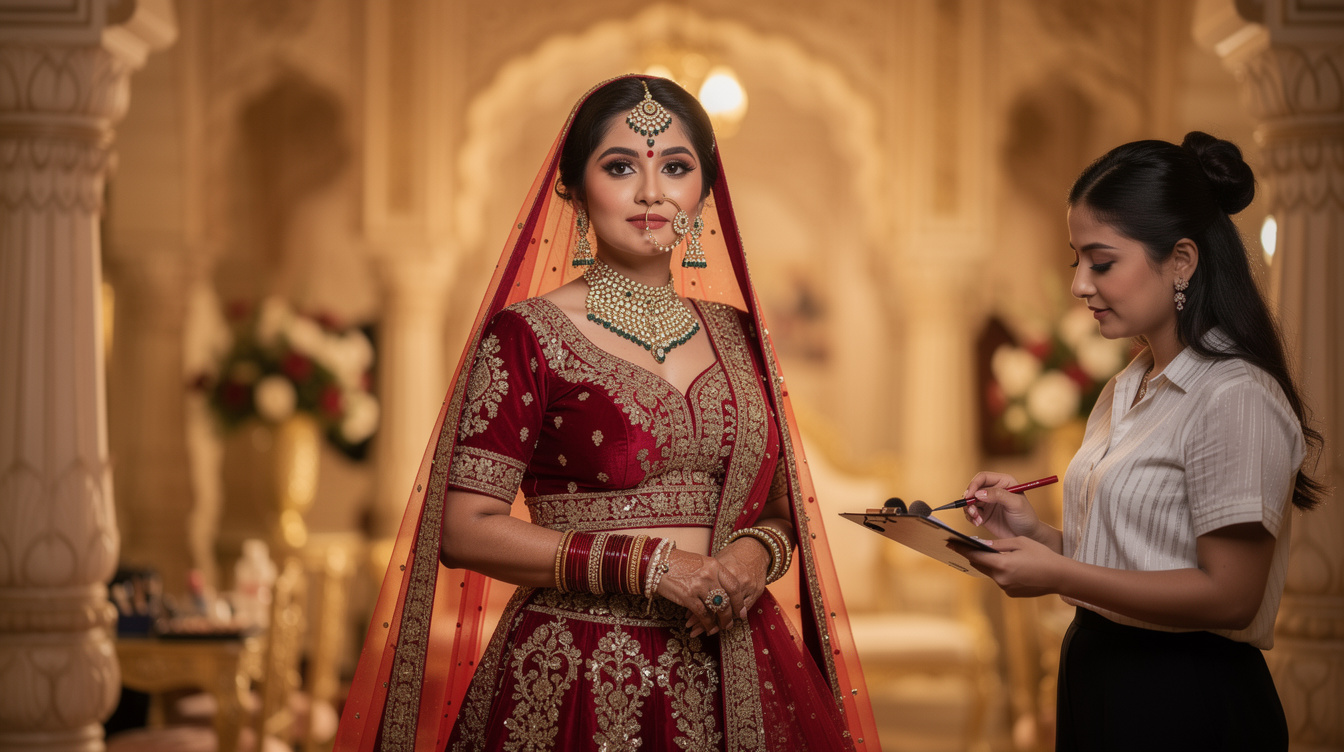
A makeup trial session is the single most undervalued hour in the bridal pipeline. Brides walk in with a Pinterest board, a slightly anxious mother, and three months of WhatsApp groups whispering opinions into their head. They walk out with a face — and, if we have done our job, with a decision. The trial is where the booking is actually won; the contract is just paperwork that follows. In this guide we are sharing how we run trials at our Sector 16 Faridabad studio, the pricing models that actually work in Delhi NCR in 2026, and the workflow we teach inside our 20-Day Professional Makeup Course.
If you are an aspiring artist reading this — Riya, this one is for you — most of what you have been told about trials online is half-true. “Always charge.” “Never charge.” “Adjust it against the final.” Each of those is right in some scenarios and disastrously wrong in others. The truth is that a trial is a sales meeting disguised as a creative session, and the rules of both apply. Students inside our Basics to Advanced course get to shadow real trials before they ever quote a paying client, which is the only way we have found to teach this skill honestly.
We have been operating since 2012 — that is 14+ years in the chair, more than 1,000 brides, and somewhere north of 2,000 individual trial sessions across Faridabad, Delhi, Gurgaon, Noida, and destination locations from Udaipur to Sri Lanka. The patterns we share below are not theoretical. They come from running them, getting them wrong, fixing them, and now teaching them inside the professional makeup course in Faridabad we conduct out of our Booth No 70-71 studio at Sector 16 Huda Market.
Why trials are the highest-leverage hour in the booking pipeline
Think about the funnel. A bride sees an Instagram reel, lands on a profile, scrolls 30 portfolio images, sends an inquiry, exchanges six WhatsApp messages, asks for a quote, asks for the quote again with the in-laws cc’d, and then — finally — books a trial. By the time she sits in your chair, she has invested attention, money, and emotion. She is closer to saying yes than at any other point in the journey. Statistically, in our own studio, the trial-to-booking conversion sits at around 78% when the trial is run properly, versus a flat ~30% close rate from inquiry-to-trial. That is the leverage.
What this means practically is that the trial is not a creative warm-up. It is a structured 90-minute experience where you are simultaneously evaluating skin, building rapport, demonstrating taste, calibrating expectations, and quietly closing the sale. If you treat it like a free demo where you “just do the makeup,” you will lose bookings to artists who are technically less skilled but more deliberate about the meeting itself.
This is also where one of the deepest fears among aspiring artists shows up — the fear of not getting clients after the course. Technique alone does not produce a booked-out calendar. Conversion does. Reading a bride’s anxieties does. Knowing when to stop talking and let the mirror do the work does. These are the things we drill repeatedly in our small-batch training, because no amount of YouTube tutorials will teach a 22-year-old how to sit across from a stressed mother-in-law and de-escalate a colour-temperature debate over the under-eye concealer.
Free vs paid vs adjusted-against-final pricing models
There are three pricing models in the Indian bridal market right now, and each one suits a different stage of an artist’s career. We have used all three at different points. Picking the wrong one for your career stage either costs you bookings or burns out your weekends.
Model 1 — Free trials (early-career, portfolio-building stage)
If you are within your first 12 months of taking paid work and your Instagram has fewer than ~50 portfolio images, free trials are a defensible strategy. You are exchanging an hour and your products for two assets — a real face on your grid and a chance at a wedding-package booking. The risk is obvious: tyre-kickers. Brides who book free trials with five different artists and then ghost. Mitigate this with a soft qualifier — ask for the wedding date, venue, function count, and a 25% non-refundable deposit if they confirm within 7 days of the trial. The deposit is the filter, not the fee.
Model 2 — Fully paid trials (established, high-demand stage)
Once your trial calendar is genuinely competing with your bridal calendar, charging a full trial fee is non-negotiable. Our own trial fee at the Faridabad studio sits in the same range as a party makeup booking — around Rs. 8,000 — because the chair time, product cost, and opportunity cost are real. A paid trial filters out non-serious leads instantly, and it psychologically anchors the bride to the value of your time. Brides who pay for trials show up on time, communicate clearly, and convert at materially higher rates. We have run the data internally — paid trials convert at over 80% versus our blended 78%.
Model 3 — Adjusted against the final invoice (the hybrid most pros land on)
This is the model we recommend most frequently for working bridal MUAs in Delhi NCR. The bride pays the trial fee upfront — say Rs. 8,000 — and that amount is deducted from her bridal package if she books within 14 days of the trial. If she does not book, the fee is retained as the trial price. This gives you the cash-flow protection of a paid trial, the psychological commitment of money exchanged, and a soft incentive to convert before the booking window expires. Combine it with transparent package PDFs, a written quote valid for 14 days, and you have a clean, professional sales close that does not feel pushy.
One more pricing note that we drill into students: never quote the trial fee in isolation. Always quote it inside the context of the full package. “The trial is Rs. 8,000, adjusted against your bridal day fee of Rs. 28,000” sounds like a discount. “The trial is Rs. 8,000” sounds like an expense. Same number, completely different emotional response.
What to actually do in a 90-minute trial
A trial is not 90 minutes of makeup. It is roughly 15 minutes of consultation, 60 minutes of application, and 15 minutes of mirror work, photography and discussion. The artists who treat the consultation as optional, or the closing 15 minutes as a casual goodbye, are the ones losing bookings to slower technicians who run the meeting properly.
Minutes 0–15 — The consultation
Have her sit, not stand. Offer water. Pull up her Pinterest board on your iPad and three to five reference images from your own portfolio that match her brief. Ask: what is she most nervous about? Skin texture, her nose, her eyes looking smaller in photographs, the lehenga colour clashing with her undertone? Brides almost always have a single private fear that they have not articulated even to their fiancé. Your job in the first 15 minutes is to surface it. Then validate it — “We understand, this is your biggest day” — and walk her through exactly which technique you are going to use to address it. This is the moment that builds trust.
Minutes 15–75 — The application
Work in the order you would on the wedding day, not faster. The trial must replicate the actual workflow because you are also testing how her skin behaves with your products under your studio lights. We use a stable rotation of MAC, NARS, Dior, Huda Beauty, Fenty Beauty, Laura Mercier, Haus Labs and Charlotte Tilbury — chosen by skin type, not by trend — and we keep the products visible on the station so she sees the quality. Talk while you work, but talk less than you think. Brides find compulsive narration nerve-wracking. Explain each major step in one or two sentences, then go quiet and let your hands do the work.
Critical detail — show her the look in stages. After base, pause. After eyes, pause. Hold up the mirror. Ask one focused question: “Does the base feel like skin to you?” “Are the eyes the depth you wanted?” Small mid-application checkpoints prevent the catastrophic moment where the look is fully done and the bride says, in a small voice, that she actually wanted something different. By the time the final lip is sealed, every major decision should already have been mutually approved.
Minutes 75–90 — Mirror, photography, close
Hand her a hand mirror first, then walk her to a full-length one. Photograph her with and without flash. Send her a few well-lit images on WhatsApp before she leaves — this is the single biggest reason brides come home and convince family members to lock the booking. Then, calmly, present the package quote. Do not say “so, what do you think?” Say “based on today’s trial, here is the package we would build for you — would you like us to hold the dates?” The phrasing is deliberate. “Hold the dates” is a low-friction yes that converts at almost double the rate of “book now”.
Trial photography — what you must capture
Trial photography is doing two jobs at once — it is closing this bride, and it is feeding your future bookings. Skip it and you lose both. Treat it as a non-negotiable part of the workflow.
For the bride, capture: a clean front-facing portrait against a neutral wall, a 3/4 angle on each side, a tight close-up of the eye work, a profile shot showing the lip and contour, and one full-flash shot to test for any flashback. The flash test is critical — it is the single most reliable way to catch SPF flashback or mineral powder issues before the wedding day. If anything ghosts white in the flash image, you have a product problem to fix in the wedding kit, not on the wedding morning.
For your portfolio, ask permission separately — never assume. We send a one-line WhatsApp consent before posting: “Beautiful trial today — would you be okay with us featuring two of these images on our Instagram once the wedding is over?” Most brides say yes. Some ask you to wait until after the wedding, which is reasonable. A small percentage decline, which is also reasonable. Respecting that boundary is part of running a professional studio, not an obstacle to it.
Equipment-wise, you do not need a DSLR. A current iPhone with the studio’s ring light and a neutral grey wall produces images that work for both client communication and Instagram. What you do need is consistency — same wall, same light, same distance — so your trial gallery looks like a single body of work and not a chaotic mosaic. This is exactly the kind of small operational discipline that we walk students through during the assessment shoot at the end of Shivangi Verma’s makeup course, because it is the kind of thing nobody tells you and everybody is judged on.
How the 20-Day Course covers trial workflow
One of the most common questions we hear from prospective students is whether the course will actually prepare them for real-world client work, or whether they will spend a lakh on theory and leave with no booked weddings. This is a fair fear, and we treat it seriously. Inside the 20-Day Professional Makeup Course we run from 12 PM to 5 PM at our Sector 16 Huda Market studio in Faridabad, trial workflow is woven into the curriculum at multiple levels — not as a separate module, but as a recurring thread across HD Makeup, Airbrush, Glass Skin and Bridal Techniques, plus client handling and business skills.
Students practise on real models every session. They observe live trials we conduct with paying clients (with consent). They sit in on the consultation phase, watch the application progress through the mirror checkpoints, and then debrief the close once the bride has left. By the final assessment shoot — conducted with a professional model — every student has been through this loop multiple times and has the muscle memory to run their own trial without freezing.
Batch size is capped at 10 students. This is a deliberate constraint, not a marketing line. Above ten, the chair time per student per day collapses, and trial workflow is exactly the kind of skill that needs repetition under supervision. Specially curated training products are yours during the course, you take a professional brush kit home to keep, and certification on completion is followed by lifetime alumni support — which in practice means you can WhatsApp Shivangi for help when your first paid bride ghosts on you, or your second one wants a look you have never tried, or your tenth one’s mother-in-law decides at 6 AM that the lipstick is wrong. We answer.
The trainer is Shivangi Verma — 14+ years in the industry, 1,000+ brides served, certified from Makeup Studio in the Netherlands, an active working bridal MUA carrying a 5-star Google rating across 62+ reviews. She personally teaches every batch, and she still personally leads every bridal appointment at the studio. This matters because the trial techniques being taught are the same techniques being run, that week, on real paying brides — not a frozen syllabus from five years ago. To enrol, you can WhatsApp +91 9873048267 directly, or Fill the inquiry form and our team will reach out with batch dates and the structured payment options.
20-Day Professional Makeup Course · Sector 16 Faridabad
Become a Professional Makeup Artist — Basics to Advanced
Hands-on training on real skin, only 10 students per batch, taught personally by Shivangi Verma — an active working bridal MUA with 14+ years and 1,000+ brides. Products, professional brush kit, certification and final assessment shoot all included.
Rs. 1,50,000 + GST → Early Bird: Rs. 80,000 + GST (save Rs. 70,000 — limited time)
💬 WhatsApp +91 9873048267 | Fill Inquiry Form | View Course Page →
FAQ
How do I know the trial will match the wedding day look?
The trial is conducted in the exact workflow, with the exact products, that your wedding-day kit will use — same primer, same base, same setting routine. We photograph the trial under both natural light and full flash so you see how the look behaves on camera. Mid-application checkpoints mean every major decision is approved before the look is sealed, so there are no surprises on the day.
Should I charge for makeup trials as a new artist?
For your first 12 months, free trials with a non-refundable booking deposit are defensible as a portfolio-building strategy. Once your calendar is genuinely full, switch to fully paid or adjusted-against-final pricing. Charging too early can stall lead flow; charging too late burns out your weekends and devalues your time.
Will the 20-Day course really prepare me for a career?
The course is intensive full-time training over 20 days, 12 PM to 5 PM, capped at 10 students. You work on real models every session, build a portfolio, complete a final assessment shoot with a professional model, and receive lifetime alumni support afterwards. It covers technique, client handling, pricing and business setup — not just makeup application — which is what determines whether you actually book clients after certification.
What does a typical bridal trial cost in Delhi NCR in 2026?
Trial fees in Delhi NCR currently range from free (early-career artists building portfolios) to Rs. 8,000–15,000 (established bridal MUAs). Most working professionals charge Rs. 8,000 and adjust the fee against the final bridal package if the bride books within 14 days. Always quote the trial fee inside the package context, never in isolation.
What if I don’t like my makeup at the trial?
A well-run trial is structured around mid-application checkpoints — base, eyes, lips — where the artist pauses and asks for your feedback before sealing each stage. If something feels wrong, say so at the checkpoint, not at the end. Most professional studios will adjust on the spot. If a look truly does not work for you, that is exactly what the trial is for — you have not committed to the wedding-day booking yet, and you have surfaced the mismatch with eight weeks to spare.
Where is the studio and how do I book a trial?
Our studio is at Booth No 70-71, First Floor, Sector 16 Huda Market, Faridabad, Haryana 121002. To book a trial — whether for your own wedding or to enrol in the academy — WhatsApp +91 9873048267 or use the inquiry form on our website. We respond within working hours and confirm dates in a single thread, so you are not chasing replies.
Trials are not a creative formality. They are the booking. Run them with structure, photograph them properly, price them honestly, and they will carry your career. If you want to learn this workflow under supervision rather than learning it expensively on real paying brides, the 20-Day Professional Makeup Course at our Faridabad studio is built precisely for that — and the early-bird intake is open right now.