
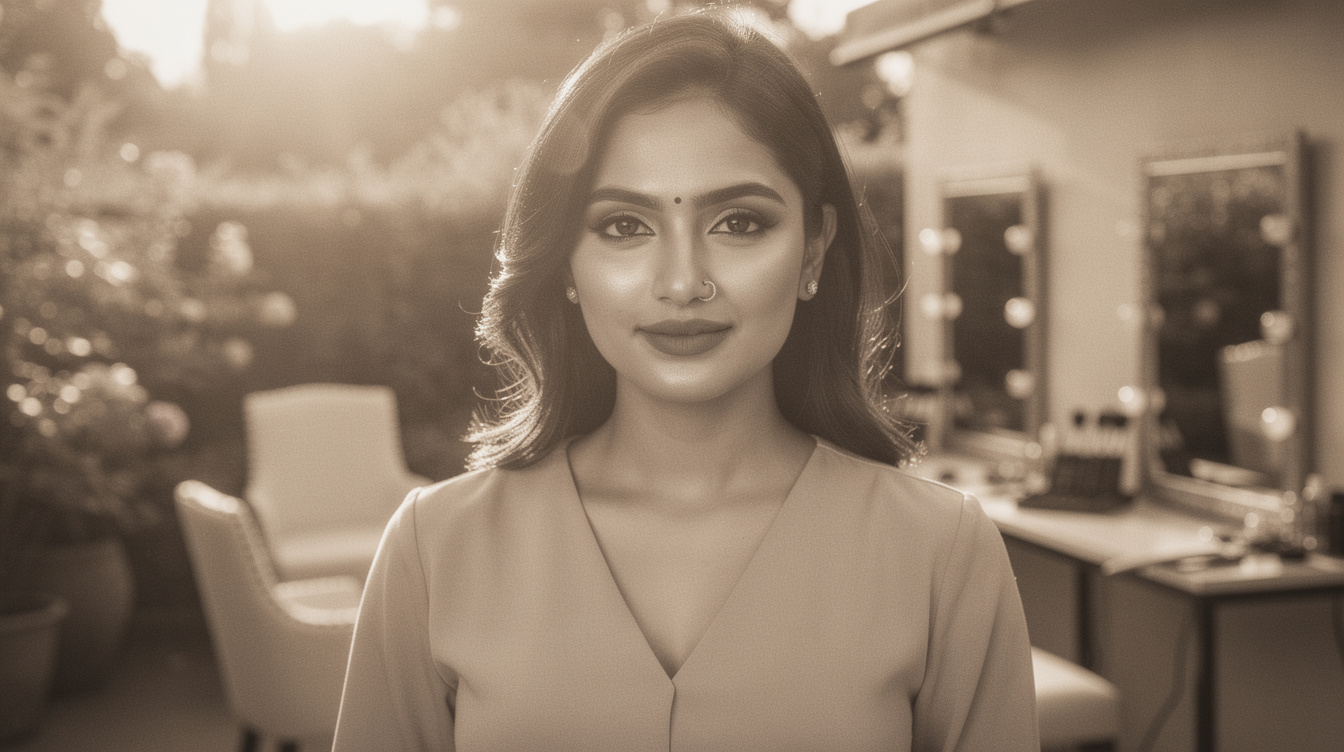
Every aspiring makeup artist who walks into our Sector 16 studio in Faridabad eventually asks the same quiet question: should I enrol with a global brand academy like MAC, or with a private boutique academy run by an active working artist? It is a fair question, and one we answer honestly several times a week. The names on the door are different, the price tags are different, and most importantly the kind of artist you become at the end of the course is different. In 2026, with the Indian bridal market more crowded and discerning than ever, the answer matters more than it used to.
This is not a takedown of MAC, and it is not a sales pitch. We use MAC products in our kits — alongside NARS, Dior, Huda Beauty, Fenty Beauty, Laura Mercier, Haus Labs and Charlotte Tilbury — because they earn their place on real bridal skin. What we want to give you in this guide is the unvarnished comparison: what the MAC pro academy in India actually delivers, what a private academy like ours offers differently, and where our 20-Day Professional Makeup Course sits in that landscape. By the end you should be able to make the choice with your eyes open.
We will be specific where it counts — fees, batch size, hours, what is included, who is actually in the room teaching you. We will also surface the fears we hear most often from students like Riya, the aspiring MUA who reads ten reviews before booking a single trial. If by the third paragraph you already feel ready to talk, you can WhatsApp us on +91 9873048267. Otherwise, read on.
What MAC Academy actually delivers (curriculum + format)
The MAC pro academy in India is, at its core, a brand academy. Its primary mandate is to train artists in the MAC product language — colour theory through MAC’s lens, application techniques optimised for MAC formulas, and the editorial-meets-counter aesthetic that built the brand. Courses are typically structured in tiered modules: a foundational programme that covers basic skin prep, eyes, lips and full face; intermediate work on bridal, party and HD; and advanced or specialist modules on editorial, fantasy, airbrush or character makeup depending on the city and intake.
Format-wise you are usually looking at a classroom-style cohort with a fixed syllabus, a rotating roster of trainers (some of whom are senior MAC artists, others external), and a tight schedule that hits every chapter on the timetable whether or not the room has fully absorbed the previous one. Batch sizes are larger than a private academy — often fifteen to twenty-five students per intake — because the economics of a brand-funded school require scale. Practice models are organised, but the hours of one-to-one feedback per student are inevitably diluted.
The genuine strengths are real. The certificate carries weight at retail counters and with brand-aligned employers. The product education is excellent — you leave fluent in foundation undertones, pigment payoff, and the technical side of editorial makeup. For students whose career goal is to work behind a department-store counter, in a brand training role, or in print and runway editorial, that fluency matters. The sticker on the certificate opens specific doors, and we will not pretend otherwise.
The honest limits are also real. Brand academies teach the brand. They are not designed, and were never designed, to walk you through the messy business of running a bridal practice in Delhi NCR — pricing your first ten weddings, handling a nervous mother of the bride, building a portfolio that converts WedMeGood inquiries into bookings, or surviving a destination shoot in Goa where the humidity eats half your prep work. That kind of training sits outside the syllabus.
What private boutique academies offer differently
A private academy — and we mean a genuine boutique one, run by a working artist rather than a franchised storefront — operates on inverse logic. The teacher is not a brand ambassador on a payroll. They are an active practitioner whose income still depends on bridal bookings, which means everything they teach is filtered through the question: does this work on a real bride at 5 a.m. in a hotel room in Udaipur? That filter is invisible to outsiders, but it shapes every minute of every session.
Batch sizes are deliberately small — at our Sector 16 Huda Market studio in Faridabad we cap our Basics to Advanced course at ten students per batch. That is not a marketing flourish; it is the maximum number where Shivangi can still personally walk between every chair, correct your hand, redo a wing on your model’s eye, and pull you aside when your blush placement is fighting your highlight. Beyond ten, the format quietly becomes a lecture, and lectures do not make makeup artists.
The curriculum at a serious boutique academy is brand-agnostic. We teach skin prep that works whether you reach for Laura Mercier, Charlotte Tilbury or a drugstore primer. We teach HD Makeup, Airbrush, Glass Skin and Bridal Techniques as techniques, not as product demos. Students leave able to evaluate any new launch — Haus Labs, Fenty, the next viral release — on technical merit rather than on hype. They also leave with a practical understanding of client handling and business skills: how to take a brief, how to price a function, how to manage timing on the wedding morning, how to recover when a bride changes her mind about her lip colour at 6.30 a.m.
The trade-off is that you do not get a globally franchised certificate. You get a certificate from the artist whose work and reviews you can verify directly — in our case, 1,000+ brides served, 62 Google reviews at a 5-star rating, a 5.0 WedMeGood rating across 26+ reviews, international training from Makeup Studio Netherlands, and a portfolio shot on real Indian skin in real lighting. For a student whose end goal is to be the booked-out bridal artist, that paper carries the weight that matters: the weight of a working practice you can shadow.
Brand prestige vs hands-on hours — the real trade-off
Strip the comparison down and you arrive at the only metric that genuinely predicts career outcome in the first two years after graduation: how many hours did your hands actually spend on real skin, with a working artist correcting you in real time? Brand prestige is a one-time gift. Hands-on hours compound forever.
Consider the maths. A standard MAC foundational course runs roughly four to six weeks part-time, with classroom theory eating a meaningful share of the timetable and live model sessions distributed across larger cohorts. Net hands-on time per student — meaning your brush, on a real face, with a senior artist watching — typically lands somewhere in the forty to seventy hour band depending on the intake size. That is not nothing. It is also not enough on its own to walk into a destination bridal call and deliver.
Our 20-Day Professional Course runs five hours a day, 12 PM to 5 PM, six days a week, with live models from day one. Even after subtracting reasonable demo and debrief time, every student leaves with well over seventy net hands-on hours and — crucially — those hours happen in a ten-student batch with one principal trainer rather than diluted across a larger cohort. The contact density is what builds confidence. By the time of the final assessment shoot with a professional model, students are not nervously dabbing — they are working.
Prestige still has its place. If your career plan is brand work, retail leadership, or editorial print where the certificate is the entry ticket, the brand academy route is rational. If your plan is to become a booked-out bridal MUA in Delhi NCR or anywhere in India, hands-on hours under an active working artist will outperform a logo on a certificate every single time. We have seen graduates from both routes walk into our studio for advanced workshops, and the gap is almost always the same: the brand-academy graduate knows the products beautifully but freezes when the bride says I changed my mind about the lip.
Where the 20-Day Professional Course at Sector 16 fits
Our professional makeup course in Faridabad sits squarely in the boutique tradition with one important addition: the trainer is the practice. Shivangi Verma has been actively working in the industry since 2012 — that is 14+ years of bridal seasons, 1,000+ brides, and an unbroken booking calendar. She is certified from Makeup Studio Netherlands, holds a diploma and certification in makeup artistry, and personally leads every batch. There is no junior teacher fronting the room while she handles weddings on the side. The teacher and the working artist are the same person, which is the only configuration that lets students see how a real bridal day is actually run.
The structure is twenty days, 12 PM to 5 PM, at Booth No 70-71, First Floor, Sector 16 Huda Market, Faridabad. Batches are capped at ten. Students receive specially curated training products — yours to use throughout the course — and a professional brush kit that is yours to keep. Certification on completion. A final assessment shoot with a professional model so you walk out with portfolio assets, not just a certificate. Lifetime alumni support, because the questions do not stop on graduation day; they multiply when you take your first booking.
On pricing, we want to be transparent because we hear the fear about wasted fees in almost every consultation. The course is regularly priced at Rs. 1,50,000 + GST. We are currently running an early-bird rate of Rs. 80,000 + GST — a saving of Rs. 70,000, available for a limited intake window. We are not framing the early-bird as the standard price; it is exactly what it says, an early-bird. If you are reading this in time to use it, use it. If you would like to talk it through before committing, please Fill the inquiry form or message us directly on WhatsApp +91 9873048267.
What is deliberately not on offer is a literal day-by-day curriculum on a public page. We hold that detail back because it is genuinely tailored — Shivangi adjusts the weekly arc based on each batch’s pace, and we want students to inquire so we can have a real conversation rather than promise a rigid syllabus that we then have to honour past the point of usefulness. What we will commit to publicly is the spine: HD Makeup, Airbrush, Glass Skin and Bridal Techniques; client handling and business skills; portfolio building; and the final assessment shoot. Within that, the rhythm is set in the room.
Decision framework for prospective students
If you are still weighing the two routes, here is the honest framework we walk students through over a consultation call. It is not a scoring sheet; it is a sequence of questions that, answered truthfully, almost always points to the right choice on its own.
What does your career actually look like in three years? If you picture yourself behind a counter at a flagship store, in a brand training role, or assisting on editorial print where the brand certificate is part of the cover letter, the prestige route is rational. If you picture yourself with your own studio, your own bridal calendar, your own WedMeGood listing, the boutique-with-a-working-artist route compounds harder.
How much hands-on time do you genuinely need before you trust your own hands? Most students underestimate this. If you are a complete beginner, the small-batch, full-time, every-day-on-real-skin format is not a luxury — it is the difference between a graduate who books and a graduate who hesitates. Riya, the aspiring artist this article is written for, almost always falls into this group whether or not she admits it on the first call.
Who is actually in the room with you? Ask before enrolling, anywhere. Find out, by name, who teaches the bridal sessions, how many real brides they did last season, and whether you can see their current work. A teacher who is also a working artist will answer this question in two sentences. A teacher who is not will hedge.
What is included in the fee, and what is extra? The headline number is the start of the conversation, not the end. With our 20-Day Professional Course, the fee covers products during training, the brush kit you keep, certification, the final shoot and lifetime alumni support. There are no hidden module upgrades. With brand academies, ask carefully about kit costs, advanced module add-ons, and exam fees, because the headline price is not always the full price.
And finally — the fear nobody says out loud. The fear we hear most often is, I will spend a lakh and learn nothing useful. That fear is rational and we treat it with respect. Our answer is structural, not rhetorical: live models from day one, premium products provided during training, Shivangi personally teaching every batch, a final shoot for portfolio, and an alumni network you stay in for life. We do not promise overnight bookings, because no honest academy can. We promise that the hours you spend in our room are hours that translate.
20-Day Professional Makeup Course · Sector 16 Faridabad
Become a Professional Makeup Artist — Basics to Advanced
Hands-on training on real skin, only 10 students per batch, taught personally by Shivangi Verma — an active working bridal MUA with 14+ years and 1,000+ brides. Products, professional brush kit, certification and final assessment shoot all included.
Rs. 1,50,000 + GST → Early Bird: Rs. 80,000 + GST (save Rs. 70,000 — limited time)
💬 WhatsApp +91 9873048267 | Fill Inquiry Form | View Course Page →
Frequently Asked Questions
Is a MAC academy certificate more valuable than a private academy certificate in India?
It depends entirely on the career you are building. For brand-aligned roles — retail leadership, brand training, certain editorial print contexts — a MAC pro academy India certificate carries specific weight. For a working bridal practice in Delhi NCR or anywhere in India, what carries weight is your portfolio, your reviews and the working artist who trained you. A certificate from an active MUA with 1,000+ brides and verifiable 5-star reviews is, in that lane, more bookable than a brand certificate.
Will a 20-day course really prepare me for a professional makeup career?
Yes, when the format is full-time, small-batch and taught by a working artist. Twenty days at five hours per day, on real models, in a ten-student batch, is roughly a hundred hours of supervised hands-on practice plus business and client-handling training. That is more contact density than most longer part-time programmes deliver, and it is enough to start taking entry-level bridal and party bookings with confidence. The alumni support afterwards is what carries you through the first year.
I’m afraid of spending Rs. 80,000 and learning nothing useful — how do I de-risk that?
This is the most common fear we hear and we take it seriously. Three concrete things de-risk it. One, ask to speak with Shivangi directly before enrolling — a real conversation tells you everything a brochure cannot. Two, verify the trainer’s working practice independently: 62 Google reviews, 5-star rating, WedMeGood 5.0 across 26+ reviews, 1,000+ brides served, are all checkable. Three, look at what is included — products during training, brush kit you keep, certification, final assessment shoot, lifetime alumni support — and confirm there are no hidden add-ons. If those three boxes tick, the fee is buying real outcomes.
Will I actually get clients after the course, or is the market too saturated?
The market for average makeup artists is saturated. The market for technically strong, business-literate artists with a real portfolio is not. Our course intentionally bundles technique with client management, pricing, and business setup, because the bottleneck for most graduates is not skill — it is converting inquiries into paid bookings. The final assessment shoot gives you portfolio assets that work on Instagram and WedMeGood from day one. We also stay in touch through alumni support, which is where most early-career questions actually get answered.
Who teaches the course at the Sector 16 Faridabad academy?
Shivangi Verma teaches every batch personally. She is not a figurehead trainer who appears on opening day and disappears. She has been actively working since 2012, has served 1,000+ brides, is internationally trained at Makeup Studio Netherlands, and continues to take bridal bookings while teaching — which is exactly why the training stays current. The studio is at Booth No 70-71, First Floor, Sector 16 Huda Market, Faridabad. You can reach her on WhatsApp at +91 9873048267.
What is included in the Rs. 80,000 + GST early-bird fee?
The early-bird fee — against the regular Rs. 1,50,000 + GST — covers the full twenty-day course, specially curated training products that are yours to use throughout, a professional brush kit that is yours to keep, certification on completion, the final assessment shoot with a professional model, and lifetime alumni support. There are no hidden module upgrades or exam fees. The only cost outside the fee is your travel to and from the Sector 16 Huda Market studio.
If you have read this far, the chances are good that the boutique route is the right one for you and you have a few specific questions left. The fastest way to get them answered is to message us on WhatsApp +91 9873048267 or to enrol directly through Shivangi Verma’s makeup course page. The June 1 batch is filling. We would rather have ten students who chose us with their eyes open than fifteen who enrolled on impulse.