
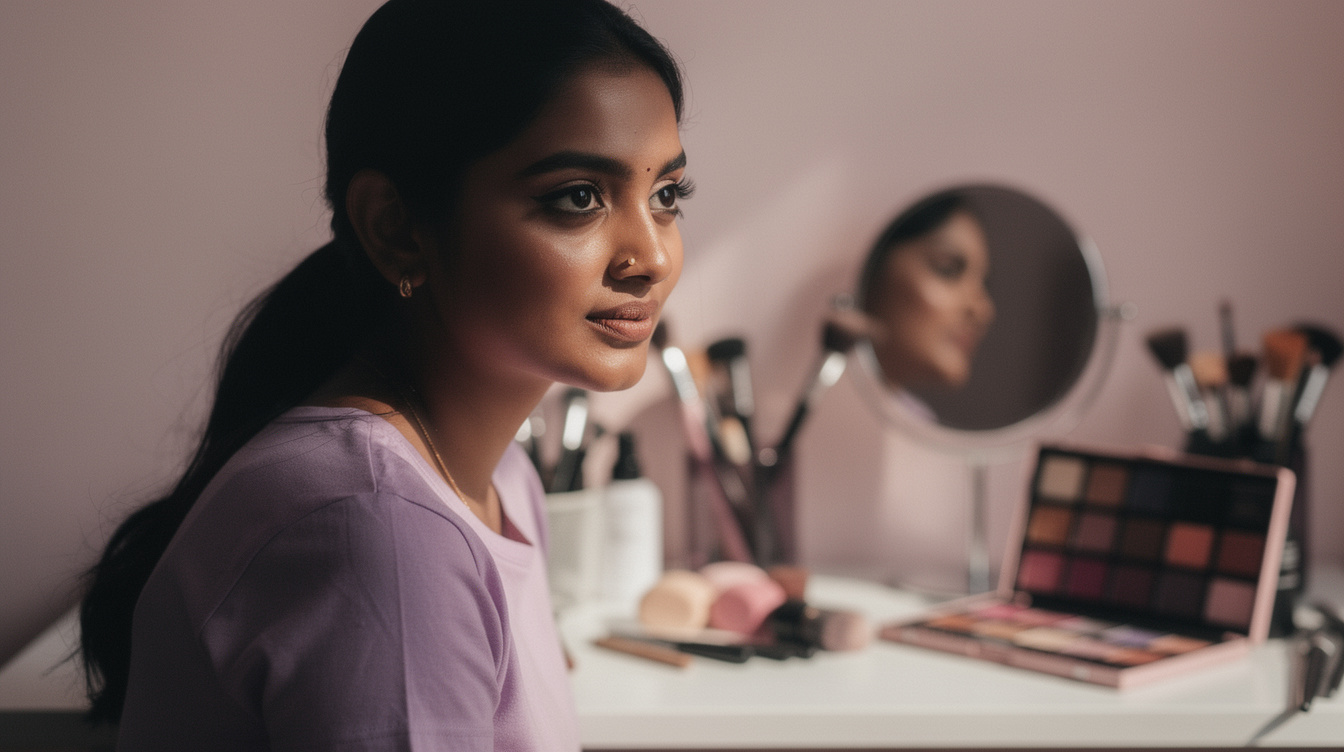
Every June, when our new batch arrives at Sector 16 Huda Market in Faridabad, the same question lands in our WhatsApp inbox a dozen times the week before Day 1: what am I actually supposed to bring? It’s a fair question, and a surprisingly loaded one. Some academies expect you to walk in with a kit worth more than the tuition. Others provide everything and you simply show up. Most sit somewhere in between, and the gap between what they say is provided and what you’ll actually need to buy in the first 48 hours is where new students get blindsided.
This guide is the one we wish someone had written for us when we started out. It’s specifically built around our 20-Day Professional Makeup Course, but the principles travel — whether you’re enrolling with us in Faridabad or anywhere across Delhi NCR. We’ll walk you through what serious academies require, what we provide as part of the course fee, the personal hygiene items that are genuinely non-negotiable, and the one or two things you’d be surprised to learn matter more than another foundation tube.
One thing to set straight before we begin: we run a small batch of only 10 students at a time precisely so we can be honest with each of you about exactly what you need. If you’re considering our Basics to Advanced course and want a personal walkthrough of the supply list before enrolling, drop us a message on WhatsApp at +91 9873048267 and we’ll talk you through it. No checklist on the internet replaces a five-minute conversation about your specific situation.
What different academies actually require students to bring
Walk into any ten makeup academies and you’ll get ten different supply lists. We’ve spent years observing the patterns, and broadly there are three models in the Indian makeup-education market — and understanding which one you’ve enrolled in is the difference between a smooth first day and a frantic late-night trip to a market.
Model one — the bring-your-own-kit academy. You enrol, you pay tuition, and then you receive a five-page list of brushes, brands and products to procure before Day 1. The list often runs to forty or fifty items: MAC foundations across multiple shades, NARS blushes in named colours, Laura Mercier translucent powder, a Charlotte Tilbury setting spray, brushes from specific brand families, sponges, palettes, disposables. The shopping bill alone can cross seventy or eighty thousand rupees, and that’s before you’ve factored in the tuition. The argument for this model is that you end the course owning a working professional kit. The argument against it is that complete beginners are asked to make purchasing decisions about products they have never used, in shade ranges they cannot yet judge.
Model two — the bare-essentials academy. The academy provides a basic shared kit that students rotate through, and you are expected to bring only personal-use items: a smock or apron, sanitisation supplies, a notebook, and perhaps your own brushes if you have them. These courses are usually budget-friendly, but the trade-off is that you rarely get to work with premium-tier products during training. When you graduate and start booking clients, you discover that the products you actually need to buy — a Huda Beauty foundation here, a Fenty Beauty contour stick there, a Dior backstage palette — feel completely unfamiliar in your hands because you never touched them in class.
Model three — the curated-provision academy. This is the model we built our course around. The academy provides a thoughtfully curated set of premium training products for you to use throughout the course — so every student works with the same calibre of foundations, palettes, contour kits, lashes and setting sprays. You don’t have to gamble on shade purchases. You don’t have to second-guess whether a brand-name palette is worth the spend. You arrive with personal-use items, hygiene supplies, a notebook and the right mindset; we hand you the tools and the techniques. At the end, you walk away with a professional brush kit that’s yours to keep, a portfolio shoot, a certification, and the confidence of having actually used the products you’ll buy when you start booking your own clients.
None of these models is universally wrong. But if you’re enrolling for the first time and you’re worried — and we hear this fear from students every single batch — about whether you’ll waste a significant fee on a course that doesn’t translate into real-world skills, the curated-provision model is the lowest-risk choice. You’re not gambling on a kit you don’t know how to use yet. You’re spending your money on instruction, materials, mentorship, and a piece of paper that means something — not on a shopping list.
What our 20-Day Course provides vs what you arrive with
Let’s get specific. Our 20-Day Professional Makeup Course runs from 12 PM to 5 PM at Sector 16 Huda Market in Faridabad, with a capped batch size of just 10 students. The class fee is currently Rs. 1,50,000 + GST at the regular rate, and Rs. 80,000 + GST on our limited-time early-bird rate — a saving of Rs. 70,000 for the next intake. That fee is structured so that the most expensive and most frequently used items are already part of what you’re paying for. You don’t pay it and then pay again at a beauty supplier.
What we provide as part of your course fee:
You receive a specially curated set of training products to work with for the entire duration of the course — foundations across multiple shade families, contour and highlight palettes, eyeshadow palettes, blushes, setting sprays, primers, lashes, lip products, and the consumables you need every day. These are yours to use during the course, on every live-model session, every drill, and every assessment. Premium-tier products from the kind of houses that fill working bridal kits in this country — MAC, NARS, Huda Beauty, Fenty Beauty, Laura Mercier, Haus Labs and Charlotte Tilbury show up across the curated set so you train your eye on the textures and undertones you’ll actually be reaching for as a professional.
You also receive a professional brush kit that is yours to keep at the end. This is genuinely the single most important physical item you’ll walk away with — quality brushes are what separates a good blend from a streaky one, and most students underestimate how many years of service a properly maintained brush set delivers. The kit covers face, eyes, lips, contour and detail work in the configurations you’ll use day to day.
Beyond the physical kit, the course fee also covers your certification on completion, a final assessment shoot with a professional model — which becomes the first real portfolio piece you can show prospective clients — and lifetime alumni support. The alumni support is something students often dismiss until they’re three months out, sitting on their first paid booking and panicking about a foundation oxidising. Knowing you can WhatsApp your trainer for a second opinion changes everything.
What you arrive with on Day 1:
Personal hygiene supplies, your own notebook, a camera or smartphone capable of taking decent photos, comfortable closed shoes, a hair tie or band, and the willingness to work on live models from the first week. That’s the short version. The full breakdown follows in the next sections — and it really is shorter than most students expect.
Personal hygiene and sanitation supplies — non-negotiables
This is the section new students skim. Don’t. The single most common reason a new artist loses a client, or a senior artist refuses to share a workstation with a junior, is poor sanitation. We are unforgiving about hygiene in our classroom because the working bridal market is unforgiving about it. Every supplier we recommend below is widely available across Delhi NCR pharmacies and supermarkets — none of it is exotic.
A clean apron or smock. Black is standard. It hides product transfer between models, it looks professional in your behind-the-scenes photos, and it spares your own clothes from foundation streaks. One is fine for the first week; two is better so you always have a clean one while the other is being washed.
Hand sanitiser — minimum 70% alcohol. Bring a 200 ml or 500 ml bottle and a small pocket-sized refillable one. You will sanitise your hands before every model, between every step, and any time you touch your phone. The pocket bottle goes with you on real bookings later.
Disposables — a generous supply. Cotton pads, cotton buds, disposable mascara wands (the spoolie type, not the bristled wand — these are individually wrapped and one-time use), disposable lip applicators, alcohol-based brush cleaner spray, and 70% isopropyl alcohol in a small spray bottle for sanitising lip and eye pencils. None of these are expensive individually, but the per-student volume across a twenty-day course is more than students anticipate. Buy double what you think you need.
Tissues and paper towels. A box of soft facial tissues for the workstation, and a roll of kitchen paper for wiping palettes, glass surfaces and your own hands between steps. Soft tissues are not optional — a coarse tissue can lift makeup that has just been carefully blended.
A personal hand towel and a model hand towel. Two towels, ideally in dark colours. One stays at your workstation for drying your own hands after washing; the other is offered to the model for dabbing if needed. Wash them at the end of every day.
A small dustbin liner or sealable pouch. All used disposables go in this, and at the end of each session it goes straight into the main bin. We do not leave used cotton on the workstation between models, ever.
Your own face — clean and bare on Day 1. This is a frequently missed instruction. Arrive on Day 1 with a freshly cleansed face and no makeup. You may end up being a practice model yourself in the first week, and starting from a clean canvas matters. Skip the heavy moisturiser too — a light, non-greasy one is fine; we’ll teach you how to prep skin properly within the first session.
Notebook, camera, and reference essentials
If hygiene supplies are the unglamorous foundation of your kit, the documentation tools are the unglamorous foundation of your learning. Every batch we’ve run, the students who finish the course with the deepest skill set are not always the ones with the steadiest hand on Day 1 — they’re the ones who took the cleanest notes and built the most thorough reference library as they went.
One A4 or A5 hardback notebook, plain or ruled. Not a loose pad, not a spiral notebook with perforated pages — those fall apart by Week 2. A bound notebook that lies flat. You’ll use this for product breakdowns, shade observations, sequencing notes, and the small technique annotations that won’t make sense to anyone else but will rebuild a full bridal look in your head two years from now. We strongly prefer plain pages because you’ll sketch face charts and brow shapes constantly, and ruled lines get in the way.
A small pencil case. Black or grey pens, a pencil and eraser for face-chart sketches, a fine-tip black marker, and a small set of skin-tone coloured pencils if you can find a basic set in a stationery store. The coloured pencils are not strictly required, but they make face-chart notes far more useful when you flip back to them later.
Your phone with sufficient storage cleared. You will photograph every look you do, every model, every before-and-after sequence. Most students underestimate how much storage twenty days of high-resolution photographs consume. Clear at least ten gigabytes on your phone before Day 1, or back up to cloud storage. A phone that runs out of memory on Day 4 is a phone that loses your most important reference photos forever.
A small ring light or a clip-on phone light, if you have one. Not mandatory, but useful. Studio lighting at our Sector 16 space is calibrated for live makeup work, but when you photograph your finished look for personal reference, a softer secondary light helps you check edges and oxidation that overhead lighting can mask. A clip-on light from any electronics market in Delhi NCR will do.
A reference folder or a digital mood board. Before Day 1, screenshot or save twenty looks you would love to learn how to recreate. Bridal, party, editorial, anything. We will refer back to these throughout the twenty days as you start to understand the technique behind what you previously only admired visually. This single act — preparing a personal reference library before the course begins — is one of the biggest differentiators between students who graduate with a clear creative direction and students who graduate technically competent but creatively lost.
Day-1 packing checklist
If you’ve read this far and you’d rather a single condensed list for the morning of Day 1, here it is. Print it, screenshot it, or save it to your notes app — whatever you’ll actually use.
Documents and admin: A photocopy of your ID, two passport-sized photos, and your enrolment receipt. We will have your file at reception, but it never hurts to have your own copy.
Hygiene block: Apron or smock, 200 ml hand sanitiser, a small pocket sanitiser, cotton pads, cotton buds, disposable spoolies, disposable lip applicators, a small bottle of 70% isopropyl alcohol, a soft tissue box, a roll of paper towels, two dark hand towels, one sealable pouch for used disposables.
Documentation block: One bound A4 or A5 notebook (plain pages preferred), a pencil case with pens, pencil, eraser and fine-tip marker, your phone with at least 10 GB free, a phone charger and a portable power bank, optionally a clip-on phone light.
Personal-comfort block: Comfortable closed shoes (you’ll be on your feet far more than you anticipate), a hair tie or band to keep your hair off your face when you’re being practised on, a light cardigan or shawl because our studio is air-conditioned, a refillable water bottle, and a small snack for the mid-session break. We provide tea and biscuits, but if you have specific dietary needs, plan ahead.
Your face: Cleansed, bare, lightly moisturised. No makeup. We mean it.
What you do NOT need to bring on Day 1: A foundation collection, eyeshadow palettes, contour kits, blushes, lipsticks, lashes, primers, setting sprays, or any branded product whatsoever. We provide all of these as part of the course. If you arrive with your own personal makeup bag, great — you may use it for your own face in your own time. But your training kit is curated and waiting for you at your workstation.
If you’re still unsure about any item on this list, or you’d like to ask a question that doesn’t fit into a packing checklist — about the certification, the assessment shoot, or whether the early-bird rate is still open for the next batch — please Fill the inquiry form or message us directly on WhatsApp. We answer personally, usually within a couple of hours.
One last note about the bigger picture. We’ve trained students who walked in convinced they had no eye for shade matching, no steadiness with a brush, and no business calling themselves makeup artists. Twenty days later, they were photographing their final-assessment bridal look with a model they’d just made over from scratch. The single most consistent feedback we hear at the end of the course echoes the same idea our brides share in reviews — that Shivangi listens patiently, understands what you actually need, and delivers without overdoing it. The course is built on the same philosophy. You bring the willingness. We bring the curation, the live models, the products, the patient instruction, and 14 years of bridal experience and 1,000-plus brides’ worth of pattern recognition.
Frequently asked questions
Do I really not need to buy any makeup before Day 1?
Correct. Our course fee includes a specially curated set of training products that you will use throughout the 20 days — foundations, palettes, contour kits, lashes, lip products and consumables. You also receive a professional brush kit that is yours to keep on completion. The only items you need to arrive with are personal hygiene supplies, a notebook, comfortable shoes and your phone. If you’re enrolling with a different academy, ask them explicitly what is included and what you must procure — and get the answer in writing.
Will the 20-day course really prepare me for a career as a makeup artist?
This is the fear we hear most often, and it’s a legitimate one. The 20-Day Professional Makeup Course runs from 12 PM to 5 PM daily — that’s 100 hours of structured, hands-on training in a batch capped at just 10 students. You work on live models throughout, you cover HD Makeup, Airbrush, Glass Skin and Bridal techniques, and the assessment shoot at the end gives you your first portfolio piece. Beyond technique, the course also covers client handling and business skills, because we know that booking your first paid client is a different challenge from doing the makeup itself. And lifetime alumni support means you have someone to ask after you graduate.
What if I’ve never held a brush before — am I too inexperienced to start?
Our course is genuinely designed for the spectrum — complete beginners through to people who have practised on themselves for years but never been taught the underlying technique. The small batch size of 10 is precisely so we can meet each student where they are. Shivangi personally teaches every session — there is no junior teaching the basics while she takes over only the advanced segments. If you’re nervous about being the slowest in the room, that anxiety usually evaporates within the first week.
How is the early-bird price of Rs. 80,000 + GST different from the regular price?
The regular price for the 20-Day Professional Makeup Course is Rs. 1,50,000 + GST. Rs. 80,000 + GST is the early-bird rate for the next batch — a limited-time saving of Rs. 70,000 that we offer to students who confirm enrolment ahead of the intake date. The course itself, the inclusions, the trainer, the products, the brush kit, the assessment shoot, the certification and the alumni support are identical at either price. The discount is purely a function of when you commit.
Do I need to bring a kit if I already own some makeup products?
You don’t need to bring your existing products to class — our curated training kit is what you’ll be working with for the duration. That said, if you already own some products and you’d like a candid assessment of which ones are worth keeping for your future professional kit and which ones to retire, bring them along and ask. We’re happy to give honest feedback, especially because most students discover that two or three of their existing products are genuinely excellent and the rest are filler — a useful audit before you spend further.
Where is the studio and how do I reach it from Delhi or other parts of NCR?
Our studio is at Booth No 70-71, First Floor, Sector 16 Huda Market, Faridabad, Haryana 121002. It’s reachable by car or auto from most parts of Delhi NCR, and the Sector 16 metro station is a short ride away. Students from South Delhi, Greater Noida and Gurugram have all completed our previous batches without difficulty. If commute is a concern and you’d like to discuss timing or transport, please WhatsApp us at +91 9873048267 and we’ll talk through the practicalities.
20-Day Professional Makeup Course · Sector 16 Faridabad
Become a Professional Makeup Artist — Basics to Advanced
Hands-on training on real skin, only 10 students per batch, taught personally by Shivangi Verma — an active working bridal MUA with 14+ years and 1,000+ brides. Products, professional brush kit, certification and final assessment shoot all included.
Rs. 1,50,000 + GST → Early Bird: Rs. 80,000 + GST (save Rs. 70,000 — limited time)
💬 WhatsApp +91 9873048267 | Fill Inquiry Form | View Course Page →
If you’ve made it through the full checklist and you’re ready to confirm your seat in the next batch of our professional makeup course in Faridabad, the simplest next step is a quick WhatsApp message. We’ll send you the exact intake date, the current early-bird availability, and a personal walkthrough of anything that’s still unclear. Day 1 is far less intimidating than it sounds — but only when you arrive prepared.