
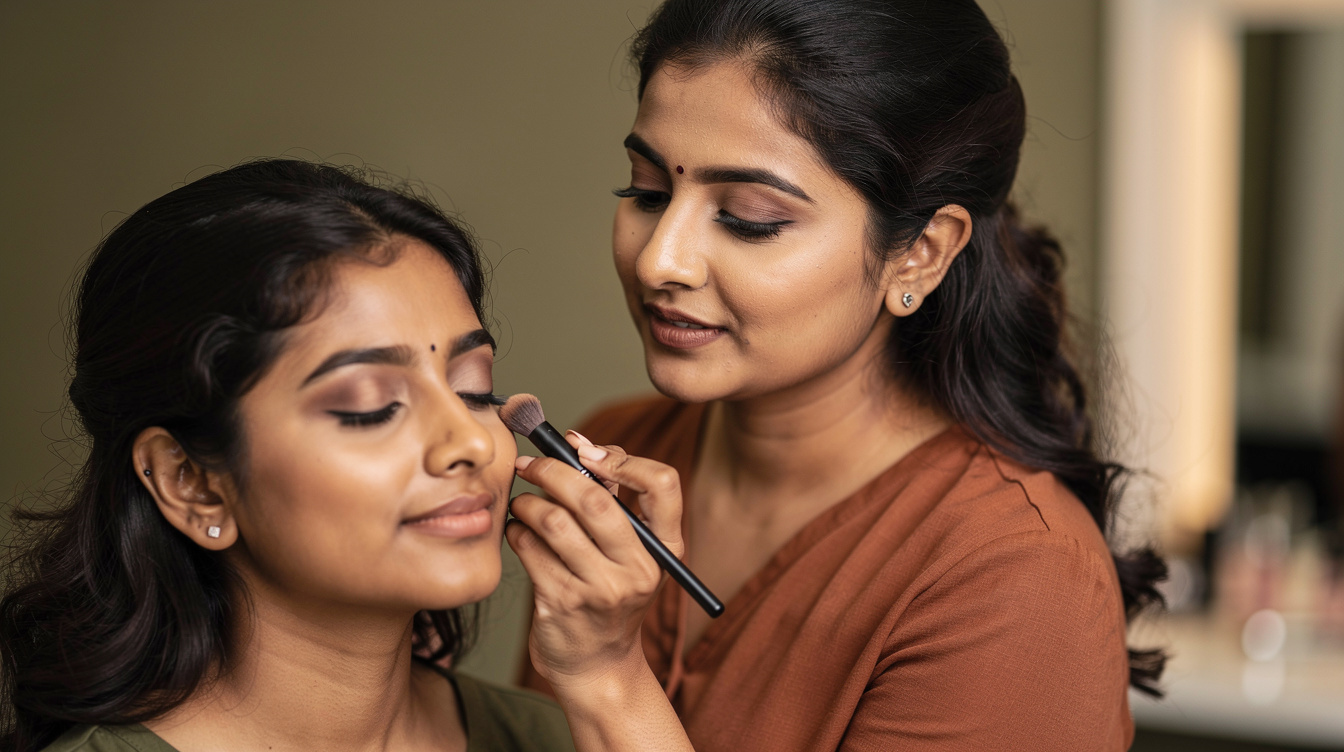
You taught yourself. You watched the tutorials, bought the palettes one paycheck at a time, practised on your sister, your cousin, the friend who said yes because she trusted you. Somewhere along the way, the work stopped looking like an experiment and started looking like a portfolio. The question that quietly took root is the one that brought you here: what does it actually take to move from self-taught to certified makeup artist, and is the leap worth making in 2026? We have walked hundreds of students through this exact transition at our Sector 16 Huda Market studio in Faridabad, and the honest answer is that the leap is mostly about closing four invisible gaps — technique under pressure, product fluency at the professional tier, business literacy, and a credential that lets you charge what your work is worth. This article is the long-form roadmap we wish more self-learners had before they enrolled anywhere, including with us.
We are writing this for the artist who can already do a clean cut crease at home, who has a respectable kit, who has been DM-ing prospective clients on Instagram, and who suspects — correctly — that the next rung up the ladder is not another YouTube binge. It is structured, supervised practice on real human skin, with feedback from someone who has done the job 1,000+ times. That is the gap our 20-Day Professional Makeup Course is built to close, and we will be candid throughout this piece about who it serves and who it does not. Faridabad and the wider Delhi NCR market in 2026 reward credentialed artists with portfolios that hold up under HD video. Self-taught is a beautiful starting line. It is rarely a finishing line.
Before we get into the structure, one note on framing. We do not believe that being self-taught is a deficit you should be embarrassed about. Some of the most technically gifted students we have trained at this studio walked in already able to execute a soft glam look that would pass on Instagram. What they came for was the part the algorithm cannot teach: working calmly on a bride who is crying twenty minutes before her vidaai, managing a client who decided this morning that she actually wants a different look, building a price sheet that does not undersell the kit you have invested in. Certification, in our view, is not a stamp that suddenly makes you a better artist. It is the structured environment in which you become one — fast, and on someone else’s models.
What self-taught artists typically miss
When we audit a new student’s existing skill set on day one, the gaps cluster around the same handful of areas almost every batch. The first is skin preparation at a professional level. A self-taught artist usually knows that prep matters; what they have not done is build a real diagnostic instinct for it. They cannot yet look at a client’s face under studio lighting and say, with confidence, that this skin needs a hydrating primer and a humidity-locking setting spray rather than a mattifying base, or that this melanin-rich undertone will pull warm from a foundation that looked perfect on the swatch. Prep is the single biggest reason self-taught work photographs differently to professional work, and it is a learnable, teachable discipline.
The second gap is product fluency at the professional tier. Most self-taught artists have done the homework on a handful of accessible brands. Working on real clients, especially in bridal, you need fluency across a wider, more demanding shelf — MAC, NARS, Dior, Huda Beauty, Fenty Beauty, Laura Mercier, Haus Labs, Charlotte Tilbury — and you need to know, instinctively, which formulas play together. Which cream blush layers cleanly over which foundation. Which highlighter reads beautifully on the eye but turns frosty on the high cheekbone in 4K. We do not teach product worship at the studio; we teach product behaviour, which is a very different conversation.
The third gap is technique under time pressure. At home, you have an unlimited clock. On a wedding morning, you have a window — sometimes ninety minutes for full bridal, sometimes forty-five for a sangeet — and the woman in your chair has emotional weight, family in the room, and a photographer arriving at a fixed time. Time discipline cannot be self-taught from a tutorial because the tutorial is edited. The fourth and most underestimated gap is the business layer: pricing your work, contracting with clients, handling cancellations, building a referral pipeline, dealing with the destination wedding logistics question on the WhatsApp inquiry. We will return to this, because for most self-learners this is the gap that is actually capping their income — not their technique.
A familiar fear surfaces around this point in conversations with prospective students, and we want to name it directly: I’ll spend serious money on a course and learn nothing useful I could not have got from the internet. It is a fair fear. Course fees are not small, and the market is full of programmes that are essentially recorded YouTube content with a logo. The honest counter is that what closes the gaps above is not information — there is plenty of information online — it is supervised practice on real skin under real conditions, with feedback from someone whose calendar is full of bookings. That cannot be downloaded. It can only be done in a room, with a model, and a trainer correcting your hand in real time.
Why credentials matter for higher-tier client trust
The instinctive reaction many self-taught artists have to the credentials question is that the work should speak for itself. In an Instagram-first market, the work largely does. But there is a tier of client — and it is the tier most self-learners say they actually want to serve — where the work alone is no longer the entire decision. A bride spending ₹2 lakh plus on her wedding-day glam is, in our experience, doing two things in parallel: she is judging your portfolio, and she is judging the framework around it. Where did you train. How long have you been operating. Are you listed somewhere she can read independent reviews. The credential is shorthand for risk reduction.
This matters even more in destination work. When a family is flying you to Jaipur or Udaipur, Sri Lanka or Canada, the trust threshold rises. They are not just hiring a face on Instagram; they are hiring a vendor they will be sleeping under the same roof with for four days. We have done destination weddings across Jaipur, Goa, Jim Corbett, Udaipur, Chandigarh, Kashmir, Sri Lanka and Canada. None of those bookings happened because of a single reel. They happened because the credential layer — international training from Makeup Studio Netherlands, 14+ years operating since 2012, 1,000+ brides, a verifiable presence on WedMeGood, WeddingWire, Sloshout, JustDial and MagicPin — gave the family the confidence to book sight unseen. As a self-taught artist, you can build that credential layer faster through a structured certification than by waiting for it to accrue organically over a decade.
There is a related fear we hear, particularly from artists in Delhi NCR comparing options: what if the academy I pick is not reputable enough? This is a legitimate question. Our straight answer is that what gives a certificate its weight is the verifiable record of the person signing it. Our trainer, Shivangi Verma, is an active working bridal MUA with a 5-star rating across 62 Google reviews and 26+ WedMeGood reviews, not someone who teaches because the bookings dried up. The certificate is meaningful because the person behind it is still doing the work, weekly, on paying brides. That is the test we would apply to any programme, including ours: is the trainer still in the chair?
Skills audit — what you should know before enrolling
One of the most useful exercises a self-taught artist can do before paying any course fee anywhere is a brutally honest skills audit. We run a version of this informally on every inquiry call. The point is not to gatekeep — we accept complete beginners through to advanced learners — but to make sure you are walking in with realistic expectations of which gaps the course will close for you, and which it will not. The audit covers six areas: skin science basics, colour theory, foundation matching across undertones, eye architecture, lash and brow work, and lip design under camera. Be honest with yourself in each.
For most self-taught artists, the audit reveals a predictable pattern: solid eye work, decent lip work, weaker base, weak prep, no client management. If that sounds like you, you are exactly the profile our Basics to Advanced course is built for — the curriculum is intentionally sequenced to spend disproportionate time on the base, on prep, and on the integration of bridal-specific techniques like HD Glass Skin, Airbrush, soft glam and skin-like finish, all of which require a base disciplines you may not yet have. If your audit reveals strong base work and a polished bridal portfolio already, the course’s value to you shifts more toward business setup, client handling, and certification for higher-tier bookings.
Two practical recommendations before you book any programme. First, take a portfolio of your last five looks — varied skin tones, varied event types, varied lighting — and ask three people whose taste you trust to be honest about what is missing. Second, send those same five looks to the academy you are considering and ask them, directly, what their course will and will not improve. We do this on every inquiry call — drop us a WhatsApp on +91 9873048267 with three of your strongest existing looks and we will tell you, candidly, where we see the gaps. If a programme cannot give you that specificity before you pay, that itself is the audit result you need.
How the 20-Day Course works for experienced self-learners
The structural design of our 20-Day Professional Makeup Course is deliberately optimised for the self-taught artist who is ready to compress years of trial-and-error into a focused, supervised window. The course runs over twenty days, 12 PM to 5 PM, at our Sector 16 Huda Market studio in Faridabad, with a batch capped at ten students. That cap matters more than any marketing line we could write — it means that across those twenty days, every student gets the kind of one-on-one correction self-learners almost never receive. We will not run a batch of thirty and call it personalised. Ten is the ceiling because ten is the number at which Shivangi can personally walk every student through every look.
What is included is structured to remove the friction self-learners typically hit. You receive a specially curated set of training products that are yours to use throughout the course, so you are not borrowing your way through technique. You receive a professional brush kit, yours to keep, calibrated to the brushes you will actually need on real bookings rather than the marketing-led 32-piece sets self-taught artists tend to accumulate. You complete a final assessment shoot with a professional model — this becomes a portfolio asset you take away. And you receive certification on completion, plus lifetime alumni support, which is the part most academies do not offer and which experienced self-learners specifically value because the questions do not stop arriving the day after graduation.
We keep the high-level curriculum focused on what employers and clients actually pay for: HD Makeup, Airbrush, Glass Skin and bridal techniques, alongside client handling and business skills. We deliberately do not publish a day-by-day breakdown because the schedule is calibrated to each batch’s actual skill profile — a batch heavier with experienced self-learners will spend more time on advanced bridal integration and business setup; a batch with more complete beginners will spend more time on foundational disciplines. The right question to ask a course is not what happens on Day 7, but how it adapts to the room. We adapt to the room.
On price: the regular fee for the 20-Day Professional Course is Rs. 1,50,000 + GST. We are currently running a limited-time early-bird rate of Rs. 80,000 + GST for the upcoming June 1 batch — a saving of Rs. 70,000 against the regular fee. We do not list the early-bird as a standing price; it is genuinely time-bound and tied to specific batches. If the figure is relevant to your decision, the simplest way to lock the rate is to fill the inquiry form or message us on WhatsApp so we can confirm seat availability and the current early-bird window before it closes.
Career step-up after certification
The question every self-taught artist quietly carries into a certification programme is whether the certificate will actually translate into bookings, or whether it will be an expensive line on a CV. We want to be careful here — no academy can guarantee bookings. What a serious programme can do is build the three assets that, in our experience, actually move the booking needle: a credible portfolio shot in professional conditions, a pricing and packaging framework you understand from the inside, and a clear positioning in a market that, yes, is crowded with Instagram artists.
This is the place where the fear of I won’t get clients after the course deserves a direct response. The market is crowded; that is true. What is also true is that the crowd thins very quickly above a certain quality and reliability threshold, and that threshold is largely about the business layer rather than the technique layer. We have watched graduates from our batches start booking party makeups and family functions inside their first month, build referral flows from those into engagement and sangeet work, and then transition into bridal as their portfolio thickens. The pattern is consistent enough that we now build the business-setup module into every batch as non-negotiable: pricing, client handling, contracting basics, social positioning, and the conversation about when to start saying no to underpriced work.
A note on the age and experience question, which we hear from both ends. Career changers — accountants, teachers, corporate professionals in their thirties pivoting into makeup — worry about being too old. Fresh graduates worry about being too inexperienced. Our honest position, drawn from thirteen-plus years of training students at this studio, is that neither concern is well-founded. Some of the strongest working artists who have come through our programme started in their thirties; some started straight out of college. What predicts who succeeds is not age. It is comfort with the human side of the work — the listening, the patience, the willingness to genuinely understand what a bride wants before lifting a brush — and that is teachable at any stage. One of the things our brides say most often in reviews is that Shivangi listens patiently and understands the vision without overdoing the look. That instinct can be built.
Earnings vary widely, and we will not quote you a number anyone could hold us to. As a rough orientation, our own listed reference rates at this studio start at ₹28,000 for bridal per function, ₹25,000 for engagement, ₹8,000 for party or family, and ₹50,000 for outstation per function — with custom quotes applied to the actual scope. Working artists graduating from a serious 20-day programme can reasonably build toward those ranges over the first year or two as portfolio and referral flow accrue. The job is not a lottery ticket. It is a craft business that compounds.
FAQ
Will the 20-Day Course really prepare me for a career as a working makeup artist?
It will prepare you to begin one. Across twenty days of 12 PM to 5 PM sessions at our Sector 16 Faridabad studio, you cover foundational disciplines, HD and Airbrush techniques, Glass Skin and bridal looks, plus client handling and business setup. The final assessment shoot gives you a professional portfolio piece. Lifetime alumni support means you can come back to us as your career develops. What it does not do is guarantee bookings — that work begins after certification, and it is largely about consistency, positioning, and reputation accrual in your local market.
I’m already self-taught and decent. Will the course be too basic for me?
Almost certainly not, and this is the most common concern we hear from experienced self-learners. The course is sequenced Basics to Advanced for a reason — even strong self-taught artists usually have invisible gaps in skin prep, foundation matching across undertones, and product behaviour at the professional tier. With a batch capped at ten students, we genuinely calibrate to where each student is. Send us three of your existing looks on WhatsApp before enrolling and we will tell you honestly where we see the value for your specific level.
How is your certification different from other Delhi NCR academies?
The honest, non-marketing answer is that the credential is only as meaningful as the person signing it. Shivangi Verma is internationally trained at Makeup Studio Netherlands, has been operating since 2012, has served over 1,000 brides, and is still actively booked on bridal work weekly — verifiable through 62 Google reviews at 5 stars and 26+ WedMeGood reviews. She personally teaches every batch. We would apply the same test to any academy you are considering: is the trainer still working as a paid MUA, or only as a teacher?
What if I’m changing careers in my thirties — is it too late to start?
It is not too late, and we say that drawn from direct experience across thirteen-plus years of training students at this studio. Career changers often arrive with strengths self-taught younger students do not yet have — patience, client communication, the ability to manage emotional dynamics in the chair. Those qualities are disproportionately valuable in bridal work, where the technical execution is only half the job. The course is designed for complete beginners through to advanced learners, with the batch tailored to the room.
Is the early-bird Rs. 80,000 + GST fee going to stay available?
It is genuinely time-bound, not a standing rate. The regular course fee is Rs. 1,50,000 + GST; the early-bird Rs. 80,000 + GST rate is tied to specific upcoming batches — currently the June 1 push — and the saving of Rs. 70,000 reflects that. Seat availability inside the early-bird window is capped at ten students per batch by design. The most reliable way to confirm whether the current rate is still open is to WhatsApp us on +91 9873048267 or fill the course inquiry form for the upcoming batch.
Will I get clients after certification, or is the market too saturated?
The market in Delhi NCR is genuinely crowded at the Instagram-artist tier — that is real and we will not pretend otherwise. What we have observed consistently is that the crowd thins quickly above a quality and reliability threshold that is mostly built on the business layer, not the technique layer. Our course includes portfolio building, pricing frameworks, client handling and business setup precisely because technique alone is rarely the bottleneck. Graduates typically start with party and family bookings, build referral flow, and grow into engagement and bridal work as their portfolio thickens.
20-Day Professional Makeup Course · Sector 16 Faridabad
Become a Professional Makeup Artist — Basics to Advanced
Hands-on training on real skin, only 10 students per batch, taught personally by Shivangi Verma — an active working bridal MUA with 14+ years and 1,000+ brides. Products, professional brush kit, certification and final assessment shoot all included.
Rs. 1,50,000 + GST → Early Bird: Rs. 80,000 + GST (save Rs. 70,000 — limited time)
💬 WhatsApp +91 9873048267 | Fill Inquiry Form | View Course Page →
If you have read this far, the truth is you are probably closer to the certified-pro version of yourself than you think. The roadmap from here is short and surprisingly concrete: complete an honest skills audit, decide whether your gap is technique or business or both, then sit inside a structured environment that closes it under supervision. We would be glad to be that environment for you. Talk to us about Shivangi Verma’s makeup course, the early-bird window for the upcoming batch, and whether your existing portfolio is the right fit — we will be candid either way.