
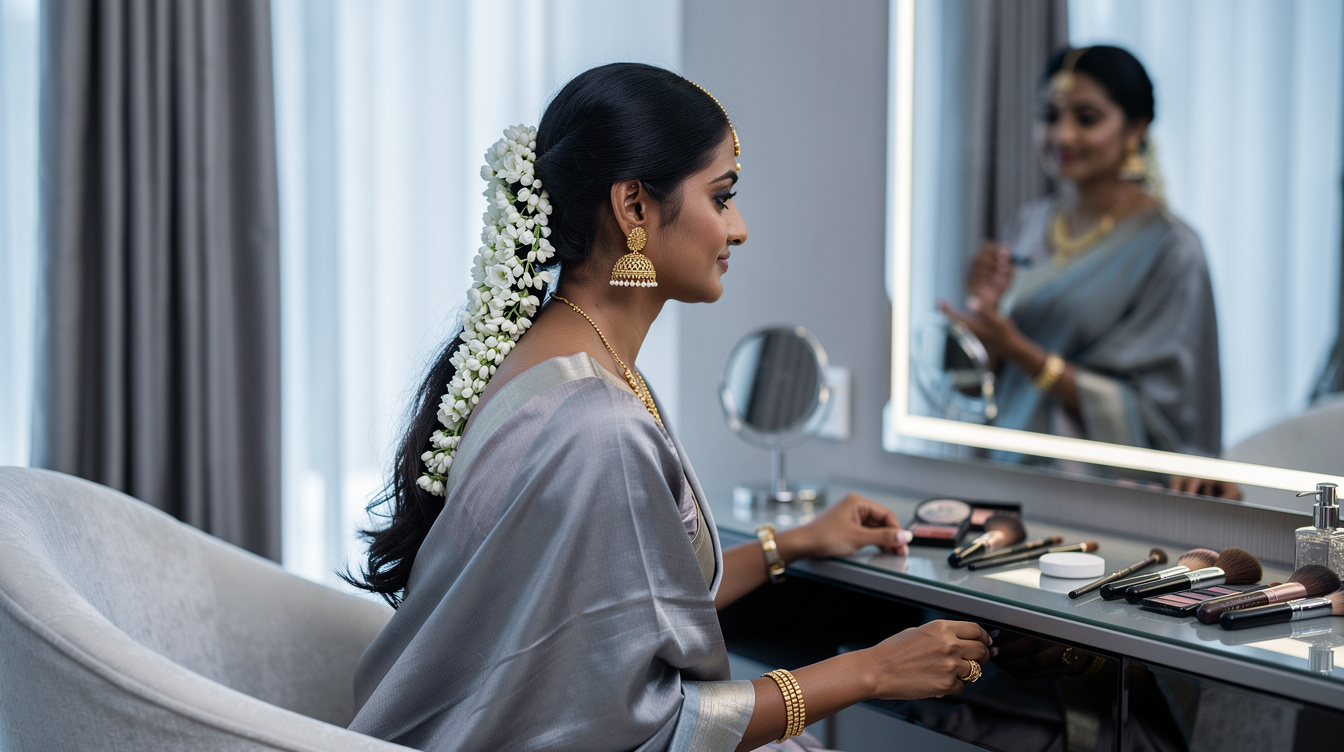
A self makeup course in 2026 is not what it was even three years ago. Back then, the phrase mostly meant a couple of weekend tutorials on Instagram or a YouTube playlist watched between meetings. Today, students typing self makeup course details into Google are doing something more deliberate — they want a structured, in-person curriculum that teaches them to do their own makeup with the same discipline a professional artist applies to a paying client. We’ve watched this shift happen up close inside our Sector 16 Huda Market studio in Faridabad, and the questions arriving in our DMs and on WhatsApp are almost identical week after week. What is actually inside a proper self makeup course? Which products should be included in the fee? How many days should it realistically run? And — quietly, but often — does a course like this open the door to a working career?
This guide answers each of those questions in turn. We’ve kept it free of marketing fluff and free of the day-by-day curriculum chart you sometimes see online — we deliberately don’t publish that, because every batch is shaped around the students inside it. What you’ll get instead is an honest map of the territory: the skills any serious self makeup course should cover, the tools and products it should put in your hands, the time it should take, and the line where a ‘self’ course ends and a career-grade programme begins. For readers who reach the bottom of this article and realise they want the career path, we’ll point you to our Basics to Advanced course at the end. For everyone else, the article stands on its own.
One small note before we begin. Most of what follows is shaped by the kind of training Shivangi Verma — our founder, lead trainer and an active working bridal MUA with fourteen-plus years and 1,000+ brides on the books — actually delivers in our Faridabad studio. We mention specific brands you’ll encounter inside any reputable kit (MAC, NARS, Dior, Huda Beauty, Fenty Beauty, Laura Mercier, Haus Labs, Charlotte Tilbury) because pretending those names don’t exist would make the article useless. We don’t, however, recommend chasing logos. The skill is in your hands and your eyes, not on the packaging.
What ‘self makeup course’ actually means in 2026
The phrase has been stretched in both directions. On one end, you’ll find ninety-minute ‘self makeup masterclasses’ that are really just product-launch events with a tutorial on top. On the other, you’ll find six-month diplomas that call themselves self makeup courses but are actually professional curriculums in disguise. Neither is wrong — but neither matches what most students actually want when they type the search.
In 2026, a self makeup course should mean something specific. It is a short, structured, in-person (or seriously studio-equivalent) programme that teaches one human being to apply makeup on their own face confidently, for the events that matter to them — engagement, sangeet, reception, family weddings, milestone birthdays, photo shoots, festive evenings, work conferences. It is not a two-day product demo. It is also not a full professional artist’s training. It sits in the middle, and the middle is where the real value lives. The student walks out able to recreate a clean base, a soft eye, a defined lip and a confident finish on themselves, on demand, without rebooking an artist for every occasion.
What separates a good self makeup course from a forgettable one isn’t the brand of foundation on the table. It’s whether the curriculum respects the gap between watching makeup and doing makeup. We’ve had students arrive at our Faridabad studio after a year of devoted Instagram-watching and still struggle to hold a brush at the right angle. The hand needs reps. The eye needs feedback. A self makeup course should be designed around that reality, not around the convenience of the trainer’s calendar.
Core skills covered (skin prep, base, eyes, lips — at high level)
Most students underestimate how much of a finished look is actually skin. Skin prep is where every reputable self makeup course should begin and where most rushed courses cut corners. In Delhi NCR’s climate — a real January morning that hovers near freezing, an April afternoon that pushes forty degrees, monsoon humidity that crashes a poorly-prepped base by lunch — skin prep is not optional. A serious curriculum spends real time on cleansing, hydration order, the difference between a primer that grips and a primer that smooths, the way a thick moisturiser interacts with a long-wear foundation, and the small unglamorous trick of letting each layer settle before moving to the next.
Base comes next. The students who walk in believing ‘base’ means foundation always leave with a wider definition. Base is colour-correction, foundation, concealer, the choice between a fluid and a cream, the choice between sponge and brush, the deliberate decision to bake or not to bake, and the patience to keep the layers thin. We teach students to read their own skin honestly — which areas are genuinely uneven, which are simply lit poorly in their bathroom mirror, and how to build coverage where it is needed without flattening the face into a mask. This is the moment most self-taught makeup-doers realise why their photographs look heavier than their reflections.
Eyes are where personality enters. A good self makeup course should not teach students one trending eye look and call it a day. It should teach the underlying grammar — transition shade, lid colour, outer-corner depth, inner-corner light, lash line, lash extension. Once that grammar is in the hand, the student can build a smoky eye, a soft-glam eye, a brown halo, a graphic festive eye, or a clean nude lid for a corporate evening, all from the same vocabulary. Liner technique, brow shaping with what the student already has, and lash application (strip, individual, magnetic — what works for whose eye) round it out.
Lips and finishing — blush placement, contour philosophy, highlight restraint, setting spray sequence — close the loop. The unsexy truth is that most amateur looks fail in the last ten minutes, not the first hour. A serious self makeup course teaches students to slow down through the finish, not to sprint to a photo.
Tools and products you should expect to be included
This is the section where students get most often shortchanged, so we’ll be specific. A self makeup course fee should already include the products you practise on during class. You should not be expected to arrive with your own foundation, your own concealer, your own eyeshadow palette and your own brushes — any course that asks you to do that is not really a course, it is a personal-tutoring session with the bill rebranded.
At a minimum, look for: a working selection of foundations across undertones (a course that only stocks one undertone is teaching you to pretend your skin matches it); concealers in light, medium and a colour-correcting peach; a primer set that covers both grip and blur; a setting powder that does not flashback in photographs; a neutral eyeshadow palette plus at least one warm and one smoky option; a reliable mascara; a lash kit; lip products in a working range; and a setting spray. The brand names you’ll meet inside a reputable studio kit usually overlap with the global standards — MAC, NARS, Dior, Huda Beauty, Fenty Beauty, Laura Mercier, Haus Labs, Charlotte Tilbury — alongside Indian brands that genuinely perform on Indian skin.
Brushes deserve their own paragraph. A self makeup course should teach you why a fluffy crease brush behaves differently from a flat shader, why a stippling brush gives a different finish than a flat foundation brush, why blending sponges have a damp use and a dry use, and how to clean your tools so that the same brush doesn’t muddy three different looks. If a course never puts a real brush in your hand because everything was demoed on a model, walk away. The hand has to do the reps.
For students who join the longer career-track programme that we’ll discuss below, the toolkit conversation expands considerably — but even then, the principle holds: training products should be provided during the course itself, and the brush kit you’ll work with should be yours to keep. If a programme charges separately for either, treat that as a quiet warning sign and ask questions before paying.
How long a self makeup course should realistically run
This is the question students worry about most, often quietly. Two days feels too short; six months feels excessive. The honest answer depends on the goal.
If the goal is one specific event — your sister’s wedding next month, your engagement in eight weeks, a milestone birthday — a focused short-format self makeup course of three to five days, properly run, can get you there. The student leaves with one or two complete looks they can recreate confidently, and the muscle memory to refresh those looks without panicking. That is a legitimate use of a self makeup course and we don’t dismiss it.
If the goal is broader — to handle multiple looks across multiple occasions for the next several years of your own life — five to ten working days is usually closer to the truth. The skill-set widens. You’re learning soft glam for daytime engagements, smoky eyes for evening receptions, a clean corporate look for work events, a heavier festive face for Diwali and Karwa Chauth, a no-makeup makeup for casual brunches. That breadth needs reps that don’t fit into a long weekend.
And if the goal — somewhere along the way — quietly shifts from ‘I want to do my own face’ to ‘I think I could do this for other people too,’ then the timeline question changes entirely. A self makeup course is no longer the right format. That is where the next section comes in.
Where the 20-Day Professional Course fits if you want a career path
One of the most common conversations we have on WhatsApp goes something like this: a student starts by asking about a self makeup course, then admits, two messages in, that they’re really wondering whether they could become a working artist. They’ve been thinking about it for months. They’ve watched enough Instagram. The fear that holds them back is almost always the same one — the fear of spending a substantial sum on a course and walking out with a certificate that doesn’t translate into actual booked work. We hear this fear weekly and we don’t dismiss it. It is a reasonable fear and it is the right thing to ask before paying any fee.
The career-track answer in our studio is the 20-Day Professional Makeup Course — Basics to Advanced — taught personally by Shivangi Verma at Sector 16 Huda Market, Faridabad, from 12 PM to 5 PM each day for twenty consecutive working days. It is not the same animal as a self makeup course and we are deliberate about not blurring the line. The 20-Day programme is designed for students who want to leave the studio able to take on a paying client, not just a paying mirror.
A few things make the 20-Day Course different in shape. The batch is capped at ten students, which sounds like a marketing line until you watch what happens inside it — every student gets hands-on time on real skin every day, and Shivangi can walk between the chairs and correct technique in real time rather than lecturing from the front. The fee includes the specially curated training products you’ll work with through the course (yours during training), a professional brush kit that’s yours to keep, certification on completion, a final assessment shoot with a professional model so you walk out with portfolio-grade images of your own work, and lifetime alumni support — meaning the WhatsApp group does not close on Day 20.
The curriculum spans HD Makeup, Airbrush, Glass Skin and Bridal Techniques, alongside the parts of the job most short courses skip — client handling, pricing conversations, trial-day choreography, the mechanics of running a small studio business. We deliberately don’t publish a day-by-day breakdown because every batch is shaped around its students; what we will tell you on a call is what you will learn, in what order, and on whom. If that conversation is something you want to have, message us on WhatsApp at +91 9873048267 or Fill the inquiry form rather than guessing from the website.
On fees, we want to be transparent because the rumour mill in Delhi NCR is loud. The regular price for the 20-Day Course is Rs. 1,50,000 + GST. For the upcoming June 2026 batch, we are running an early-bird rate of Rs. 80,000 + GST — a saving of Rs. 70,000 — for students who confirm during the open enrolment window. This is a limited-time rate, not the standard fee, and we are upfront about that. The reason we mention it is not pressure; it is that the most common fear we hear is wasting a large fee on a course that doesn’t translate into work, and the early-bird structure exists specifically to lower the financial risk of joining this batch. The course you receive — same trainer, same hours, same included items, same certification — is unchanged.
One last thing worth saying plainly. Shivangi Verma is not a former artist who has retired into teaching. She is an active working bridal makeup artist with fourteen-plus years in the industry, more than 1,000 brides on her books, a 5-star Google rating across 62 reviews, international training from Makeup Studio Netherlands, and she leads every batch personally. The course is taught by the person whose work you can see on Instagram every weekend. That distinction matters more than any brochure can describe — and it is the answer to the fear of an academy ‘not being reputable enough,’ because reputation here means a working client list, not a stack of franchise certificates.
FAQ
Will a short self makeup course really prepare me to do my own bridal-style makeup?
For one specific event, yes — provided the course is hands-on rather than demonstration-only and you are given real reps on your own face. For a multi-event wedding week with five different looks, a longer format gives you breathing room. We answer this honestly on WhatsApp before students book, including suggesting a shorter or longer format based on what your calendar actually holds.
What’s the difference between a self makeup course and a professional makeup course?
A self makeup course teaches you to do your own face for your own occasions. A professional course — like our 20-Day Professional Makeup Course — teaches you to do paying clients’ faces under real working conditions, including HD Makeup, Airbrush, Glass Skin, Bridal Techniques and the business side of client handling. They are different tools for different goals, and choosing between them is mostly a question of what you want to be doing twelve months from now.
I’m worried I’ll spend a large fee and learn nothing useful — how do I judge a course before paying?
This is the most reasonable fear in the room and we never dismiss it. Three quick filters: ask whether the trainer is an active working artist or only a teacher; ask whether you’ll work hands-on on real skin every day or only watch demonstrations; and ask exactly what is included in the fee — products, brush kit, certification, portfolio shoot. If those answers feel evasive, walk away. If they’re concrete, you’re probably looking at a serious programme.
Is the 20-Day Professional Course really enough time to start a career?
Twenty days at five hours a day in a batch capped at ten students is one hundred hours of supervised hands-on training. Combined with the included portfolio assessment shoot and lifetime alumni support, it is genuinely enough to launch — provided you continue to practise, take small bookings and build your Instagram in the months that follow. We are honest about the fact that no course finishes the work of becoming an artist for you; what it does is give you a working foundation and a network you can lean on while you keep building.
Where is the studio and what are the timings?
The studio is at Booth No 70-71, First Floor, Sector 16 Huda Market, Faridabad, Haryana 121002. Course timings are 12 PM to 5 PM, every working day for twenty days. WhatsApp +91 9873048267 for batch dates and to confirm a seat — only ten seats per batch, and they tend to close before the batch start date.
If you’ve read this far and the question quietly shifted from ‘should I do a self makeup course’ to ‘what would it take to actually do this for a living,’ the next step is a five-minute conversation, not a five-hour Google search. We run our professional makeup course in Faridabad in small ten-student batches at our Sector 16 Huda Market studio, and the most useful thing you can do is tell us where you are right now — complete beginner, light hobbyist, semi-pro — so we can tell you honestly whether the next batch fits. The block below has all three ways to reach us.
20-Day Professional Makeup Course · Sector 16 Faridabad
Become a Professional Makeup Artist — Basics to Advanced
Hands-on training on real skin, only 10 students per batch, taught personally by Shivangi Verma — an active working bridal MUA with 14+ years and 1,000+ brides. Products, professional brush kit, certification and final assessment shoot all included.
Rs. 1,50,000 + GST → Early Bird: Rs. 80,000 + GST (save Rs. 70,000 — limited time)
💬 WhatsApp +91 9873048267 | Fill Inquiry Form | View Course Page →