
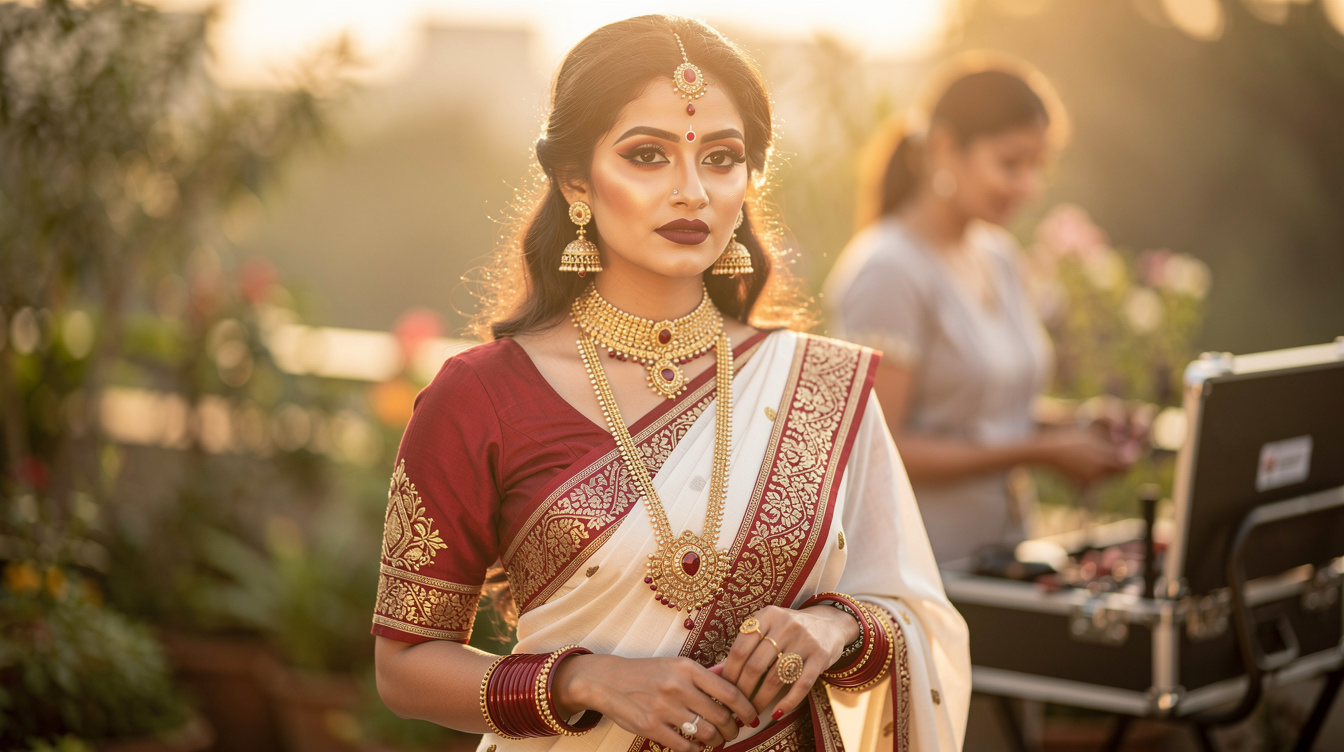
Every January, the bridal makeup conversation in India resets. New mood boards leak out of Mumbai studios, Reels start trending out of Delhi, and a fresh vocabulary — glass skin, ultra HD, skin-like, soft glam — circulates faster than most aspiring artists can keep up with. By March, every makeup school in the country is advertising a “2026 trends masterclass.” By May, half of those trends will have quietly disappeared, and another set will have taken their place. If you are an aspiring makeup artist watching this churn from the outside, it is easy to feel like the goalpost is moving every quarter — and that whatever you learn today will be outdated by your first paid booking.
We have been working full-time as a bridal MUA in Faridabad and Delhi NCR since 2012, and we have watched a lot of trend cycles come and go. What we want to do in this article is something most trend round-ups do not bother with — separate the surface (what is being marketed as a trend) from the substrate (what is actually changing about how brides want to look in 2026 across North India). And then, because this is the question every student eventually asks, we will explain why our 20-Day Professional Makeup Course deliberately teaches you techniques rather than fads — and why that distinction matters more than ever this year.
This is the long version of the conversation we have on WhatsApp with prospective students almost every week. If you are an aspiring artist — call you Riya, the persona we usually have in mind when we write these — and you are trying to figure out whether 2026 is the year to invest in serious training, this piece is for you. By the end of it, you will understand the 2026 bridal spectrum well enough to talk about it confidently with a bride, an Instagram audience, or the admissions counsellor at any professional makeup course in Faridabad.
What’s actually trending vs what’s marketed as trending
The cleanest way to read the 2026 trend cycle is to keep two columns in your head. On one side, what is genuinely shifting in the way Indian brides want to look. On the other, what is being marketed as a trend because it photographs well on a luxury studio’s Instagram grid. They are not the same.
Genuinely shifting: skin priority. Five years ago, a North Indian bride’s brief usually started with the eye — heavy cut crease, dramatic liner, sometimes glitter packed wet across the lid. The skin was a backdrop. In 2026, the order has flipped. Almost every consultation we run now opens with a sentence like “I want my skin to look amazing” — and only then moves to the eye, the lip, the contour. The eye has become a complement; the skin is the protagonist. That is real, it is durable, and it is changing the technique stack you have to learn.
Marketed as trending but actually narrow: “latte makeup,” “cold girl bridal,” “strawberry-glazed bride,” the rotating cast of TikTok-derived names that get a viral week and then vanish from real bookings. We almost never see a bride walk into a trial in Faridabad and ask for a latte-themed wedding look by that name. They will, however, describe something — “warm, kind of bronzy, but my skin should still look like skin” — that maps to the same underlying technique. The name is the marketing. The technique is the trend.
If you are learning to be a working MUA — not an aesthetic content creator — the lesson here is brutal but useful. Stop chasing the name of the trend. Learn the underlying skin, base, and finish techniques well enough that you can deliver any of these moods on demand when a bride hands you a Pinterest board with no caption.
Glass skin, Ultra HD, soft glam — the 2026 spectrum
Three terms dominate the 2026 conversation in Indian bridal makeup: glass skin, ultra HD, and soft glam. They are not competing trends — they are points on a single spectrum that runs from luminous-and-translucent on one end to camera-flawless-and-buildable on the other. A working MUA in 2026 needs to be fluent at all three points and the gradient between them.
HD Glass Skin. The Korean-origin influence has fully integrated into Indian bridal. Brides ask for it by name now. The technique is not about layering more product — it is the opposite. It is about prep (deep hydration, careful exfoliation in the days before), thin sheer base, strategic luminosity placed where light naturally hits, and a setting strategy that holds the dewiness through a four-hour function in a Faridabad summer. Done badly, glass skin photographs as oily. Done well, it photographs as twenty-five-year-old skin lit from inside. The product side leans on lightweight bases — Laura Mercier’s tinted skincare lines, Charlotte Tilbury’s Hollywood Flawless Filter as a mixer, Haus Labs’ Triclone base for the long-wear version, Fenty Beauty’s Eaze Drop as a sheerer alternative.
Ultra HD. This is the camera-first end of the spectrum. Ultra HD is what you reach for when you know the bride will be photographed under bright LED panels by a high-end photographer with a mirrorless body and a 50mm prime — every pore visible, every transition between products visible. Ultra HD bases (think the heavier-coverage end of MAC, Dior Forever Skin Glow used skilfully, NARS Light Reflecting Foundation for the diffused-finish version) buy you flawlessness in 4K without the cakey collapse you got from the older airbrush-heavy approach. The art is in the application: thin layers, generous time, careful colour-correction underneath, and a setting powder strategy that does not flashback in the photographer’s on-camera flash.
Soft glam. The middle of the spectrum and, frankly, where about sixty percent of 2026 North Indian bridal bookings actually sit. Soft glam is the daughter of the heavy traditional bridal of the 2010s — same drama, half the weight. The eye is still defined, the lip is still bridal-appropriate, the contour is still present — but everything is dialled back, blended longer, and built on a skin-like base that does not announce itself. Huda Beauty’s complexion line, NARS Radiant Creamy Concealer, Charlotte Tilbury’s Pillow Talk family, MAC’s powder products used judiciously — these are the workhorses. Soft glam is the look most brides describe when they say “I want to look like myself but elevated.” Learning to deliver it consistently is the single most commercially valuable skill you can graduate with in 2026.
Beyond these three, the rest of the 2026 vocabulary — skin-like finish, nude-bride, no-makeup makeup, Ultra HD with a glass-skin overlay — is essentially recombination of these techniques. Master the spectrum and you can adapt to whatever vocabulary the next year invents. If you want to see how we structure this in training, the Basics to Advanced course overview lays it out in plain language.
Regional preferences across North India
If you are training in Delhi NCR — which most of our students are — you cannot read the 2026 trend cycle without a regional filter. A glass-skin bride in South Delhi is asking for something subtly different from a glass-skin bride in Old Faridabad, and both are different from what a Chandigarh bride or a Jaipur bride will ask for. These are not aesthetic accidents; they reflect lighting environments, venue types, photographer preferences, family expectations, and even the time of year a region prefers to wed.
Faridabad and Delhi NCR. Brides in our home region in 2026 are leaning hard into the soft-glam end of the spectrum for the main ceremony, with an Ultra HD register for the reception. The wedding-week structure here typically involves a haldi, a mehendi or sangeet, the main pheras, and a reception — and brides are increasingly asking for a different point on the spectrum for each. Glass skin for the daytime mehendi, soft glam with traditional pigmentation for the pheras, Ultra HD with sculpted contour for the reception. This is one of the reasons our 1000+ brides over the years have nudged us into a teaching philosophy built around fluency across the spectrum rather than specialisation in one register.
Destination weddings out of Delhi NCR. Our team has travelled with brides to Jaipur, Goa, Udaipur, Jim Corbett, Chandigarh, Kashmir, and internationally to Sri Lanka and Canada — and the regional brief shifts every single time. A Goa beach ceremony at 4pm needs a long-wear humidity-proof base that still reads as skin in golden hour. An Udaipur palace wedding under warm tungsten venue lighting needs a different undertone strategy from a Jim Corbett resort with mixed daylight and LED. Kashmir cold weather collapses a glass-skin base in unique ways. None of this is taught by mood boards. It is taught by location reps and an instructor who has actually done the work.
Punjab and Haryana wedding circuit. The trend here in 2026 is the most interesting story in the country, in our view. The previous heavy-traditional aesthetic — high-coverage, sculpted, dramatic — has not disappeared, but it has been re-engineered for HD cameras. Brides want the visual weight of traditional bridal with the camera-friendliness of modern technique. That is technically the hardest brief in the spectrum, and it is where soft glam meets Ultra HD in a way the trend round-ups rarely articulate clearly.
Why a 20-Day course covers techniques, not fads
This is the section most aspiring artists tell us they wish someone had written for them earlier. We will be direct: a course that teaches you 2026’s named trends will be outdated by your second wedding season. A course that teaches you the techniques underneath those trends will give you a career.
Our 20-Day Professional Makeup Course runs from 12 PM to 5 PM at our Sector 16 Huda Market studio in Faridabad, with batch size capped at ten students. We deliberately keep batches small because the only way to teach the spectrum we described above — glass skin, Ultra HD, soft glam, and the gradient between them — is hands-on, on real skin, with feedback from someone who has actually done a thousand brides. We cover HD Makeup, Airbrush, Glass Skin and Bridal Techniques alongside the business side of the craft: client handling, pricing, portfolio building, the WhatsApp-to-trial-to-booking pipeline that determines whether you eat in your first year out of school.
What you take with you: specially curated training products that are yours during the course, a professional brush kit that is yours to keep, certification on completion, a final assessment shoot with a professional model so you graduate with portfolio work, and lifetime alumni support for the moments — and they will come — when you are five minutes from a bride’s pheras and something has gone wrong. This support is the part most schools do not advertise because they cannot deliver it. We can, because Shivangi Verma personally leads every batch — she is not a celebrity name on a flyer, she is an active working bridal MUA with 14+ years in the industry, 1,000+ brides served, 62 Google reviews at a 5-star rating, and a portfolio you can verify on WedMeGood (5.0 rating, 26+ reviews, 215+ photos).
We hear the biggest fear from prospective students often, and we want to name it directly: “What if I spend a lakh and learn nothing useful?” It is the most honest question you can ask before enrolling anywhere, and you should ask it of every academy you consider. Our answer is structural, not promotional. You train every day on live models. You shoot a portfolio before you leave. You are taught by the person who is actually booking weddings that month, not a former-artist-turned-full-time-teacher. Course fee is Rs. 80,000 + GST as an Early Bird rate against the regular Rs. 1,50,000 + GST — a Rs. 70,000 saving, available for a limited time as we run the next batch. The transparent pricing, the personal teaching, and the included portfolio shoot together are how we answer that fear honestly.
One real-client phrasing we keep close, from the bridal side of our work: brides tell us repeatedly that we patiently listen to what they need and then deliver. That same disposition is what we bring to teaching. If you want to talk through whether this is right for you, you can message us on WhatsApp at +91 9873048267 or use the Course inquiry form — no pressure, no hard sell.
How alumni stay current after graduation
Twenty days of intensive technique training is the foundation. The real work of staying current happens in the years after — and this is where most academies leave their students stranded. We do it differently because the industry is small enough that we see our alumni working alongside us at venues across Delhi NCR, and we want them to do well.
Lifetime alumni support. When a 2026 graduate is on a Goa booking in 2028 and a sudden monsoon humidity spike is melting their glass-skin base off, they can WhatsApp us in real time. When an alum in 2029 is pricing their first destination job and does not know whether to quote inclusive of travel, they can ask. The support is not a closed Facebook group with three monthly check-ins. It is direct, working, in-the-field problem solving — because we are running shoots ourselves and the techniques we teach are the techniques we ourselves are still refining.
Product cycle awareness. Foundation formulations change every eighteen months. A 2026 graduate who only memorised the SKUs from their training will be wrong by 2028. The thing to internalise is the kind of product — what “sheer luminous medium-coverage with a satin finish that does not flashback” looks like as a category — so that when the named product changes, you can swap intelligently. This is the foundation our curriculum is designed around.
Continued portfolio investment. Every six months, do a creative shoot. Not a wedding. A creative editorial that pushes the part of the spectrum you are weakest at. If you are confident at soft glam, shoot an Ultra HD editorial. If you are confident at glass skin, shoot a heavy-traditional reinterpretation. The portfolio you graduated with is the floor — your work two years out should be visibly different from your final-assessment shoot.
FAQ
Will the 20-Day course really prepare me for a career as a bridal makeup artist?
It will prepare you for the first six to twelve months of a working career — which is exactly what a course can and should do. Twenty intensive days, 12 PM to 5 PM daily, in batches of ten on real models is roughly 100 hours of hands-on practice plus a portfolio shoot. We have had complete beginners graduate, take their first paid bookings within sixty days, and grow steadily from there. What the course cannot do is give you ten years of industry exposure in twenty days — that is what the lifetime alumni support is structured to bridge.
How is HD Glass Skin different from regular bridal makeup?
HD Glass Skin is a base technique built on deep skin prep, a thin sheer-coverage foundation, strategically placed luminosity, and a setting strategy that holds dewiness without sliding into oiliness. Regular traditional bridal makeup tends to use heavier coverage and matte-set finishes for longevity at the cost of skin transparency. In 2026 the spectrum has blurred — most working MUAs in Delhi NCR now layer glass-skin techniques underneath even a heavier traditional bridal look, so the skin still reads as skin in HD photography.
I’m worried I’ll spend the course fee and not get any clients afterward — is that a real risk?
It is the most honest fear an aspiring artist can have, and we take it seriously. The reason most certified artists do not book clients is not the technique — it is the business side. Pricing, portfolio, the WhatsApp inquiry flow, trial-to-wedding conversion, dealing with the in-laws who sit in on consultations. We deliberately teach the business and client-handling side alongside the technical side, which is why our graduates’ booking rate in the first year is significantly stronger than a technique-only certification would deliver.
Will makeup flashback show up in my wedding photographs?
Flashback is the white cast some setting powders and SPF-heavy bases throw under direct flash, and it is one of the single most common 2026 bridal complaints. The fix is technical, not magical — non-titanium-dioxide setting powders in the right places, SPF in skincare rather than in foundation, a base built for HD photography. This is the kind of practical risk-management we train for every single day in the studio, and it is the kind of thing we want our students to instinctively check on every bride before the photographer arrives.
I’m a complete beginner with no prior makeup background — am I too inexperienced to start?
No. Our course is explicitly designed for complete beginners through to advanced learners, and our batches always include a mix. What matters is that you are full-time committed for the twenty days — this is not a side-project format. Students from finance, education, hospitality, and homemaking backgrounds have completed the course and built working bridal practices. The small batch size of ten means you get personalised pacing whether you arrive with zero experience or with some self-taught practice already.
Can I tour the Faridabad studio before enrolling?
Yes — and we recommend it. The studio is at Booth No 70-71, First Floor, Sector 16 Huda Market, Faridabad, Haryana 121002. Message us on WhatsApp at +91 9873048267 to set up a visit before you commit. You should see the space, meet Shivangi, and understand the format in person before you transfer a course fee. Any academy that resists an in-person visit before enrolment is a flag.
20-Day Professional Makeup Course · Sector 16 Faridabad
Become a Professional Makeup Artist — Basics to Advanced
Hands-on training on real skin, only 10 students per batch, taught personally by Shivangi Verma — an active working bridal MUA with 14+ years and 1,000+ brides. Products, professional brush kit, certification and final assessment shoot all included.
Rs. 1,50,000 + GST → Early Bird: Rs. 80,000 + GST (save Rs. 70,000 — limited time)
💬 WhatsApp +91 9873048267 | Fill Inquiry Form | View Course Page →
If 2026 is the year you decide to stop watching trend Reels from the sidelines and actually train into the bridal makeup industry, we would be glad to talk it through with you. The next batch of Shivangi Verma’s makeup course is filling now at the Early Bird rate — small batch of ten, hands-on every day, taught personally by an active working MUA who is still on bridal sets every weekend. The techniques you will learn outlast every trend cycle this article walked you through. That is the entire point.