
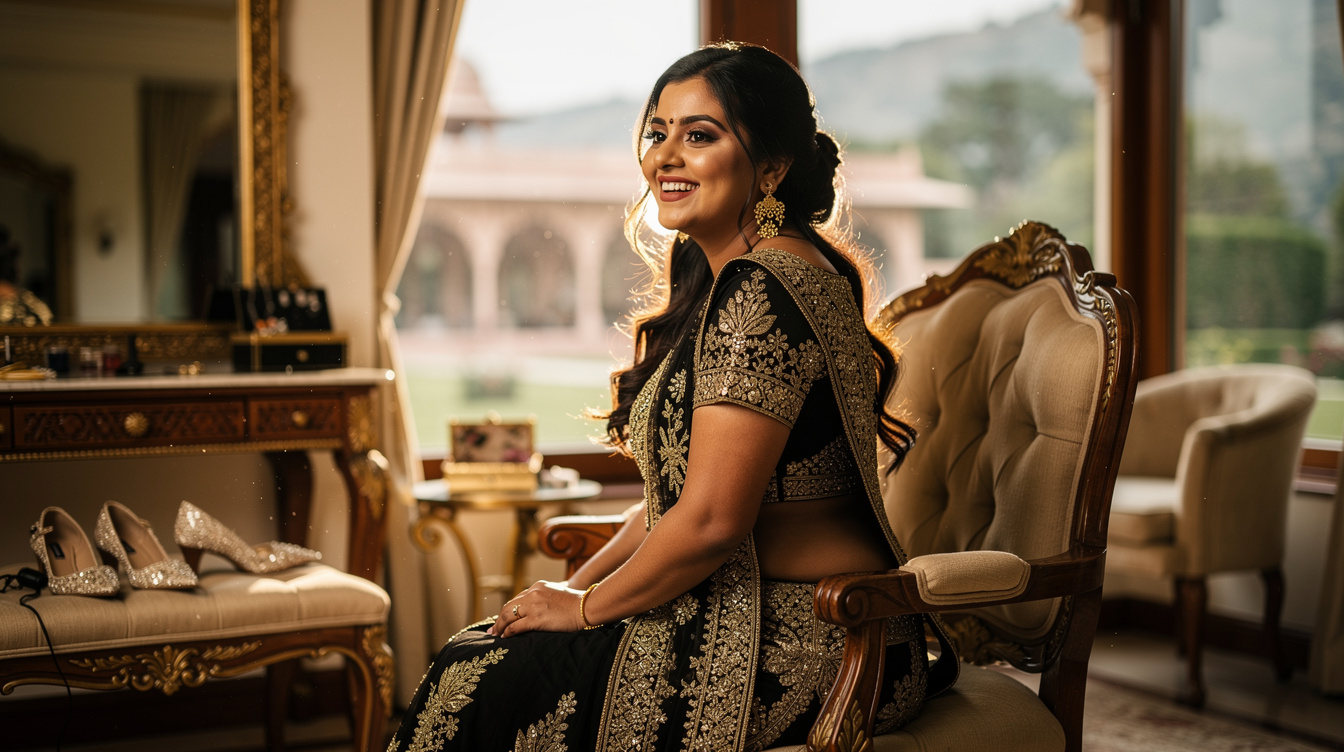
A destination wedding is a story you write across a landscape — a heritage palace in Udaipur, a beachfront in Goa, the misty foothills of Jim Corbett, or a vineyard somewhere far from home. Every element travels with you, and few decisions shape the day as quietly as choosing the right artist to paint your face. We’ve been part of more than a thousand bridal mornings since 2012, and the brides we still hear from years later are the ones whose makeup felt like an extension of themselves rather than a costume layered on top.
This guide is built for the bride researching how a destination wedding makeup artist in India actually works — what climate does to product, what a real timeline looks like, what ₹50,000 per function buys you, and what questions separate a polished professional from a portfolio that won’t survive the wedding day. We’ll walk through fourteen of the country’s most-loved destinations and what each one demands of your kit, then share how our team has handled real weddings across Jaipur, Goa, Udaipur, Jim Corbett, Chandigarh, Kashmir, Sri Lanka, and Canada.
If you’re a first-time researcher, take this slowly. If you’ve already shortlisted artists, skip to the booking checklist. Either way, the goal is the same — for you to walk out of your hotel suite on the morning of your wedding feeling unmistakably like yourself, only luminous.
For a broader perspective on destination wedding makeup that covers international locations (Bali, Phuket, Maldives, Italy, Greece, Dubai), multi-event look planning across the full wedding week, and the operational frameworks for choosing your MUA, see our complete destination wedding makeup guide. This page goes deeper specifically into the fourteen India destinations we work most often — the climates that shape every product choice, what each region quietly demands of an experienced kit, and the real weddings that have taught us what each location actually needs.
How destination wedding makeup actually works
Studio bridal makeup and destination bridal makeup share a product list. They do not share a process. The studio bride sits in a controlled room, climate-managed, with every backup product within arm’s reach. The destination bride is on a property we may have never set foot in, in a state whose humidity, altitude, and water quality reshape every product choice. The artist who plans for both contexts the same way is the artist who creates problems on wedding morning.
In our practice, a destination project starts the moment a date and venue are confirmed. We pull the climate forecast for the wedding week, check the venue’s lighting (warm tungsten, daylight, mixed), confirm whether functions are indoor, outdoor, poolside, or beachfront, and then map a product list per event. A Goa beach pheras is a different chemistry problem than a Udaipur palace reception, even if both happen in February. We pack two of every shade-critical product because a single damaged tube in transit cannot delay a 300-guest function. We carry a portable steamer, oil-blotting sheets, a hairspray that holds in 80% humidity, and lash adhesive rated for sweat — not because every bride needs all of it, but because every destination has a hidden variable.
The brands we trust on a destination kit are the ones that perform under HD lighting and long-wear conditions: MAC, NARS, Dior, Huda Beauty, Fenty Beauty, Laura Mercier, Haus Labs, and Charlotte Tilbury. None of this is brand worship — it’s working specification. A foundation that flashes back on camera ruins the album whether the wedding is in Faridabad or Phuket.
The team that travels also matters. For destination weddings we move as a unit — Shivangi personally on the lead, a hairstylist, a draping expert (drapist), an in-house photographer for behind-the-scenes coverage, and an assistant who manages timeline, touch-ups, and family makeup. This is not a luxury; it’s the reason a four-event wedding stays on schedule when a haldi runs forty minutes long or a sangeet is moved indoors at the last minute.
The 14 India destinations we work — and the climate brief each one writes
Every region in India presents its own brief to a bridal kit. Here are fourteen destinations brides ask us about most often, and what each one quietly demands of an experienced makeup artist for destination wedding work.
- Udaipur — Lakeside humidity meets stone-walled palaces. Foundations need to read luminous in tungsten light without going greasy by reception. Setting sprays must cope with the humidity bouncing off Pichola.
- Jaipur — Dry heat in the warmer months, sharp cold mornings in winter. Hydration is the priority — a bride’s skin can read flat under desert dryness if the prep isn’t right.
- Goa — Coastal humidity is the headline. Add salt air, sweat, and frequent outfit changes between beach pheras and indoor receptions. Waterproof and airbrush are non-negotiable.
- Jim Corbett — Forest weddings sit in cool, often misty mornings. Cream-based products perform; powder-heavy looks photograph dull under canopy lighting.
- Kashmir — Cold, dry, and altitude-affected. Skin loses moisture quickly, lips chap, and the wrong primer can flake on camera. Prep starts a week before the wedding.
- Chandigarh — Comparatively moderate, but seasonal extremes still bite. Winter weddings need extra hydration; summer functions need oil control and frequent t-zone touch-ups.
- Jaisalmer — Desert. Sand, dryness, wind. Eye makeup needs to be locked, brows need to be set, and the kit needs sand-proof storage between functions.
- Jodhpur — Heat-driven. Long-wear matte foundations layered with dewy finishing keep the skin alive on camera. Indoor blue-city venues read cooler on camera than they feel in person.
- Kerala (Munnar / Kovalam / backwaters) — Tropical humidity year-round. Airbrush wins. Powder-heavy formulations dissolve by the second function.
- Mahabaleshwar — Hill-station weddings carry surprise rain and dropping temperatures after sunset. Touch-up windows need to be planned around the chill.
- Lonavala — Monsoon-romantic, but unpredictable. The kit travels rain-sealed; lashes are pre-tested for humidity drift.
- Pondicherry — Coastal heat with French-quarter lighting. White-washed walls bounce light beautifully but expose any unblended foundation, so the base build has to be flawless.
- Rishikesh — Ganges-side venues are cooler than the city, with mineral-heavy water that affects skin prep on the morning. We carry our own micellar and rose water.
- Andaman — Tropical island humidity at its peak. Treat every product as if a wave will reach the bride.
We’ve worked across Indian climates from desert dryness in Jaipur to the cool mornings of Jim Corbett and the salt air of Goa, and the lesson has been consistent — the artist’s preparation matters more than the brand on the box. A signature finish like our HD Glass Skin makeup reads differently under tungsten than it does under daylight, and a working artist has both calibrations ready before the bride sits down.
Pricing — what destination makeup actually costs
Destination wedding makeup pricing is one of the most opaque parts of the wedding planning conversation, and we’d rather it weren’t. Our outstation bridal rate begins at ₹50,000 per function. That covers the bridal application itself — skin preparation, base, eyes, lips, lash, blush, and finishing — by Shivangi personally, on every appointment. It does not include travel, accommodation, or per-diem for the team, which are quoted transparently based on the destination, the season, the airline routing, and whether the venue is providing room nights for the artist team.
For context, our other rates remain consistent with what is publicly listed on WedMeGood — bridal in Faridabad and Delhi NCR begins at ₹28,000 per function, engagements at ₹25,000, and party or family makeup from ₹8,000. The ₹50,000 destination figure reflects the additional logistics, the extended kit, the team’s travel days (usually a day in, the wedding days, a day out), and the redundancy we build into a destination operation.
When a bride asks us for a custom quote, we send it over WhatsApp with every line itemised — the per-function rate, family heads, hairstyling, draping, photography, travel, and accommodation. There are no surprise charges on the wedding morning. Couples planning a destination wedding in India should also budget for the artist’s airfare or train travel, accommodation for the team (typically two to three rooms), and meals during the wedding window. We’ve found brides feel calmer when this is on the table early rather than negotiated at the last minute.
If your wedding has multiple functions — a haldi, a mehndi, a sangeet, a wedding morning, and a reception — talk to us about a package. The per-function rate compresses meaningfully when the team is already on site. Custom quotes are always available; ranges are starting points, not ceilings.
How to book — your timeline, month by month
Destination weddings reward early booking. The artists worth flying in fill their calendars six to nine months ahead, and peak season — November through February — locks faster than many brides expect. Here is the timeline we use on every destination project.
- Nine to twelve months out: Lock the venue and date, then start the artist conversation. Browse portfolios, watch behind-the-scenes content, and request video calls with shortlisted artists. We block dates on a first-come basis.
- Six to nine months out: Confirm your artist, sign the agreement, and pay the booking advance. This is also the right window for a trial in Faridabad if you can travel; we run trials at the studio (Sector 16 Huda Market) so you see the products on your skin under multiple lights before the day.
- Three to six months out: Share your event-by-event briefing. Outfit photos, jewellery, hair plans, your flow of functions, and any allergies or sensitivities. We build the kit list per function from this brief.
- One to two months out: Final timeline. The artist team’s flight, accommodation, and on-the-ground logistics are confirmed. We share the call sheet and morning-of timeline with you and your wedding planner.
- Wedding week: Travel day, on-site recce of the bridal suite for lighting, a low-key meet-up with you the night before, and we begin in your suite the next morning at the agreed call time.
Brides who follow this timeline report the smoothest wedding mornings. The ones who wait until two months out can usually still find an artist, but the calendar dictates the artist rather than the bride dictating the team.
What to ask before booking — a real checklist
We’d rather a bride ask us five direct questions than nod through a quote and discover gaps later. Here is the list we would want a bride to bring to any destination wedding makeup artist in India.
- Who exactly is doing my makeup? Is the lead artist personally present, or is the work delegated to a team member on the day? In our practice Shivangi is on every bridal appointment; that’s a non-negotiable.
- What products are in your kit? Brands matter. Look for MAC, NARS, Dior, Huda Beauty, Fenty Beauty, Laura Mercier, Haus Labs, Charlotte Tilbury — these are the products we work with for HD photography and long-wear performance.
- Have you worked at this destination or in this climate before? Experience in dry desert is not the same as experience in coastal humidity. Ask for examples.
- What is your contingency plan? Lost luggage, delayed flights, a kit damaged in transit. The right artist has answers — duplicate kits, local backup, and travel insurance for the team.
- Does the team include hair, drape, and photography? A coordinated single-team operation is faster on wedding morning than three vendors trying to merge.
- Is a trial available, and where? If you can travel to the artist before the wedding, do it. The trial is when you see exactly what you’ll get, not Instagram-filtered expectations.
- What happens if I want a change on the wedding morning? You should hear “we adjust” without resistance. Your face. Your day.
- Will makeup last through outdoor functions, vidaai, and reception in this climate? Long-wear and waterproof aren’t marketing words for a destination kit — they’re a working specification.
- What’s included in the rate, and what isn’t? Travel, accommodation, family heads, touch-ups, late-night reception coverage. Get every line on paper.
- When is the final balance due? Standard practice is the booking advance at signing and the balance closer to the wedding. Watch for unusual schedules.
Our destination experience: Jaipur, Goa, Udaipur, Jim Corbett, Sri Lanka, Canada
We’ve already done this work, and we’d rather show than tell. What follows is drawn from real weddings, not aspirational marketing.
Jaipur. We’ve handled palace weddings where the bride moves between a haldi in the haveli’s open-air courtyard, a sangeet under string lights, and a wedding ceremony lit entirely by hundreds of diyas. The kit ran two parallel — a daylight-balanced base for the daytime ceremonies, a slightly warmer build for the night-lit reception. The brief was always the same: keep her looking like herself. Pink City weddings in winter call for hydration-led prep; summer Jaipur weddings call for an oil-control regimen we’ve refined over multiple visits.
Goa. Our work has spanned beachfront pheras and resort receptions. Coastal humidity is unforgiving on conventional foundations; we’ve leaned into airbrush makeup and waterproof base, with a touch-up plan tied to the function timeline rather than the artist’s convenience. One bride moved from a sunset beach ceremony to an indoor reception three hours later — same makeup, only a refresh of lip and a powder pass on the t-zone.
Udaipur. Heritage venues, lakeside light, multiple functions, family from across continents. Our team has travelled to Udaipur for full multi-day weddings, with the drapist, hairstylist, photographer, and assistant moving as a single unit. The lighting at Pichola at dusk is genuinely special, and a base that handles it well is built deliberately, not by accident. This is the kind of destination where having the full team in one van pays for itself by lunchtime on day one.
Jim Corbett. Forest-resort territory — cool mornings, canopy-filtered light, and a bride who wanted to look ethereal without any of the heaviness. Cream products dominated the kit. The wedding photos read soft and luminous, and the bride’s mother told us her daughter looked exactly like her engagement photos, only with more glow. That’s the highest compliment we receive.
Chandigarh and Kashmir. Two ends of the northern climate spectrum on our destination list. Chandigarh weddings have the comfort of moderate weather for most of the year; Kashmir weddings demand cold-weather skin protocol, with hydration starting days before, lip care upgraded to a hero of the kit, and base shades that read warmer to counter the cooler indoor lighting.
Sri Lanka. An international project that taught us how rigorous our prep needed to be when crossing borders with a professional kit. We handled customs paperwork, kit insurance, and a full multi-day wedding with humidity that competed with Goa’s. The bride had a Hindu pheras in the morning and a Sri Lankan-influenced reception that night. Two looks, one bride, one team, and zero late starts.
Canada. Our coldest brief. North American winter weddings demand serious skin prep — hydration starts a week before, lip balm becomes part of the kit’s heroes, and the foundation is built warmer than it would be for an Indian winter wedding because Canadian indoor lighting reads cooler. The bride’s reviews still mention how natural her skin looked despite the climate.
Across all of these — Jaipur, Goa, Udaipur, Jim Corbett, Chandigarh, Kashmir, Sri Lanka, Canada — the brides who hired us were responding to the same instinct. They didn’t want a transformation that erased them. They wanted to feel beautiful and recognisable. Reviews repeat this language often: she understood my vision, she didn’t overdo it, the makeup was light yet had great coverage, her makeup and hair-do were intact till late hours, she was totally involved and patient. That’s the standard we hold ourselves to, and it’s the standard we’d want a bride to hold any artist to.
Will I still look like myself? Addressing the bride’s biggest fear
This is the fear we hear most, and we want to address it directly. Many brides arrive at a trial having seen Instagram disasters — heavy contour, mismatched foundation, eyes that belong to a stage performance and not a wedding. The fear is rational. The answer is also rational: a signature finish like HD Glass Skin or skin-like base is a deliberate choice not to layer a mask over your features. We work for natural enhancement, not transformation. Real client reviews on our profile describe the makeup as feeling so light it was almost imperceptible, while still giving great coverage on camera. That distinction is the entire job.
If you’re nervous, ask for a trial. We run trials at our Faridabad studio so you see the products on your own skin under multiple lights before the day. You’ll know exactly what you’re walking into.
Will it last, and will it photograph well?
Two of the next-most-common fears overlap on a destination wedding day. Will it last through 14-hour functions and tropical humidity, and will it photograph well under HD cameras? Our reviews answer the first — brides describe makeup and hair-do staying intact till late hours, even after vidaai, hugs from two hundred relatives, and a reception that runs past midnight. International training at Makeup Studio, Netherlands, and our HD and Ultra HD techniques specifically built for close-up cinematography answer the second. We’ve also got an in-house photographer on the team for behind-the-scenes coverage — which means lighting tests run before the call time, not after. For deeper reading on the techniques themselves, see our notes on our bridal makeup services.
Destination Wedding Makeup · India & International
Discuss Your Destination Wedding
14 years of destination wedding experience across India and internationally. Trial sessions at our Faridabad studio, transparent logistics handling, and a no-surprise pricing structure.
WhatsApp Shivangi directly to discuss your wedding date, destination, and event plan.
Frequently asked questions
Will I still look like myself with destination bridal makeup?
Yes — that’s the entire intent. Our signature HD Glass Skin and skin-like finishes are designed for natural enhancement, not transformation. Reviews on our profile consistently mention that we make brides look pretty without overdoing it, and the trial system means you see exactly what you’ll wear before the wedding day. If something on the morning doesn’t feel right, we adjust. There is no time pressure during the application.
How long will my makeup last during a destination wedding in summer or humid climates?
We design every destination kit around the climate. Waterproof and airbrush products carry the bride through 8–16 hour functions. Reviews explicitly mention the makeup and hair-do staying intact till late hours. For coastal or humid destinations like Goa, Sri Lanka, or Andaman, the kit shifts further toward sweat-proof and humidity-locked formulations, and we plan touch-up windows around the function flow rather than the artist’s convenience.
Can Shivangi travel to my destination wedding in Goa, Udaipur, or abroad?
Yes. We have already worked weddings in Jaipur, Goa, Udaipur, Jim Corbett, Chandigarh, Kashmir, Sri Lanka, and Canada. The team — Shivangi personally, hairstylist, drapist, photographer, and assistant — travels together as a single unit. WhatsApp us at +91 9873048267 with your venue and dates for a custom quote.
What does the ₹50,000 outstation per-function rate cover, and what’s extra?
The ₹50,000 figure covers the bridal makeup application itself, by Shivangi personally, on every appointment. Travel for the team, accommodation, and per-diem are billed transparently based on your destination and routing. Multi-function packages (haldi, mehndi, sangeet, wedding, reception) are quoted on request and typically reduce the per-function cost when the team is already on site. Family makeup heads are quoted separately at our standard rates.
How do I know my makeup will photograph well under HD cameras?
Our practice was built around HD and Ultra HD techniques learned during international training at Makeup Studio, Netherlands. Foundation flashback, wrong shade matching, and reflective primer issues are tested at the trial. Our portfolio of 215+ photos and 49 portfolio items on WedMeGood is the visible record, and our 5.0 rating across 26+ reviews speaks to consistency. With an in-house photographer on the team, lighting tests run before the call time, not after.
What if I don’t like something on the wedding morning?
We adjust. Your face, your day. Brides describe the experience as patient and totally involved because that’s the standard we work to. There is no time pressure during the application, and changes are part of the process — never a friction point.
How early should I book for a destination wedding in India?
Nine to twelve months ahead for peak season (November through February). The artists worth flying in fill calendars early. We’ve found brides who book three months out can usually still find an artist, but the calendar dictates the artist rather than the bride dictating the team. For weddings in shoulder season (March-May or September-October), six months is typically workable.
How does humidity in coastal destinations like Goa or Kerala affect makeup choice?
Coastal and tropical destinations push the kit toward airbrush, waterproof, and sweat-locked formulations. Powder-heavy looks dissolve by the second function. We pre-test lashes for humidity drift and plan touch-up windows around the function flow. For Kerala specifically, even the air’s mineral content in some venues affects skin prep, so we travel with our own micellar and rose water.
Do you handle destination weddings in remote locations like Jim Corbett, Mahabaleshwar, or Andaman?
Yes. Forest weddings (Jim Corbett), hill-station weddings (Mahabaleshwar, Lonavala), and island weddings (Andaman) each require their own kit briefing. Jim Corbett needs cream products under canopy lighting. Hill stations need touch-up windows planned around dropping evening temperatures. Andaman requires the most humidity-proof setup we run, with sand-resistant kit storage between functions.
What’s the difference between booking a Mumbai/Delhi MUA who travels versus a local destination MUA?
Mumbai/Delhi-based MUAs typically offer a larger and more reliable pool of experienced bridal artists, established quality bars from working in competitive metropolitan markets, sharper instincts about bridal photography requirements, and cohesive look across trial and wedding day. Local destination MUAs offer venue-specific familiarity, lower travel cost, and easier last-minute logistics. For most brides whose preferred MUA is in their home city, the traveling MUA produces better outcomes. For more detail on this decision, see our complete destination wedding makeup guide.