
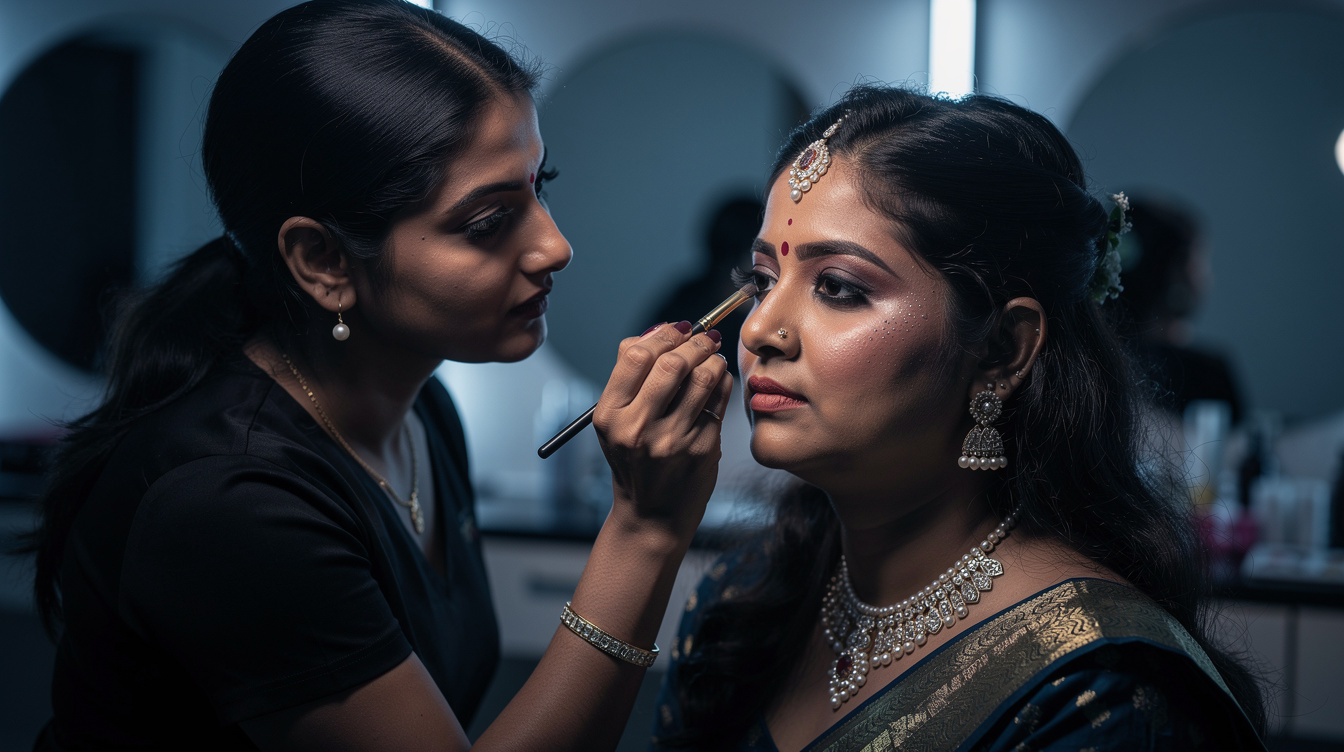
Joining a makeup academy is a serious financial and emotional commitment, and we’ve watched too many aspiring artists in Faridabad and Delhi NCR walk into glossy classrooms only to walk out with a decorative certificate and zero working skills. After running our own academy since 2012 — and having trained at Makeup Studio in the Netherlands ourselves — we know exactly what separates a transformative course from an expensive disappointment.
This is the checklist we wish every aspiring artist had before she signed up anywhere. Ten questions to ask any academy in writing before you transfer a single rupee, plus a fear-honest FAQ at the end. Some of these answers will save you ₹1,00,000 and a year of misdirected effort. Read them slowly. Ask them seriously.
Question 1 — Is the trainer an active working MUA? (Not just a teacher)
This is the single most revealing question you can ask, and it almost never gets asked. The makeup industry moves faster than any textbook can keep up — what worked for HD video three years ago is already showing pores in today’s 4K wedding films. An instructor who hasn’t held a brush on a real bride in the last twelve months is teaching outdated techniques without realising it.
Ask: how many brides did the lead trainer personally do this season? When was their last destination wedding? Are they currently posting recent client work on Instagram, or only repeating older portfolio images? Can they show you a wedding film from this year that they personally led?
At our own academy we’ve personally led over 1000 bridal appointments since 2012, and every batch we teach is informed by what we did on a real bride last weekend — not what we did in a textbook ten years ago. This is also why we never delegate teaching to junior assistants. The same person who does the bride is the same person who teaches you to do the bride. If the academy struggles to name the lead trainer’s last paid client, walk away.
Question 2 — What’s the batch size? (10 vs 30–40 matters)
There is a brutal difference between learning in a batch of ten and learning in a batch of thirty to forty. In a small batch you get hands-on correction every single day. In a large batch you watch demonstrations from the back row, practise on your own face in a mirror, and rarely get individual attention from the lead trainer.
Ask for the maximum batch size in writing. Ask for the trainer-to-student ratio. Ask whether the founder personally teaches every session, or whether assistants take over after the introductory week. Ask whether you can sit in on one live demo before you enrol — any confident academy will let you.
Our 12-Day Course is intentionally capped to keep ratios tight. Every student gets daily personal feedback directly from us, not from a delegated junior. That is how we ensure ninety-six hours of genuine hands-on practice, not ninety-six hours of watching from a distance.
Question 3 — Are products provided or self-purchase?
This is where hidden costs love to hide. A course advertised at ₹80,000 can quickly become ₹1,50,000 once you discover you are expected to bring your own MAC, NARS, Dior, Huda Beauty, Fenty Beauty, Laura Mercier, Haus Labs and Charlotte Tilbury kit from Day 1.
Ask exactly which products are provided during training. Ask whether premium brands are used, or whether you’ll be practising on dupes that simply do not behave like the real thing on real skin. Ask whether you keep any of the products at the end of the course, and what brushes you’ll be using.
In our 12-Day Course (₹1,00,000 + 18% GST), training products are provided so you learn on the exact premium brands you’ll use professionally afterwards. There is no point learning a glass-skin technique with a foundation that does not deliver glass skin, and there is no point learning airbrush on a machine that doesn’t atomise correctly.
Question 4 — Is there a portfolio photoshoot?
A certificate is paper. A portfolio is a career. Without professionally photographed bridal looks on real models, you cannot pitch yourself convincingly to a single prospective client after graduation, no matter how good your technique actually is.
Ask whether a portfolio shoot is part of the course fee or an add-on. Ask who is behind the camera — a working wedding photographer or a friend with a smartphone? Ask whether you receive high-resolution, retouched images suitable for Instagram, a website, and a printed lookbook. Ask how many final looks you’ll have to show after the course.
Our course includes a structured portfolio shoot because we know the very first question every prospective bride asks any new artist is, simply: “Show me your work.” If your academy cannot show you exactly what your post-graduation Instagram grid will look like — what your portfolio page will actually contain — that gap in their answer is itself the answer.
Question 5 — What post-course support exists?
The course ends; your career begins. The biggest fear we hear from aspiring artists during consultations is the same: “I won’t get clients after the course.” That fear is valid, and we want to address it honestly. We understand. Certification alone does not generate bookings.
Ask: is there a closed alumni group? Will the lead trainer actually respond to a question about a real client three months after you graduate? Are there assist opportunities on real weddings? Is there structured mentorship on pricing, on quoting destination jobs, on negotiating with photographers and decorators, on writing your first WedMeGood listing?
A serious academy treats you like a peer-in-progress, not a transaction that ends on Day 12. Our own students stay in touch for years — we have alumni who message us long after graduating with questions about a difficult skin type, and we still answer. The course fee is the deposit on a relationship, not the rent for twelve days.
Question 6 — Certification: what does it actually mean?
Many academies hand out impressive-looking certificates printed on heavy stock with gold foil. The honest question is: who actually recognises it? Some certifications carry real industry weight; many are purely decorative.
Ask whether the certification names a recognised institution. Ask about international affiliations. Ask which doors it has actually opened for past students — names, bookings, photographer collaborations. Our own certification is backed by 13+ years of operating credibility, an international training lineage from Makeup Studio in the Netherlands, and a verifiable public track record (5.0 on WedMeGood across 26+ reviews, 49 portfolio items, 215+ photos, 25,000+ followers on Instagram). The paper matters far less than the network and the working portfolio behind it.
Question 7 — Model arrangement: who do you actually practise on?
You cannot become a bridal makeup artist by practising on yourself in a bedroom mirror. Real skin, real face shapes, real lighting, and the real anxiety of working on someone else’s wedding — that is the only training that actually translates to paid bookings.
Ask whether models are arranged by the academy or whether you must drag a friend to class every day. Ask how many different face types, skin tones, ages and skin conditions you will work on across the course. Ask whether you will complete at least one full bridal look on a model under correct lighting, with a correct turnaround time, before graduation.
If the academy expects you to organise twelve different models on twelve different days entirely on your own, factor that hidden labour cost into your decision. Model arrangement is not a small detail — it is half of whether the course is genuinely hands-on.
Question 8 — Practice days: is it 12 days of theory or 12 days of brushwork?
There is genuine scepticism about short-format twelve-day courses versus three-to-six-month diplomas, and that scepticism is fair when the short course is mostly lecture. We hear this fear regularly from prospective students: “Twelve days is not enough.”
The honest answer depends entirely on what those twelve days actually contain. Twelve days of full eight-hour sessions with hands-on application equals ninety-six hours of practice — that is more brush time than many three-month courses that meet twice a week for two hours.
Ask for the daily timetable in writing. Ask how much time per day is hands-on application versus lecture versus cleanup. Ask whether you do a complete bridal look — skin prep, base, contour, eye, lash, lip — on a real model from Day 4 onward, or whether you spend the entire first week on theory and brush taxonomy. Our 12-Day Course is intentionally intensive: full-time, basic to advanced bridal, with HD Glass Skin, Ultra HD, nude / no-makeup, skin-like, soft glam and airbrush all covered. The format is short by design — but the brush time is not.
Question 9 — Hidden fees: get the total in writing
This is where ₹1,00,000 quietly becomes ₹1,50,000 by the end of the course. Common hidden costs include: separate kit purchase, model fees, photoshoot as an add-on, certification fee, GST surprises, studio rental for “extra practice days”, brush sets, and sanitation supplies.
Ask for a fully itemised total in writing before any payment. Ask whether GST is included in the headline price or added on top. Ask whether the photoshoot, certification and product use are bundled or extras.
Our pricing is deliberately transparent: ₹1,00,000 + 18% GST for the 12-Day Course, with training products provided during the course. Anything beyond that is optional and disclosed up front. You should see the complete final number on paper before you decide — not after Day 1, when leaving suddenly costs you a non-refundable deposit. Contact us for the full breakdown if you want it on paper before enrolling.
Question 10 — Refund policy: what happens if it isn’t for you?
Reputable academies maintain a written refund policy. Insist on getting it in writing. What is refundable in the first 48 hours, the first three days, the first week, beyond that? Is the deposit refundable if the academy itself cancels or postpones the batch? Is there a transfer policy if you have a medical emergency mid-course or a family bereavement?
The presence of a clear, written refund policy is a quiet but reliable sign of operational confidence. Academies that refuse to put refund terms in writing — and there are several in the NCR market — are usually the same academies that have had repeated refund disputes. The policy itself does not need to be generous; it needs to exist on paper. That is the actual signal.
The academy behind the answers
We built our 12-Day Course inside our Sector 16 Huda Market studio in Faridabad around the 13+ years of work we’ve done since 2012 — over 1000 brides served, a 5.0 rating across 26+ verified reviews on WedMeGood, 49 portfolio items, 215+ portfolio photos, and destination weddings completed across Jaipur, Goa, Jim Corbett, Udaipur, Chandigarh, Kashmir, Sri Lanka and Canada. Notable clients include Shiba Chadha and Priya Malik. Our own training came from Makeup Studio in the Netherlands.
We mention all of this not to sell, but to illustrate exactly what “active working MUA” looks like on paper — the same standard you should hold any academy to when you ask Question 1.
Brides consistently say the same thing in our reviews: “she understood my vision and made me look so pretty without overdoing it.” That natural-beauty-enhancement philosophy is precisely what we teach inside the Faridabad academy — you graduate doing skin-like, HD-friendly bridal work that photographs cleanly in 4K, not mask-like, heavy makeup.
Book Your Bridal Makeup Consultation
Shivangi Verma brings 13+ years of expertise to make your special day unforgettable. Based in Sector 16 Faridabad, serving brides across Delhi NCR and destination weddings worldwide.
📞 +91 9354888093 | 💬 WhatsApp Us | 📍 Booth 70-71, First Floor, Sector 16 Huda Market, Faridabad
Frequently Asked Questions
Will the 12-Day course really prepare me for a career?
Yes — when the format is intensive and hands-on. Twelve days of eight-hour sessions equals 96 hours of brushwork, more practice time than many three-month courses that meet twice a week. Our course covers basic-to-advanced bridal, HD Glass Skin, airbrush, skin-like, soft glam and the business side: pricing, portfolio, client management. We also remain available to alumni for years after graduation, which is where most of the actual career-building happens.
I’m worried I’ll waste ₹1 lakh and learn nothing useful — how do I avoid this?
This is the most common fear, and it is valid. Avoid it by asking the ten questions in this article in writing before you pay. Insist on hands-on training, a real portfolio shoot, premium training products provided in the fee, and lead trainers who are still actively working on real brides. Our course is structured this way intentionally — full-time, model-based, photographed, with the founder personally teaching every session.
How do I judge whether an academy is reputable enough versus the bigger chains?
Reputability is not the same as scale. Ask for verifiable proof: review ratings on independent platforms like WedMeGood, real recent client work from the lead trainer, named alumni outcomes, transparent pricing in writing, and an actual refund policy. Our 5.0 rating across 26+ WedMeGood reviews, 1000+ brides since 2012, and Netherlands training lineage are the kind of public, verifiable signals you should require from any academy you consider.
I’m a complete beginner — am I too inexperienced to start?
No. Our 12-Day Course is designed for complete beginners through to working artists who want to upskill. Students arrive from diverse backgrounds — career changers in their thirties, fresh graduates, working professionals — and graduate with the same hands-on portfolio. Day 1 starts at skin science and brush handling; we build up to full bridal looks across the twelve days. Inexperience is not a barrier; willingness to put in 96 hours of brushwork is.
What hidden costs should I be most alert to?
Self-purchase kit requirements are the largest hidden cost — sometimes adding ₹50,000+ on top of the headline fee. Watch also for separate model fees, separate photoshoot fees, separate certification fees, and GST added quietly on top of the advertised price. Always ask for a fully itemised total in writing. Our own course is ₹1,00,000 + 18% GST, products provided, photoshoot included — that is the full number, not a starting number.