
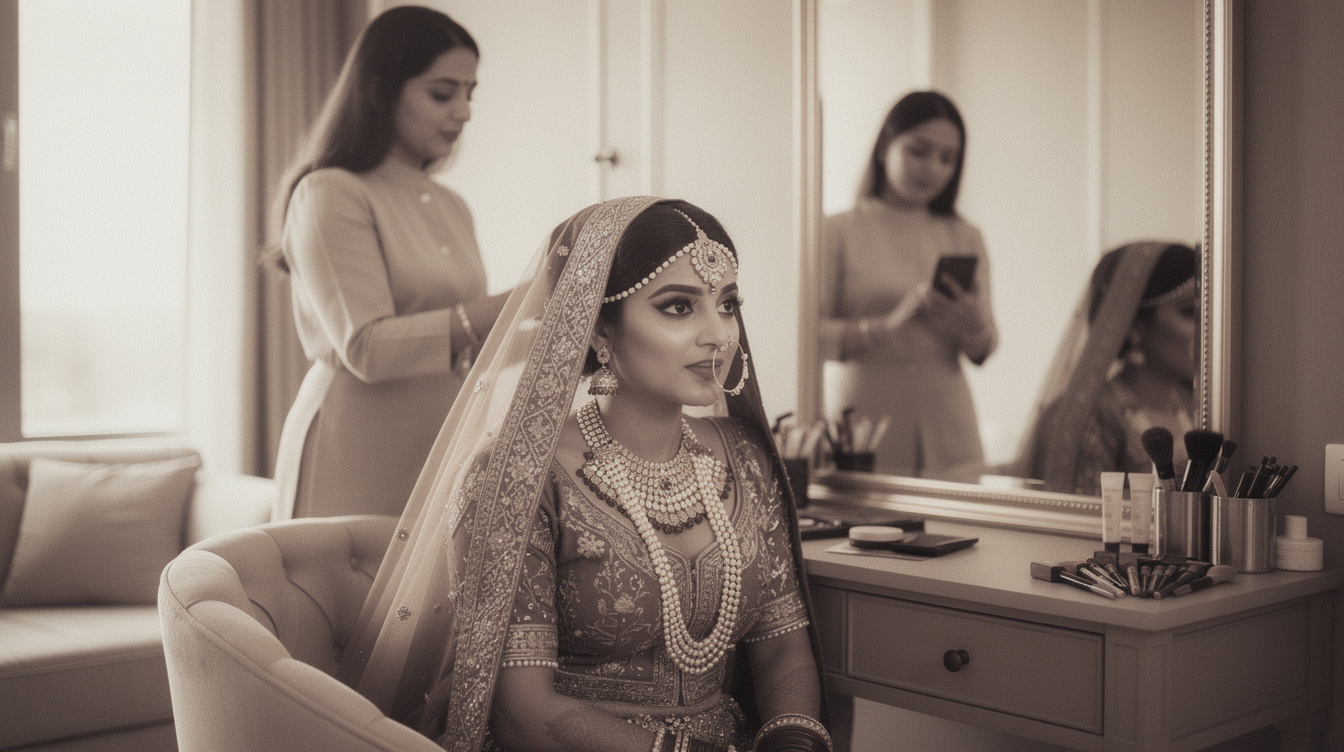
Every few weeks a message lands in our inbox from someone like Riya — twenty-three, working a job she does not love, scrolling bridal reels at midnight, wondering whether to enrol in the Lakme self makeup course she has seen advertised on every metro pillar, or whether to commit to a smaller boutique academy closer to home. The question sounds simple. It is not. The wrong choice in 2026 costs you a year of your life and a not-insignificant sum of money, and you exit with a certificate that does not turn into bookings. The right choice puts a brush in your hand on Day One and a paying client in your DMs before the year ends.
We run a small studio in Faridabad. We also train. So we have lived inside both ends of this comparison — the giant brand-academy model and the small-batch private-academy model — and we want to walk you through what each one actually delivers in 2026, where the genuine differences lie, and how a focused programme like our 20-Day Professional Makeup Course sits inside that landscape. No competitor names, no marketing fluff, just the structural realities of how the two formats teach.
This is a long read because the decision deserves it. By the end you will know exactly what to ask any academy before you pay them — and if the boutique route makes sense for you, you will know why our Basics to Advanced course at Sector 16 Huda Market, Faridabad has been built the way it has.
What the Lakme self-makeup course delivers
The Lakme self-makeup course is, in its truest form, a self-grooming programme. It is built for the bride, the working professional, the bridesmaid — for the person who wants to learn to apply makeup on her own face confidently, not for the person who wants to apply makeup on someone else’s face for money. That distinction is important. Read the syllabus carefully and you will see it: face mapping, skincare prep, day-to-night looks, basic eye makeup, lip techniques, and a self-execution module where the student practises the entire routine on her own face in front of a mirror.
That format has real strengths. The brand is recognisable — your relatives understand the name, which counts for something when you are explaining to your family that yes, you are spending money to learn makeup. The curriculum is standardised across centres, which means the experience in one city is broadly comparable to the experience in another. Product exposure tends to be brand-tied, which is fine because Lakme has serious R&D behind its colour line. And the duration is short — typically a handful of weeks of evening or weekend sessions — which suits students who cannot quit a job or a college course to train full-time.
What it is not built to deliver, though, is the muscle memory of working on other people’s skin. Self-application is a different motor skill from professional application. When you do your own face, your hand is hovering at an angle your wrist already knows, you can feel the pressure of the brush through your own skin, and your eye is closed at the exact second you need it closed. None of that is true when you are working on a client. The geometry of your hand, the lighting, the way the eye blinks, the way a bride’s expression shifts when she sees herself in the mirror — those are skills that only emerge from hours on real, varied, paying-grade skin. A self-makeup programme, by design, does not put you in those hours. It puts you in front of your own reflection.
So before we go any further: if you are reading this because you want to do your own bridal look on your own wedding day, the Lakme self-makeup course is genuinely a sensible choice. If you are reading this because you want to charge ₹28,000 for a bridal function eighteen months from now, you need a different format. That is the comparison this article is really about.
What private boutique academies deliver differently
A boutique academy — by which we mean a small, founder-led studio that takes a handful of students per batch and is run by an active working artist — operates on a fundamentally different equation. The brand-academy model is optimised for scale: one curriculum delivered to many cities, taught by certified instructors, supported by centralised pricing. The boutique model is optimised for transmission: one founder’s specific way of seeing, taught directly to a small enough group that the teaching can adapt to each student in the room.
Three structural advantages follow from that. First, the trainer is the practitioner. In a boutique academy you are usually trained by the person whose name is on the door — someone who is, that same week, doing brides for paying clients. Their hand is calibrated by the market, not by a teaching manual that was last updated two years ago. They will catch the subtle things — the way you are loading too much product on your beauty blender, the way your contour is sitting half a centimetre too high — because they have made and corrected those mistakes themselves on real wedding mornings.
Second, the curriculum is current. A small academy can change its module on glass-skin technique in the same week a new product drops, because the founder has just used that product on a bride and knows exactly how it behaves under flash. The flagship-academy model cannot move that fast. Curriculum revisions there go through committees, brand approvals, and centralised retraining of instructors. By the time the new module reaches the classroom, the technique it teaches may already be twelve months behind what working artists in the city are charging for.
Third, and most under-rated: the boutique academy teaches the business. Makeup as a craft is the easy half of being a makeup artist. The harder half is pricing your services, handling cancellations, managing the bride’s mother, building a portfolio that converts on Instagram, deciding whether to take an outstation booking when the rate barely covers your travel. A founder-led studio teaches that work alongside the technique because the founder lives it. We have watched students leave large brand academies technically competent and commercially helpless. They could neutralise undertones beautifully and had no idea how to ask for the deposit.
Trainer access, batch size, real-skin hours — the comparisons that matter
If you strip out the marketing language and the testimonial reels, only three numbers really decide whether an academy will turn you into a bookable artist. Trainer access. Batch size. Real-skin hours. Ask any academy you are evaluating to give you those three numbers in writing. The answers will tell you almost everything.
Trainer access means: in a typical day, how many minutes does the founder or senior trainer spend with their hand on your work? In a 30-student batch with rotating instructors, that number is honestly measured in single-digit minutes. The maths is unforgiving. In a 10-student batch with a single founder-trainer present for the full session, the same five-hour day produces roughly thirty minutes of direct, individualised feedback per student. That is the difference between a student who knows what their weakness is by Day Three and a student who graduates without ever being told.
Batch size matters because makeup is taught by demonstration and corrected by observation. A trainer cannot watch ten brushes at once and cannot watch thirty at all. A capped intake of around ten students is, in our experience, the upper bound at which a single trainer can keep eyes on every hand in the room. Beyond that, you are no longer being taught — you are being lectured at while you practise. Those are not the same thing, and the difference shows up in your portfolio twelve months later.
Real-skin hours is the single number that matters most for someone planning a career. How many hours of the course will you spend with a brush in your hand, working on a face that is not your own? Mannequin hours do not count. Self-application hours do not count. Watching demonstrations does not count. Only live human practice — friends, classmates, models, bridal-look photoshoots — builds the calibration you will sell. A 20-day intensive at five hours a day delivers around 100 contact hours, of which the majority can be structured as real-skin practice if the format is built that way. A weekend self-application programme cannot mathematically deliver that, no matter how good the syllabus.
This is also where Riya’s biggest unspoken fear lives — the fear that she will spend a serious amount of money and walk out with nothing useful. We hear it in almost every inquiry conversation, and it is a legitimate fear. The protection against it is not the brand on the certificate. It is the number of real-skin hours, the size of the batch, and the seniority of the person who corrected your work.
Sector 16 Faridabad — Shivangi Verma’s 20-Day Professional Course
This is where we have to be transparent about what we ourselves run, because it is the alternative we know best. Our professional makeup course in Faridabad is taught by Shivangi Verma at our studio at Booth 70-71, First Floor, Sector 16 Huda Market. Shivangi has been operating since 2012 — fourteen-plus years in the industry as of 2026 — and has personally done makeup for over 1,000 brides. She trained at Makeup Studio in the Netherlands and holds international certification, and her studio carries 62 Google reviews at a 5-star average from brides who have walked through the same door her students walk through.
The course itself runs for 20 days, from 12 PM to 5 PM daily, which gives us a five-hour intensive working window — long enough to set a look, photograph it under proper lighting, and break down the corrections, but short enough that students do not collapse mid-week. Batch size is hard-capped at 10 students. We do not flex on that number. Once the ten seats are taken, the batch closes and the next intake gets a new date — because the moment you let an eleventh student in, the maths of trainer attention starts to break.
What is included in the fee is, in our view, the second test of whether an academy is being honest with you. Ours includes a set of specially curated training products that are yours to use throughout the course, a professional brush kit that is yours to keep after graduation, certification on completion, a final assessment shoot with a professional model so you walk out with portfolio frames you can publish, and lifetime alumni support — meaning if a year from now you have a bride asking for a technique you have not done before, you can message us and we will walk you through it. The curriculum covers HD Makeup, Airbrush, Glass Skin and Bridal Techniques at a working-artist level, plus client handling and the business-of-makeup conversations that determine whether your craft turns into income.
One thing we deliberately do not do, and you should know it: we do not publish a literal day-by-day curriculum on the public website. The reason is not gatekeeping — it is that the syllabus shifts in small ways every batch in response to what the cohort needs and what the market is doing that quarter. Students who want the exact module-by-module breakdown can request it on a call, and we will share it before they pay. If you would like that, the cleanest path is the WhatsApp number at the end of this article or the Course inquiry form on the site.
Fee comparison across both formats
Fees are where most students start the comparison and, honestly, where most students should finish it last — after they have already decided the format. A self-makeup programme at a flagship brand academy in 2026 typically sits in the lower-five-figures range, sometimes higher in metro centres, occasionally bundled with a starter product kit. That price reflects what the programme is: a self-application course delivered at scale. It is not, strictly speaking, comparable to a professional intensive, because the deliverable is different.
For a professional-track 20-day intensive at our Faridabad studio, the regular price is Rs. 1,50,000 + GST. For the June 1, 2026 batch, we are running an early-bird rate of Rs. 80,000 + GST — a saving of Rs. 70,000 off regular pricing. That early-bird rate is a limited-time figure tied to this specific batch enrolment window; it is not the standard price and we are explicit about that. Once the batch fills or the early-bird window closes, fees revert to the regular figure.
What you are paying for at Rs. 80,000 + GST is roughly 100 contact hours with an active working bridal artist who has worked with over a thousand brides, a 1-in-10 student-to-trainer ratio, products and a brush kit you keep, a model-shoot portfolio asset, and a working-artist network you can lean on after graduation. We will not tell you that is the right price for everyone. We will tell you that it is structured around the three numbers we said matter most — trainer access, batch size, real-skin hours — rather than around classroom seat count. If those three numbers matter to you, the maths usually works out.
If you would prefer to talk through fees and dates directly before deciding, message us on WhatsApp at +91 9354888093. We answer personally — Shivangi or her assistant, never an outsourced sales desk — and we will not pressure you onto a batch you are not ready for.
20-Day Professional Makeup Course · Sector 16 Faridabad
Become a Professional Makeup Artist — Basics to Advanced
Hands-on training on real skin, only 10 students per batch, taught personally by Shivangi Verma — an active working bridal MUA with 14+ years and 1,000+ brides. Products, professional brush kit, certification and final assessment shoot all included.
Rs. 1,50,000 + GST → Early Bird: Rs. 80,000 + GST (save Rs. 70,000 — limited time)
💬 WhatsApp +91 9354888093 | Fill Inquiry Form | View Course Page →
FAQ
Is the Lakme self-makeup course a professional makeup course?
No, and that is not a criticism — it is simply how the course is designed. The Lakme self-makeup format is built around teaching a student to apply makeup on her own face confidently. It does not, by structure, deliver the live-model hours, the trainer-to-student feedback ratio, or the portfolio shoot a working makeup artist needs to start charging clients. If your goal is self-grooming, it is genuinely a sensible programme. If your goal is paid bookings, you need a professional intensive that puts a brush in your hand on someone else’s skin, daily, for weeks.
Will a 20-day course really prepare me for a career as a makeup artist?
It will if it is structured for it. Twenty days at five hours a day is roughly 100 contact hours, and at a 1-in-10 student-to-trainer ratio, the majority of those hours are real practice on real skin under direct supervision. That is more focused real-skin time than many three-month diploma formats deliver, because diploma formats often dilute hands-on hours with theory and large batches. What matters is not the calendar length but the density of corrected practice — and a small-batch intensive can deliver that density very effectively.
What if I am a complete beginner — am I too inexperienced to start?
You are not. The course is built to take a complete beginner from basics through to advanced bridal techniques, which is precisely why we call it Basics to Advanced. We have trained students who had never held a foundation brush before Day One, and we have trained career-changers in their thirties stepping out of unrelated jobs. The format is designed for that mix. What matters is your willingness to practise — the hands you arrive with on Day One are not the hands you leave with on Day Twenty.
Will I actually get clients after the course?
That depends partly on the course and partly on you. What we can control is what we teach: alongside technique, the programme covers portfolio building, pricing your services, client handling, and the basic business setup of running yourself as an artist. The final assessment shoot gives you publishable portfolio frames the day you graduate. What you do with them — how you publish, how you respond to inquiries, whether you turn up consistently — is on you. The course removes the technical and portfolio barriers; the discipline is yours to bring.
What is included in the fees besides the teaching itself?
For the Sector 16 Faridabad intensive, fees include a set of specially curated training products you use throughout the course, a professional brush kit that is yours to keep after graduation, certification on completion, a final assessment shoot with a professional model, and lifetime alumni support — meaning if a difficult bride brief lands in your inbox six months later, you can ask us. The fees do not include outstation travel, accommodation, or personal living expenses during the course. Everything we promise is in writing before you pay.
How do I enrol or get a detailed syllabus before deciding?
The fastest route is WhatsApp at +91 9354888093 — we answer personally and will share the full module breakdown, batch dates and payment terms in the chat. You can also Fill the inquiry form and we will call you back within working hours. Either way you will speak to Shivangi or her direct assistant, not a sales desk, and you will not be pushed onto a batch before you have had your questions answered.
The honest summary is this: the Lakme self-makeup course and a Faridabad boutique intensive are not really competing for the same student. One teaches you to do your own face beautifully; the other teaches you to do other people’s faces for money. Choose the format that matches your actual goal, then ask the three numbers — trainer access, batch size, real-skin hours — before you sign anything. If your goal is a paying career, and a small-batch founder-led studio fits that goal, we would love to walk you through Shivangi Verma’s makeup course in detail. The June 2026 batch is filling, the early-bird window is open for now, and the door at Sector 16 is genuinely open.