
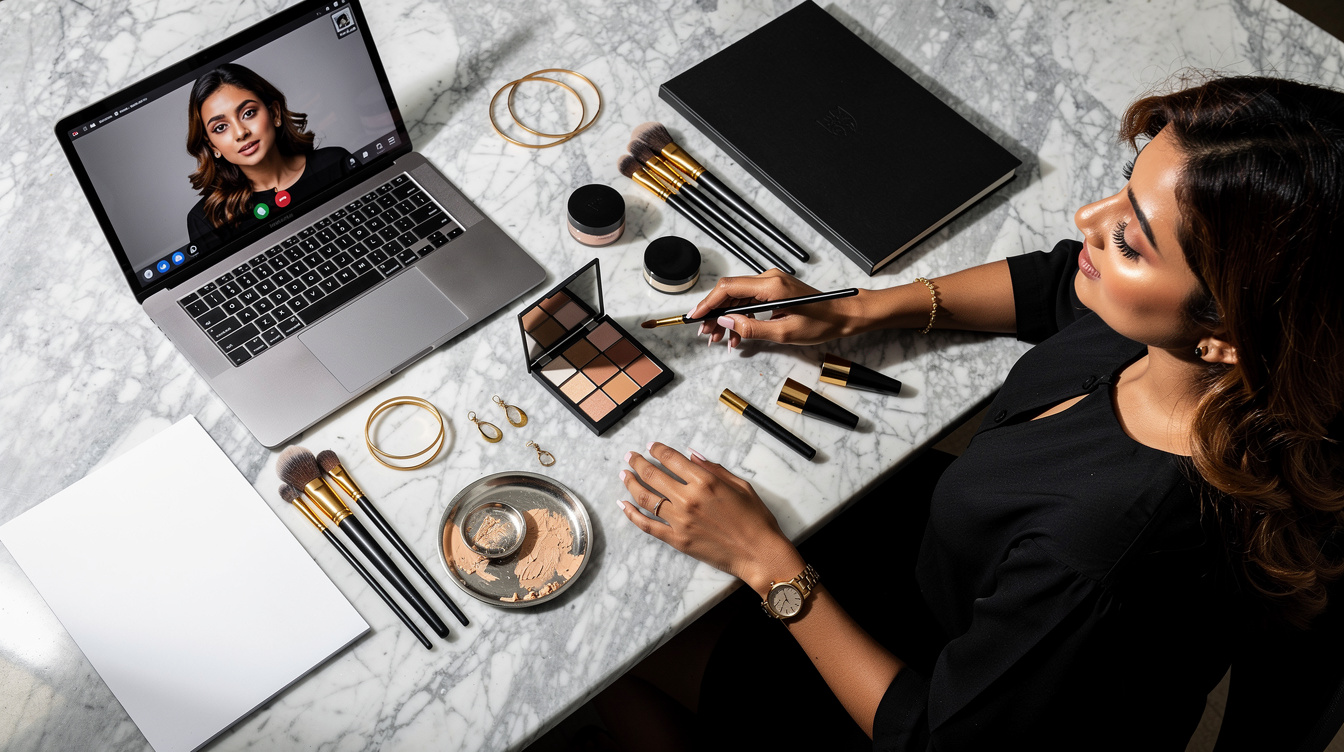
Type “makeup artist certification online” into Google in 2026 and you will get a blizzard of choices — global academies offering downloadable PDFs, recorded modules from international studios, low-cost weekend courses on generic learning marketplaces, and a growing crop of Indian brand-led programmes promising employability in thirty days. For Riya, who has been quietly building a saved folder on Instagram for two years and is finally ready to take this seriously, the question is not “should I get certified?” It is “will an online certificate actually teach me how to do a bride’s face on her wedding morning, or am I about to pay for a piece of paper?”
We have sat with that question across hundreds of student conversations on WhatsApp. The honest answer is not yes or no. It is that online makeup certification in India in 2026 is genuinely useful for some things, genuinely insufficient for others, and the smart way to use it depends entirely on what kind of artist you want to become twelve months from now.
This is a candid review — the pros, the cons, and the practical reality of what online learning can and cannot give an aspiring artist preparing for the Indian bridal market. We will also walk through where our own 20-Day Professional Makeup Course at the Sector 16 Huda Market studio in Faridabad fits into that picture, because the honest answer for most career-track learners is a hybrid one.
What online certification can teach — and what it can’t
Let us start with what genuinely works in an online format. Theory translates well to video. The science of skin undertone, the colour wheel, the difference between cool and warm pigments, the chemistry of why silicone-based primers behave differently on textured skin, the structural anatomy of the eye socket, the rules of facial mapping — every one of these is a knowledge problem first, and a knowledge problem can be taught well by a confident instructor with a camera, a whiteboard and a curated stills library. Done well, an online module on undertone identification is sometimes clearer than a live demonstration, because the instructor can pause, zoom, annotate and revisit.
Product education also benefits from the format. Walking through the texture profile of MAC Studio Fix Fluid versus NARS Sheer Glow, the polymer chemistry behind Dior Forever Skin Glow, how Charlotte Tilbury’s hyaluronic primer interacts with Laura Mercier translucent powder, the way Huda Beauty FauxFilter sets differently from Fenty Beauty’s softer matte finish, why Haus Labs’ triclone-base products demand a different powder strategy — this is information you can absolutely absorb from a screen, take notes on and revisit when you need to.
What online certification cannot teach is touch. Pressure. The exact gram-force you apply when you press a damp sponge into foundation on a brow bone versus a cheek hollow. The rhythm of stippling base into peach fuzz without lifting it. The angle at which a concealer brush has to travel under the eye so that texture from a fourteen-hour wedding day does not catch on dehydrated under-eye skin at eleven at night. The difference between a brush stroke that lays product down and one that pushes it sideways into pores.
These are tactile skills that live in your hands. They are built by doing them on real skin, on real faces, in real conditions, with someone watching you over your shoulder and saying “soften that, you are working too dry, your client is going to feel that brush mark in twenty minutes.” No screen can give you that feedback loop. This is the first honest pro and con of online makeup certification: the theory you can keep, the touch you cannot fake.
Why bridal-track learners hit a wall with online-only training
If your end goal is editorial makeup for stills, or if you want to work as a remote consultant teaching skincare routines, an online-only path can take you a respectable distance. We have seen artists build credible content careers off pure self-study. Bridal is a different problem entirely.
An Indian bride’s wedding morning is a stress test that exposes every gap in an artist’s training. You arrive at five in the morning. The room temperature is unstable — the air conditioning was off all night and someone has now cranked it to eighteen degrees while a hot iron is steaming a saree two metres away. The bride has not slept properly. Her skin is dehydrated, possibly inflamed from a week of pre-wedding facials and threading, and the sangeet from the night before left a faint tan line at the jaw. She has makeup references on her phone that contradict each other, a mother-in-law who wants “less heavy” and a photographer who wants “more luminous for the camera.”
You have four hours. The hair team is working in parallel. The drapist needs the bride’s blouse pinned by half past eight. Photography starts at nine. There is no second take.
This is not a scenario you can rehearse against a webcam. It is a scenario you can only survive by having done it — or something close to it — many times before, with a senior artist correcting you in real time. Online certification, no matter how thorough, leaves a structural gap here. The graduates we meet who tried to bridge that gap on their own often spent their first year of paid bookings learning expensive lessons on someone else’s wedding day, which is the worst possible classroom.
This is the single biggest reason we built our Basics to Advanced course as a fully offline, in-studio programme. The bridal track is not a place to be self-teaching the tactile fundamentals.
When online courses make sense (theory, business skills)
So when does online certification actually pay off? Three situations, in our experience.
First, as a pre-study before you begin in-person training. If you spend three or four weeks working through strong online theory content on undertone, colour theory, skin science and product chemistry before you walk into a hands-on classroom, you arrive faster. You stop wasting bench time asking questions that have textbook answers and you start using bench time for the things only bench time can teach you. Many of our incoming students do exactly this and they are noticeably ahead by day three.
Second, for the business and brand layer of becoming a working artist. An online course on running a freelance practice, photographing your own portfolio with phone lighting, structuring packages, writing client contracts, handling deposits, posting consistently on Instagram, dealing with planners — this is a knowledge problem and online formats handle it well. Some of the most useful learning many of our alumni do post-graduation is online business education, not online makeup education.
Third, for ongoing continuing education once you already have a foundation. Once you can already do the work with your hands, an online masterclass on a specific contemporary technique — a glass-skin breakdown from a working pro, or a deep-dive on bridal eye geometry for South Indian features — is high-value. You have the base skills to interpret what you are watching and translate it through your own hands. You are using the screen to refine, not to start from zero.
If you fit one of those three profiles, online certification is a smart investment. If you fit none of them — if you are a complete beginner whose end goal is paid bridal work — online-only is going to leave you exposed.
How offline 20-Day training in Faridabad fills the practical gap
This is where we want to be specific about what offline training gives you that online cannot, using our own programme as the concrete example.
Our 20-Day Professional Makeup Course runs at the Sector 16 Huda Market studio in Faridabad, every day from 12 PM to 5 PM. Five hours a day, twenty days, full immersion. By design, the cohort is capped at ten students per batch — small enough that Shivangi Verma, who personally leads every session, can stand at your station, watch your hand, and correct your pressure in real time. This is not a back-of-the-room arrangement. It is the structural opposite of a webinar.
The curriculum runs from foundational skin prep and product theory through to advanced bridal techniques — HD makeup, airbrush, glass skin, soft glam, no-makeup skin-like finishes, modern bridal techniques — alongside the business and client-handling layer of running a real practice. You also work through a final assessment shoot with a professional model, which gives you a portfolio image you actually own, taken on a real set, before you walk out. We deliberately do not publish a literal day-by-day curriculum because the work is sequenced around how each cohort progresses, not around a fixed checklist.
Every student receives specially curated training products — yours to use throughout the course — and a professional brush kit you keep at the end. Certification is included on completion, and so is lifetime alumni support, which in practice means our graduates message Shivangi about real brides, real client problems and real pricing decisions years after their batch ends.
On fees: the regular price is Rs. 1,50,000 + GST, currently available at an early-bird rate of Rs. 80,000 + GST for the upcoming June 1, 2026 batch — a saving of Rs. 70,000, limited to this intake. We are deliberate about who teaches it: Shivangi has been operating since 2012, has personally done the makeup for over 1,000 brides, holds international certification from Makeup Studio Netherlands, and continues to take live bridal bookings every week. Her 5-star Google rating across 62 reviews and her public WedMeGood feedback are open to anyone who wants to verify them. You are learning from someone who is, this very weekend, doing the exact work you want to learn how to do.
That is the structural difference an online certification cannot match. It is not just “more practice hours.” It is supervised practice on real skin with an active working artist correcting you — an apprenticeship compressed into twenty days.
We also want to address the fear we hear most often on WhatsApp from students like Riya: “I will spend a lot of money and learn nothing I can use.” It is a fair fear. Our answer is that the course is built to be the opposite of theory-only — every day involves hands-on work on live faces, premium products are provided so you are not held back by your kit, the assessment shoot gives you a real portfolio image, and Shivangi teaches every session herself rather than handing the room to a junior. The honest validation of this is in our alumni’s first paid bookings, not in our marketing copy. If you would like to hear it from them directly, you can WhatsApp us and we will connect you to recent graduates. If you are considering the June batch, the simplest next step is to Fill the inquiry form or message us directly on WhatsApp at +91 9354888093 — we answer personally, not through a bot.
Hybrid path — combining theory online with intensive offline practice
For most career-track learners we speak to, the right answer in 2026 is not online or offline. It is both, in the right order.
The hybrid path that consistently produces working artists looks something like this. Spend four to six weeks on strong online theory — skin science, undertone, colour theory, product chemistry, the structural anatomy of facial mapping. Take it seriously. Take notes by hand. By the end of those weeks you should be able to look at a face and articulate what you are seeing in technical language, even if you cannot yet execute on it.
Then enrol in an intensive offline programme where the entire focus is doing — hands on real skin, supervised by an active working artist, in conditions close to real bridal work. Twenty days of full-time hands-on practice on live models, with daily correction, will move your hands further than twelve months of self-study at home. This is the phase where touch is built. It cannot be skipped, and there is no online substitute for it.
After certification, return to online learning for the business and brand layer — pricing, portfolio, contracts, planner relationships, Instagram strategy, package structure. This is the layer that turns a trained artist into a booked one, and it is a knowledge problem that online formats handle well.
The mistake we see most often is doing this in the wrong order — hands first, theory and business second, or worse, online-only and never doing the hands phase at all. The artists who build sustainable bridal careers in Delhi NCR almost always do theory first, hands second, business third. That is the hybrid path we would recommend to anyone serious about treating this as a career rather than a side income.
20-Day Professional Makeup Course · Sector 16 Faridabad
Become a Professional Makeup Artist — Basics to Advanced
Hands-on training on real skin, only 10 students per batch, taught personally by Shivangi Verma — an active working bridal MUA with 14+ years and 1,000+ brides. Products, professional brush kit, certification and final assessment shoot all included.
Rs. 1,50,000 + GST → Early Bird: Rs. 80,000 + GST (save Rs. 70,000 — limited time)
💬 WhatsApp +91 9354888093 | Fill Inquiry Form | View Course Page →
If you are at the start of that path and considering where to do the hands phase, our professional makeup course in Faridabad is built for exactly this stage. It assumes you have done some reading, brings you fully into hands-on work for twenty days, and sends you out with a portfolio image, a brush kit, certification and the alumni support to keep going. That is the practical bridge between an online certificate on your laptop and a paid bridal booking on a real wedding morning.
FAQ
Is an online makeup certification valid in India for bridal work?
Online certifications are recognised in the sense that no Indian regulator licenses makeup artists — anyone can call themselves certified. What clients and planners actually evaluate is your portfolio, your reviews and your ability to deliver under bridal conditions. An online certification on its own rarely produces the portfolio and the hands-on competence those gatekeepers look for. It can be a useful first layer of theory, but it should not be your only credential if you want paid bridal work.
Can I learn enough through online courses alone to charge for makeup?
You can charge from day one — there is no licensing barrier. The honest question is whether you will deliver work the client is happy with, whether you will get re-booked, and whether you will get referrals. For party and family makeup, a strong self-study foundation plus relentless practice on friends and family can get you started. For bridal — where the stakes, the timeline pressure and the technical complexity are higher — online-only is structurally insufficient. We see this repeatedly in students who join our offline batch after a year of self-study and finally close skill gaps they did not know they had.
Will the 20-day course really prepare me for a career?
Twenty days of full-time hands-on work — five hours a day, ten students to a batch, taught personally by an active working bridal MUA — is the foundation, not the finish line. By the end of the course you will have completed a final assessment shoot with a professional model, walk out with a portfolio image you own, certification, your professional brush kit and lifetime alumni support. From there, what makes the career is your first year of paid bookings — engagements, family functions, smaller weddings — where the training compounds. Most of our alumni are taking solo bridal bookings within twelve to eighteen months.
I am a complete beginner — am I too inexperienced for this course?
The course is explicitly designed Basics to Advanced, which means complete beginners are exactly who it is built for. Students arrive from many different backgrounds — career changers in their thirties, fresh graduates in their twenties, working professionals exploring a second income, women returning to work after raising children. The small batch of ten means Shivangi can pace the early days for true beginners while still pushing more experienced students forward. You do not need prior makeup experience to enrol; you need the willingness to do the hands-on work every day.
How do I decide between an online certification and your offline 20-day course?
Ask yourself what you will be doing twelve months from now. If the answer is content creation, brand consulting, or supplementing existing work — online may be enough on its own. If the answer is “I want to be doing real brides, on wedding mornings, in Delhi NCR or beyond” — you need the hands phase, and you need it under supervision from an active working artist. The simplest way to figure out which path fits you is to message us on WhatsApp at +91 9354888093 or fill our course inquiry form, and we will have an honest conversation about whether our June 1, 2026 batch is the right next step for you specifically. We turn away students who are not ready as often as we admit ones who are.