
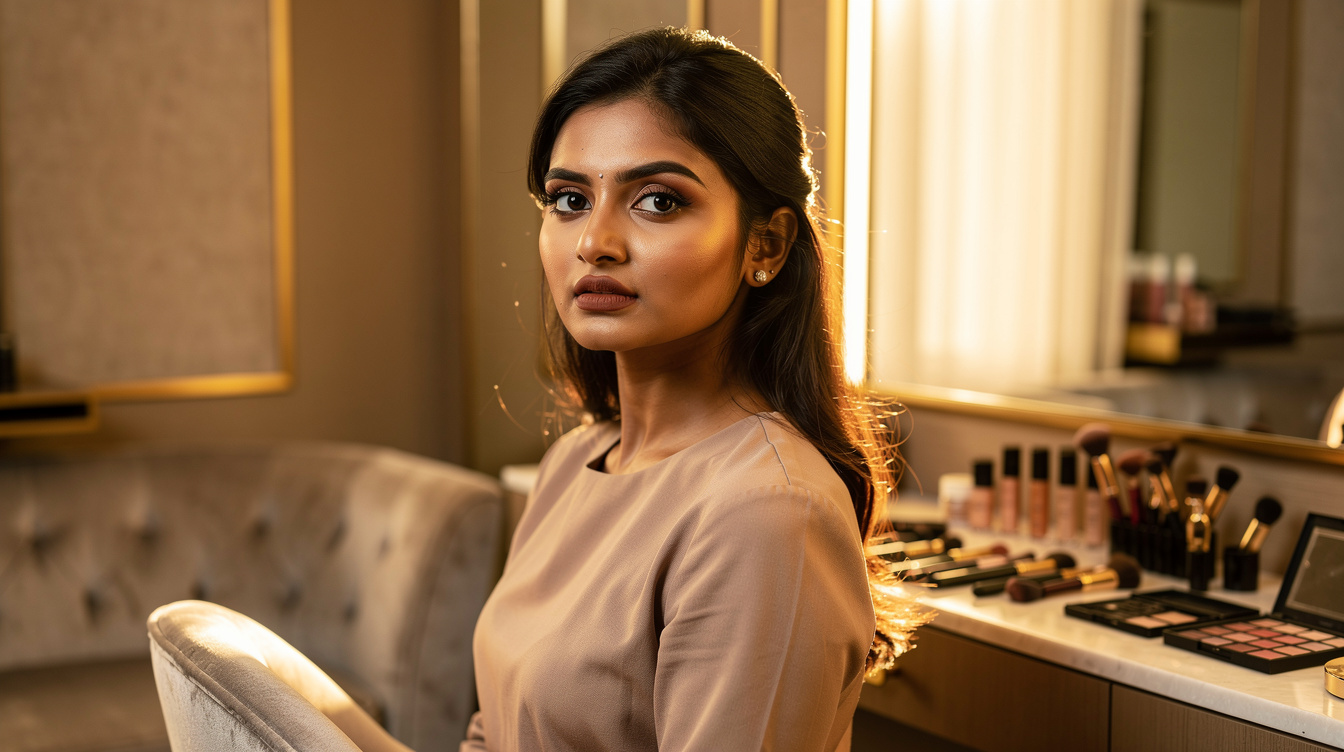
Contouring is the technique we get asked about more than any other. Bridal clients want it on the wedding day, aspiring artists want to master it before anything else, and the demand for a focused, contour-only workshop in Faridabad and Delhi NCR has only grown over the last two years. We understand why. Done well, contour is what makes a face look photographed rather than merely made up — it carves cheekbones in flat studio light, tightens a jawline that would otherwise wash out under flash, and lets a bride read sculpted across hours of heavy ceremony lighting.
But a contour-only format also raises a fair question: is technique enough on its own, or does it only land when it sits on top of a base that’s been built correctly? That is the real conversation we want to have here. Whether you’re considering a short contouring makeup course or our 20-Day Professional Makeup Course at Sector 16 Huda Market, Faridabad, the answer reshapes everything about what you should actually sign up for.
This guide is written for Riya — the aspiring makeup artist trying to map a real career path from Faridabad or anywhere across Delhi NCR. We’ll cover what a contour-only course genuinely teaches, where it falls short, and how the 20-day intensive run by Shivangi Verma — an active working bridal MUA with 14+ years behind the chair and 1,000+ brides on record — integrates contour into a complete bridal skill set instead of treating it as an isolated party trick. If you’d rather skip ahead and speak to us, you can reach Shivangi directly on WhatsApp at +91 9354888093.
Why contouring deserves a focused workshop
Contour is not eyeshadow. It does not forgive a heavy hand. A misplaced shadow on the cheekbone reads as dirt on camera. A too-warm cream contour on a cool Indian undertone reads as muddy under tungsten light. The margin for error is small, the geometry is unforgiving, and the rules quietly change with every face shape, every undertone, and every type of light a bride will sit in across a single function.
That is why a focused workshop has real value. When a student spends two or three concentrated days only on contour, the muscle memory builds faster than it would inside a longer course where the same hours are spread across base, eyes, lips and bridal styling. The repetition compounds. By the end of a tight workshop, a student has placed contour on fifteen or twenty different face shapes — round, oval, heart, square, oblong, long — instead of placing it on three. The eye starts seeing bone structure differently. You stop reaching for a generic placement and start reading the face in front of you.
There is also a precision argument. Contour is one of those skills where watching the same correction land twenty times in two days finally makes it click. Why the temple shadow needs to angle slightly differently on a heart-shaped face. Why a cream product from MAC behaves nothing like a powder from Charlotte Tilbury on a brand-new layer of Laura Mercier translucent. Why NARS Laguna sits beautifully on warm Indian skin but pulls orange on a fair, pink-toned client. A workshop that does nothing but contour for forty hours is a privilege of focus most weekend short courses never give you.
And there is a market argument. In Delhi NCR specifically, party makeup, soft glam, and quick engagement looks lean heavily on contour as their signature lift. An artist who can deliver a clean, photographable sculpt in under twenty minutes will book client after client in this market. The demand is real, and it is one of the reasons we see steady interest in face contouring classes India searches each month.
What’s actually covered in a contour-only format
Most contour makeup course formats — whether they’re run as a one-day masterclass or a three-day intensive — follow a similar arc. The first hours are theory: face mapping, identifying high points and low points, the difference between sculpting and shading, the difference between bronzing and contouring. Then the workshop moves into product literacy. A student learns to compare cream versus powder, warm-toned versus cool-toned, and which finish belongs on a HD bridal base versus a soft glam evening look.
From there, the focus shifts to placement. A good contour-only format will run drills on the same face shape repeatedly until the student can place product without measuring or second-guessing. Cheekbones first, then temples, then the jawline. The forehead. The sides of the nose. The chin shadow that tightens a wider lower face. Each placement is taught against a specific outcome: lift, slim, sculpt, soften.
Blending is treated as a separate craft inside contouring, and rightly so. Most failed contours fail at the blend, not the placement. The workshop trains brush selection — flat versus angled versus dome — and the difference between buffing, sweeping, and stippling. Students work with brands they will actually use professionally: Huda Beauty for warm cream contours, Fenty Beauty for fairer Indian skin, Dior for refined powder finishes, Haus Labs for high-pigment cream that survives full-day shoots. Brand choice matters here because each formula behaves differently on different undertones.
Highlight is usually folded in toward the end. Where to place it, where not to, why a heavy strobe ruins a sculpted contour, and how to balance the warmth of a contour against the cool of a high-point highlight without making the face look striped. By the close of a contour-only format, a student should be able to take a flat-lit face and turn it into a photographed face in under fifteen minutes. That is a real, sellable skill.
Why technique alone isn’t enough without base mastery
Here is where we have to be honest. A contour can only ever be as good as the base it sits on. We have seen technically accurate contours look terrible because the foundation underneath was the wrong undertone, set too heavily, set too lightly, or applied with the wrong primer for the bride’s skin type. Contour does not exist in isolation — it exists as a layer in a sequence, and if the layer below it is wrong, no amount of perfect placement saves the look.
Cream contour will streak on a base that wasn’t moisturised long enough before foundation. Powder contour will cling to dry patches under the cheekbone if the prep wasn’t right. A nose contour will sink into pores if pores weren’t filled. A jaw contour will fade across a six-hour reception if the foundation underneath wasn’t locked properly. None of this is taught in a contour-only workshop, because that workshop assumes the base is already there. For an aspiring artist, that assumption is dangerous.
This is the most common gap we see in students who walk into our Faridabad studio after one or two short workshops elsewhere. They can place a contour beautifully on a flawless practice face. Put them in front of a real bride with combination skin, mild texture, and four hours of summer ahead of her, and the contour falls apart by the end of the trial. The hands learnt the placement. The eye never learnt the prep.
This connects directly to one of the biggest fears we hear from aspiring artists: the fear of paying a serious course fee and walking away without skills that translate to paying clients. We take that fear seriously. It is exactly why our Basics to Advanced format treats base, contour, eyes, and bridal finishing as a single integrated practice rather than a stack of disconnected workshops. You do not just learn where the contour goes — you learn what has to be true about the skin underneath for that contour to survive a real day.
How the 20-Day Professional Course integrates contour with skin
The 20-Day Professional Makeup Course at our Sector 16 Huda Market studio runs from 12 PM to 5 PM, six days a week, with a hard cap of ten students per batch. The small batch size is deliberate. Contour, more than almost any other technique, has to be corrected at the brush — across the chair, in real time. Ten students lets Shivangi physically reach every chair every hour. A larger batch turns into a lecture. We don’t run lectures.
The course covers HD makeup, Airbrush, Glass Skin, and bridal techniques as a connected sequence. Contour appears across multiple phases — first as a basic structural lift inside a soft glam day look, then as a sculpted finish under HD photography lighting, then as a longer-wear sculpt for full bridal functions, and finally as a refined element inside Glass Skin and skin-like finishes where the contour has to almost disappear into the cheekbone. Each phase is built on the base mastery taught in the earlier days. By the time you contour a Glass Skin bride, you already know exactly what’s underneath, because you built it.
Every student receives specially curated training products that are theirs to use throughout the course, and a professional brush kit that is theirs to keep at the end. Certification is awarded on completion, alongside a final assessment shoot with a professional model so the work goes into a real portfolio rather than a phone camera roll. Lifetime alumni support continues after the course closes — students message Shivangi months and years later for client advice, product recommendations, and pricing guidance, and they get answered. It’s also worth filling out the Course inquiry form if you’d like a structured callback from our team rather than a WhatsApp chat.
One thing we deliberately don’t publish is a day-by-day curriculum, and we get asked about that often. The reason is simple: every batch shapes around its students. The Day 4 of a batch with three career-changers and seven freshers is not the same as the Day 4 of a batch full of working salon artists upgrading their bridal skills. The framework is consistent — basics through to advanced bridal, business and client handling, portfolio shoot — but the time spent on each piece flexes to where the room actually needs more work. That flexibility is part of why ten students works and thirty does not.
Workshop vs full course — when each makes sense
A contour-only workshop is the right choice in two specific cases. The first is when you are already a working makeup artist with strong base skills, and you want to sharpen one specific technique. If you can prep skin properly and lay a clean foundation in your sleep, then forty focused hours on contour will measurably level up your work. You’ll come out of it placing sculpt faster, blending tighter, and reading face shape more confidently.
The second case is curiosity. If you’re not sure makeup is the right career and you want to test the water before committing to a longer course or a real fee, a short contour workshop is a low-stakes way to find out whether you actually enjoy the discipline of the work. Plenty of our 20-day students started exactly that way. A weekend workshop confirmed they wanted more, and they came to Faridabad for the full intensive a few months later.
A workshop is the wrong choice if you are trying to build a career from zero. We say this gently because we know the appeal — it’s cheaper, it’s shorter, and it sounds like a faster path to client work. It is not. A career as a bridal makeup artist in Delhi NCR demands base mastery, eye work, lip work, hair coordination, draping awareness, client handling, pricing knowledge, and portfolio strength. None of that is in a contour workshop. A bride doesn’t book you because your contour is sharp. She books you because your trial photos look like her, your skin work survives her wedding day, and your communication felt safe.
For aspiring artists, the professional makeup course in Faridabad is structured precisely so that contour is one well-developed limb of a complete artist, not the whole body. The current early-bird pricing is Rs. 80,000 + GST against a regular price of Rs. 1,50,000 + GST — a saving of Rs. 70,000, available for a limited window before the next batch begins. Combined with the included products, brush kit, certification, assessment shoot, and lifetime alumni support, the value comparison against stacking three or four short workshops becomes very straightforward.
20-Day Professional Makeup Course · Sector 16 Faridabad
Become a Professional Makeup Artist — Basics to Advanced
Hands-on training on real skin, only 10 students per batch, taught personally by Shivangi Verma — an active working bridal MUA with 14+ years and 1,000+ brides. Products, professional brush kit, certification and final assessment shoot all included.
Rs. 1,50,000 + GST → Early Bird: Rs. 80,000 + GST (save Rs. 70,000 — limited time)
💬 WhatsApp +91 9354888093 | Fill Inquiry Form | View Course Page →
FAQ
Will a contouring-only course really prepare me for a career as a makeup artist?
Honestly, no — not on its own. A contour-only workshop sharpens one technique inside a much larger craft. To work professionally as a bridal artist in Delhi NCR, you need base mastery, eye and lip work, finishing, client handling, pricing, and a real portfolio. Our 20-day intensive integrates all of that, with contour taught as a layer inside the full process rather than a standalone party trick. If a career is the goal, a structured Basics to Advanced course is the more honest path.
I’m worried I’ll spend money on a course and not learn anything useful — how do you address that?
This is the most common fear we hear, and we take it seriously. Our format is hands-on every day on real models, the batch is capped at ten so every student gets corrections at the chair, premium training products are provided so you’re learning on the brands you’ll actually use professionally, and a final assessment shoot with a professional model means you walk away with portfolio images, not a phone-camera roll. Shivangi personally leads every batch — there is no junior delegation.
What’s the difference between a contour course and a contour module inside a full course?
A contour-only workshop assumes the base under the contour is already correct, and trains technique in isolation. A contour module inside a full course teaches contour against the actual prep and base it will sit on, across multiple finishes — HD, Airbrush, Glass Skin, soft glam, bridal — so the contour learns to survive real wedding-day conditions, not workshop conditions. The second teaches you to think; the first teaches you to place.
Is the academy reputable enough — how does it compare to bigger institute names?
Shivangi Verma is an active working bridal MUA with 13+ years of experience operating since 2012, certified from Makeup Studio in the Netherlands, with 1,000+ brides on record, 62 Google reviews at a 5-star rating, and destination weddings completed across India and internationally including Sri Lanka and Canada. Students are taught by someone who is currently in the chair every week with paying clients, not someone who only teaches. That working track record is the credential that matters in this industry.
How does the early-bird pricing work for the 20-Day Professional Course?
The regular fee for the 20-day course is Rs. 1,50,000 + GST. The current early-bird rate is Rs. 80,000 + GST — a saving of Rs. 70,000 — available for a limited time before the next batch begins. The fee covers specially curated training products that are yours during the course, a professional brush kit that is yours to keep, certification on completion, the final assessment shoot with a professional model, and lifetime alumni support. To check current batch availability, message us on WhatsApp at +91 9354888093 or use the academy inquiry form.
If contouring is the technique pulling you toward this career, treat it as the doorway, not the room. Sign up for a focused workshop if you want to test the discipline or sharpen an existing skill. Choose our Basics to Advanced course if you want to walk out as a working artist who can take a real bride from clean skin to camera-ready across a full function. We run the 20-day intensive in small batches at our Sector 16 Huda Market studio in Faridabad, 12 PM to 5 PM, with Shivangi personally at every chair. WhatsApp +91 9354888093 when you’re ready to talk.