
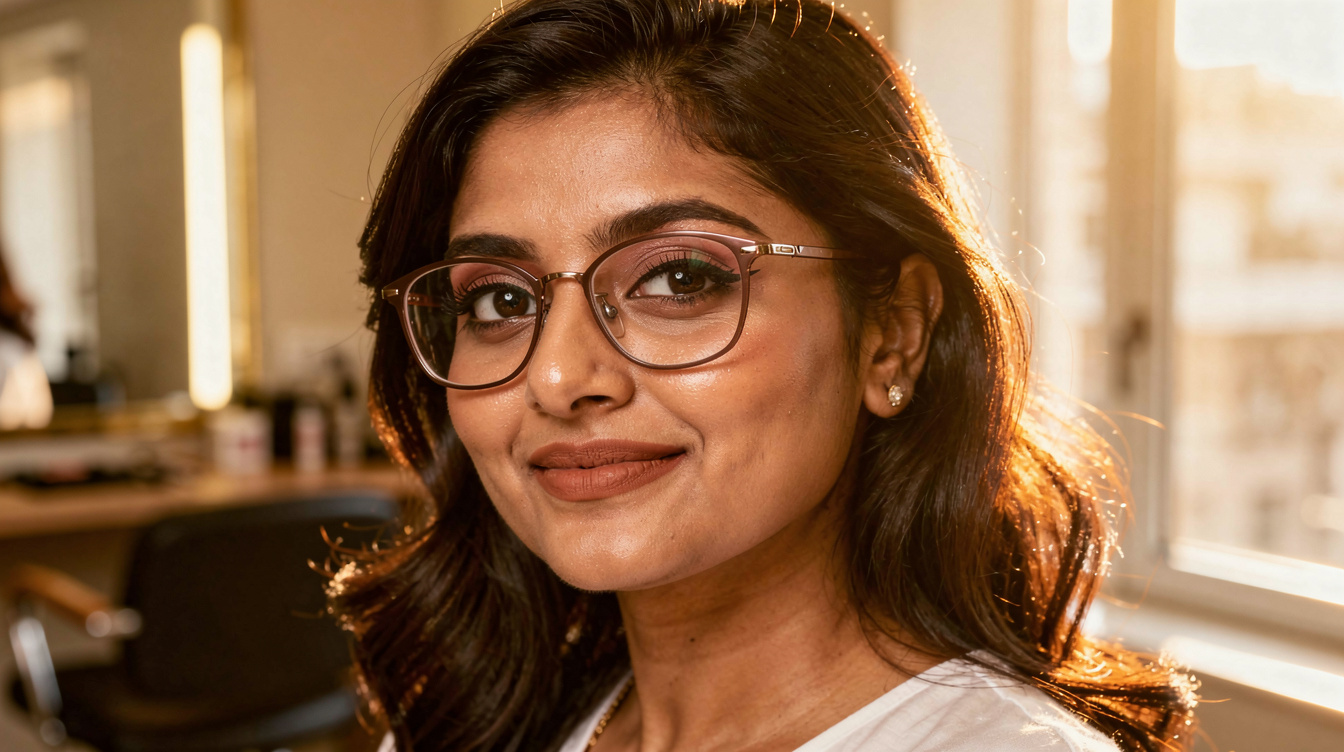
Eye work is where most makeup artists actually win or lose a face. Skin can be evened, lips can be filled, but the eyes are where a bride’s photograph stops being a flat snapshot and starts feeling like her. So the question keeps arriving in our DMs in Faridabad — is there a serious eye makeup course in India for 2026, can a student just learn the eyes and skip the rest, and what does it actually cost? In this guide we walk through the real options on the market, what an eye-only programme can and can’t do for your career, and how the eye block inside our 20-Day Professional Makeup Course compares.
We’re answering this from the perspective of a working bridal studio in Sector 16 Huda Market, Faridabad, where Shivangi Verma personally teaches every batch and has been doing eye work on real brides for fourteen years. Some of what we’ll say will sound counter-intuitive — an eye-only course is genuinely the right answer for some readers, and an expensive detour for others. We’ll be honest about both, and we’d rather you walk away with a clear-eyed decision than a sale you’ll regret.
If you’re already certain you want the full bridal-track training, you can skip the comparison and look at our Basics to Advanced course directly. If you’re still weighing a workshop versus a complete programme, read on — the next ten minutes will save you the cost of buying the wrong product.
Why eye-only courses exist and who they suit
Eye-only courses exist for a real reason. The eye is the most technical surface on a face — it has its own anatomy, its own folding behaviour, and a list of dedicated tools (pencil, gel, liquid, kohl, glitter adhesive, lash strips, individual lashes, brow soap, brow lamination kits) that most beginner courses simply can’t fit into a curriculum without thinning everything else out. So the Indian market has responded with short, dense, eyes-only programmes priced anywhere from Rs. 8,000 to Rs. 60,000 depending on the trainer, the city and the contact hours.
Who do these courses actually suit? In our honest read, four kinds of student.
First, the self-taught Instagram artist who already books party and engagement clients but knows her eyes look flat in photographs. She doesn’t need a foundation course; she needs cut-crease, halo and graphic-liner technique. Second, the working salon makeup artist whose original academy training was strong on skin and weak on eye drama — many salon programmes still treat the eye as a thirty-minute module sandwiched between contour and lip. Third, the bride-to-be who wants to learn her own eye look for the engagement or sangeet but has no intention of going professional. Fourth, the career-curious beginner who wants to test whether she even enjoys the craft before she commits to a longer programme.
If you’re in any of the first three categories, an eye-only course can be excellent value. If you’re in the fourth — the career-curious beginner — we’d gently push back, and we’ll explain why later in the decision framework.
What’s covered: cut-crease, smokey, halo, soft glam
The vocabulary of eye makeup has expanded enormously in the last five years. A serious eye-makeup-only course in India should now cover, at minimum, the techniques below — and you should see them named explicitly in the syllabus before you pay for anything.
Classic smokey eye. Still the foundation skill. Black, brown, plum, bronze and burgundy variants. Diffusion through the crease, blend points, lower-lash treatment, and the distinction between a soft Indian-bridal smokey and a hard editorial smokey. If a course doesn’t drill smokey eye properly, nothing else will hold up — every advanced look borrows from this technique.
Cut-crease. The technique that broke through on Instagram around 2017 and is now a default request from sangeet and reception clients. Hard-line crease, eyelid pop colour, and the hygiene side — clean concealer, sharp brushes, and not letting the cut-line muddy when the bride blinks during a four-hour shoot. Cut-crease is unforgiving; small errors are visible from across a banquet hall.
Halo eye. The reason a bride’s eye looks “lit” in wedding photographs. A central shimmer, darkness pulled outward and inward, and inner-corner highlight placement that holds up under flash. Halo work is where premium products start to matter — pigment density and shimmer-particle size from a brand like Huda Beauty, Charlotte Tilbury or Pat McGrath behaves visibly differently from drugstore equivalents under camera.
Soft glam. The “I want to look like myself but better” request — the one we hear most often from intimate-wedding brides and corporate-event clients. Neutral mattes, gentle shimmer, restrained liner. Soft glam is technically the hardest of the four because there’s nowhere to hide; every brush stroke shows, and there’s no drama to mask a sloppy blend.
Adjacent skills. Brow shaping (powder, pencil, soap, pomade), lash application (strip, cluster, individual), and the colour-theory frame for matching eye work to lehenga shade and skin undertone. A course that omits these is selling you a partial skill that will fall apart on a real client. We’d also expect a serious programme to spend time on under-eye concealing technique, because that’s where most beginners’ eye work collapses — beautiful shadow placement undone by a heavy concealer crease by hour three.
What we’d avoid: any short-format course promising to also cover full base, contour, lip and bridal hair in the same week. That isn’t an eye course; that’s a thin foundation course rebranded.
Workshop-tier options vs full bridal-track training
The Indian market currently splits eye-makeup education into three rough price tiers. We’ll describe them honestly, including where each one stops being useful.
Tier one — the weekend workshop, Rs. 5,000 to Rs. 15,000. One or two days. Usually demonstration-led — the trainer does an eye on a model while a room of fifteen to thirty students watch. You may get one practice round on yourself, but rarely on a different face. Honest assessment: useful as a refresher for someone who already knows the basics, almost useless for a beginner. Demonstration without supervised practice does not transfer skill — muscle memory only forms when somebody corrects your brush angle in real time.
Tier two — the focused eye-only programme, Rs. 20,000 to Rs. 60,000. Four to ten days. Smaller groups, hands-on practice on each other or on volunteer models, written notes, sometimes a kit. This is the genuine eye-only category. Pick carefully — the difference between a Rs. 25,000 and a Rs. 55,000 programme is usually the trainer’s actual booking volume (are they an active working artist or only a teacher?), the product quality on the trainer table, and whether your final work is photographed under proper lighting.
Tier three — the full professional programme that includes deep eye work, Rs. 80,000 to Rs. 1,50,000+. This is where Shivangi Verma’s makeup course sits, currently at an early-bird rate of Rs. 80,000 + GST (regular fee Rs. 1,50,000 + GST) — a saving of Rs. 70,000, available for a limited window around the upcoming June 1 batch. You’re not paying for eyes alone here; you’re paying for skin, eyes, brows, lashes, lips, contour, hairline blending, hair, draping consultation and client-handling, with eye work integrated across every day rather than siloed into a single module.
If your goal is a career, tier three is almost always the better economics. A standalone eye course will sharpen one skill; it won’t qualify you to take a Rs. 28,000 bridal booking on your own, because brides don’t book on eye skill alone — they book on the entire face holding up for ten hours.
How the 20-Day Professional Course handles eye work in depth
We’ll explain how eye work is actually woven into our programme, because this is the question we get most often on WhatsApp.
The course runs for 20 days, 12 PM to 5 PM, at our Sector 16 Huda Market studio in Faridabad. Batches are capped at 10 students. That cap is non-negotiable — Shivangi personally walks each student through eye placement, brush angle and product layering, and that doesn’t scale beyond ten in a five-hour day. Ten is the number we landed on after years of running smaller and larger groups; below ten the energy in the room flattens, above ten the personal correction breaks down.
Eye work isn’t a discrete module on Day 4 or Day 8 — and we deliberately don’t publish a literal day-by-day breakdown, because the rhythm shifts with each batch’s starting level. What we will say is that the eye thread runs across the full twenty days. Early sessions establish anatomy, brush selection, and the four core looks (smokey, cut-crease, halo, soft glam) on each student’s own face. Middle sessions move onto live models — a different face every few days, because a hooded eye behaves nothing like a deep-set eye, and the only way to learn that is to do it. Later sessions integrate eye work with full bridal looks for HD Makeup, Airbrush, Glass Skin and traditional bridal photography conditions, where flash, tungsten and natural light each treat shimmer differently.
You’re trained on the products we actually use on paying brides — MAC, NARS, Dior, Huda Beauty, Fenty Beauty, Laura Mercier, Haus Labs and Charlotte Tilbury, plus a curated selection of Indian and imported gel and liquid liners and lash systems. The fee includes specially curated training products for use during the course, a professional brush kit that’s yours to keep, certification on completion, a final assessment shoot with a professional model (eye work is graded explicitly, with the photographs delivered to you for portfolio use), and lifetime alumni support for product, pricing and client questions after you start working.
One fear we hear constantly from prospective students — and it deserves a direct answer — is “I’ll spend close to a lakh and learn nothing useful.” It’s a legitimate worry, and we hold it in mind every batch. Our answer is structural, not promotional. Every day is hands-on on real skin, not slide decks. Shivangi teaches in the room, not by sending a senior assistant to cover for her. The final assessment is photographed under proper lighting so you leave with portfolio-grade images of your own eye work — not just a printed certificate. And alumni support means we keep answering your questions after the twenty days end, including the ones that only come up once you’re charging your first paying client. If a programme can’t show you those four things, the lakh is genuinely at risk.
For the full eye-work module breakdown matched to your specific starting level — complete beginner versus salon-trained versus self-taught — message us on WhatsApp at +91 9354888093 and we’ll send a personalised note. Shivangi answers these herself; she’s been operating as a working bridal MUA since 2012, has served over a thousand brides, and holds international certification from Makeup Studio in the Netherlands, so the recommendation will reflect what actually works on real wedding-day timelines.
Decision framework: workshop now, full course later
Here is the honest framework we share with prospective students who walk into our Faridabad studio undecided.
Pick a one-day workshop (Rs. 5,000–15,000) if: you already have a working makeup business, you only need to refresh one technique (typically halo or graphic liner), and you’ve already invested in a decent kit. Don’t pick a workshop hoping it will teach you the craft from zero — it won’t, and the disappointment will sit on top of the fee.
Pick a focused eye-only programme (Rs. 20,000–60,000) if: you’re a salon artist whose original training was light on eye work, you book parties and engagements but not bridals yet, and you have a specific gap to close. Verify the trainer is an active working artist and not a full-time educator. Verify hands-on hours, not just demonstration hours. Ask for the names of three students from the last batch and message them.
Pick a full professional programme (early-bird Rs. 80,000 + GST) if: you want a career, not a side skill. If your endpoint is taking your own bridal bookings — eight thousand for a party face, twenty-eight thousand for a bridal function, fifty thousand for outstation work — you need the full integrated training, not eye work on its own. The fee maths only works when you can charge bridal rates within the first year, and that requires the skin, hair and client-handling layers as well.
The trap we see most often is the student who buys a Rs. 25,000 eye course expecting it to translate into bridal bookings. It rarely does, because brides don’t book on eye skill alone — they book on skin longevity, photograph performance and the trust signal of a complete portfolio. The eye course was good; it just wasn’t the right product for that goal.
If you’re still weighing the decision, the next step is conversation, not commitment. Fill the inquiry form with your starting level and your goal, or message us directly. We’ll tell you honestly whether the 20-Day course is the right fit or whether a focused workshop would serve you better — we have turned away students whose goal didn’t match the programme, and we’d rather do that than take a fee we don’t deserve.
20-Day Professional Makeup Course · Sector 16 Faridabad
Become a Professional Makeup Artist — Basics to Advanced
Hands-on training on real skin, only 10 students per batch, taught personally by Shivangi Verma — an active working bridal MUA with 14+ years and 1,000+ brides. Products, professional brush kit, certification and final assessment shoot all included.
Rs. 1,50,000 + GST → Early Bird: Rs. 80,000 + GST (save Rs. 70,000 — limited time)
💬 WhatsApp +91 9354888093 | Fill Inquiry Form | View Course Page →
Frequently asked questions
Is an eye-only course enough to start a makeup career in India?
Honestly, no — not on its own. An eye-only course will sharpen one skill, but it won’t qualify you to take a full bridal booking. Brides pay for skin longevity, hair, draping coordination and portfolio confidence as much as for eye drama. If your endpoint is a paying career, treat an eye-only course as a refresher tool rather than a starting point. A full programme like our 20-Day Professional Course covers the integrated skill set — base, eyes, lips, hair and client handling — which is what gets you actually booked at bridal rates.
How much does an eye makeup course cost in India in 2026?
Pricing in India in 2026 splits into three bands. Weekend workshops run Rs. 5,000 to Rs. 15,000. Focused multi-day eye-only programmes run Rs. 20,000 to Rs. 60,000. Full professional programmes that include deep eye work — like our 20-Day course — currently run at an early-bird Rs. 80,000 + GST (regular Rs. 1,50,000 + GST). Always verify what’s actually included: product kit, brush kit, hands-on hours on real models, certification, and post-course support. The headline fee can be misleading if half of it is theory.
Will I waste my money if I take a full course when I only want to learn eyes?
If your goal is genuinely “just eyes for my own engagement” or “refresh one technique”, then yes — a full course is over-investment, and a focused workshop is the right product. But if there’s any chance you’ll take paid bookings, a full programme is almost always cheaper in the long run. We’ve watched students buy three short workshops in a year and still need a full course to feel confident enough to charge bridal rates. The cumulative spend ends up higher than starting with the integrated programme.
Do you offer an eye-only short course at the Faridabad studio?
We focus on the 20-Day Professional Makeup Course because that’s where we can genuinely take a student from zero to bookable. We periodically run shorter focused sessions for working artists who need a specific technical upgrade, and we’d rather you message us on WhatsApp at +91 9354888093 with your starting level so we can recommend honestly — sometimes the answer is a workshop, sometimes it’s the full programme, and we’re happy to say so either way without pushing the bigger fee.
Will I get hands-on practice or is it mostly demonstration?
This is the most important question to ask any course before you pay. In our 20-Day programme the day is structured as a short demonstration followed by supervised hands-on practice on yourself, your batch-mates and live models. The 10-student batch cap exists specifically to keep that ratio high — every student gets eye-on-eye correction from Shivangi within the same five-hour window. If a course can’t tell you the demonstration-to-practice ratio explicitly, treat that as a warning sign and ask again.
What products will I learn to use in the eye sections?
You’ll work with the brands we actually use on paying brides — MAC, NARS, Dior, Huda Beauty, Fenty Beauty, Laura Mercier, Haus Labs and Charlotte Tilbury for shadows and shimmers, plus a curated selection of liquid and gel liners and lash systems. Premium pigment density matters more on the eye than anywhere else on the face, especially under flash, and we believe in training students on the same products they’ll need in a working kit so the skill transfers directly to client work without a re-learning curve.
Whether you ultimately choose a workshop or our professional makeup course in Faridabad, we hope this guide saves you the cost of buying the wrong product. Eye work is one of the most rewarding crafts in makeup — it deserves to be taught properly, by an artist who is still actively working on real brides, in a room small enough that your brush angle gets corrected before it becomes a habit. If you’d like to talk that through with us directly, our WhatsApp line is open at +91 9354888093, or you can fill the course inquiry form linked above and we’ll come back to you the same day.