
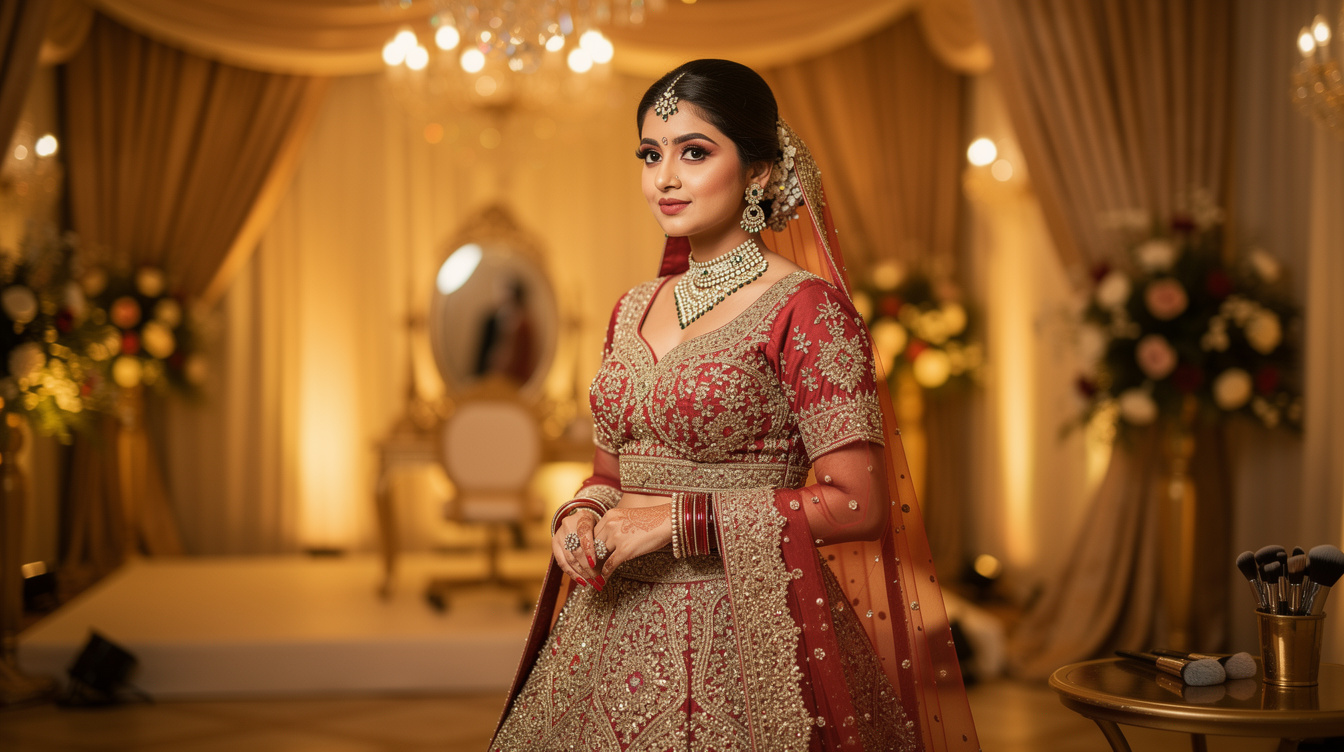
Every few weeks, our DMs fill up with the same hopeful question: “Ma’am, are there any free makeup courses in India? I really want to learn but I cannot pay right now.” We understand the fear behind that message — the worry that an entire career might sit on the wrong side of a fee cheque, the suspicion that the people who succeed are the ones whose families could afford to bet on them. So we want to do something genuinely useful in this piece: walk through every credible free option in India in 2026, tell you honestly what each one teaches and what each one hides, and then — only at the end — explain how our own 20-Day Professional Makeup Course in Faridabad is structured so the price is not the wall it looks like at first glance.
This is not a sales review dressed up as advice. We have taught hundreds of students in our Sector 16 Faridabad studio, and we have seen the gap between what someone learns in a free YouTube series or a one-day brand workshop and what a paying bridal client expects to sit in front of on her wedding morning. Both can coexist. Free education is a real, legitimate first rung — millions of artists started there, including many we admire. The question is never “free or paid”; the question is what does each level actually deliver, and where does it stop being enough. That is what we want to be precise about today, because the cost of being wrong here is not the course fee — it is two or three years of stalled progress.
If you are reading this with a notebook open and a budget of zero, you are exactly the person we wrote it for. We will not pretend our paid program is the only path. We will tell you what we genuinely think, including which free routes are worth your weekends and which ones are dressed-up advertising. And if at the end you decide that our Basics to Advanced course is the right next step, you will at least walk in knowing exactly why — not because someone scared you into it.
What’s actually ‘free’ (and what’s hidden)
The first honest thing to say about free makeup courses in India is that very few of them are free in the way the word suggests. There is almost always a hidden cost — and not always a financial one. Sometimes it is your data, sometimes it is your time, sometimes it is your kit. Before you sign up for anything that markets itself as no-cost, run through the four hidden-cost categories below and ask which ones apply.
The product cost. Most genuinely free workshops do not provide products to practise with. You bring your own kit. A serious beginner kit — even with budget brands — runs Rs. 8,000 to Rs. 15,000 for foundations across three to four undertones, a usable concealer, a small eyeshadow palette, blushes, lashes, brushes, sponges, setting spray and a primer. If a course is “free” but assumes you already own this, the real cost is the kit you have to assemble before day one. For comparison: when we run our paid course, the curated training products and the professional brush kit are included and yours to keep — that single line item alone closes most of the gap to the fee.
The model cost. Makeup is not learnt on your own face in a mirror. You learn it on other skin tones, other eye shapes, other ages, other photographic conditions. Free courses almost never provide live models — you are expected to find your own friends, sisters, neighbours. That is genuinely difficult for many beginners, especially women in conservative households who cannot keep dragging acquaintances over for practice. The hidden cost is either the social capital you spend on favours, or the months of practice you do not actually do because you ran out of faces.
The time cost. A YouTube playlist that promises a complete makeup course in fifteen videos is genuinely free of money but it costs you the most expensive resource you have, which is structured time. The reason a 20-day intensive works is precisely because someone has already done the curation — picked which technique to teach when, in what order, with which corrections — so you are not spending six months in a fog deciding whether you should learn baking before contour or contour before baking. Free playlists do not solve the curriculum problem. They are a library, not a syllabus.
The certification cost. Many “free” workshops are loss-leaders for paid certification. The two-hour session is free; the certificate that lets you put the workshop on your resume is Rs. 4,000 to Rs. 12,000. There is nothing dishonest about this model — the brands are running a business — but you should know the actual price before you walk in expecting to walk out with paper.
Government skill-development schemes — realistic expectations
India does have genuinely free makeup-adjacent training routes through government skill-development programs. The Pradhan Mantri Kaushal Vikas Yojana (PMKVY) has historically offered Beauty & Wellness sector courses through accredited training partners, and several state-level programs run similar tracks. The certification is valid, the training is structured, and the fee is genuinely zero — sometimes there is even a small stipend.
Here is what we want you to understand before you decide a government scheme is your full answer. The Beauty & Wellness modules are designed for general salon employability — facials, threading, basic hair, basic party makeup, hygiene and salon protocols. They are excellent at what they are designed for. They are not designed to produce a wedding-ready bridal artist who can walk into a Rs. 28,000-per-function booking with confidence. The advanced techniques that drive bridal income in 2026 — HD Glass Skin, Ultra HD finishing, Airbrush, soft-glam structuring, lasting work that survives a Faridabad summer or a destination beach ceremony — are not on the standard PMKVY syllabus, and they were never meant to be.
So our honest recommendation is this. If you can get into a government beauty-and-wellness program, take it. It is real training, it is real certification, it is real free. Use it as your foundation layer — your understanding of skin types, contraindications, salon hygiene, basic application. Then layer specialised paid training on top when you are ready to commit to bridal as a career, not as a curiosity. The two are complements, not substitutes.
The practical caveat: seat availability is highly variable. Centres open and close, batches fill quickly, and the syllabus differs between training partners. Check the official Skill India portal for currently active centres in your district rather than relying on month-old listings. A genuinely free seat in your own city is worth far more than a paid seat far away.
Influencer-led free workshops — quality vs marketing
The biggest growth in “free” makeup education in 2026 has come from social-media-led workshops. Brand-sponsored masterclasses on Instagram Live, free webinars from YouTube creators, weekend pop-up sessions in metro cities, and brand-store demonstration events. We want to be careful here, because there is real value mixed with a lot of theatre.
The real value: top-tier creators genuinely know their craft, and watching a skilled artist verbalise why they are placing a colour somewhere — not just where — is one of the fastest ways to upgrade your eye. A two-hour live where someone walks through a Glass Skin base and explains the order of products, the temperature of the cream blush, why they avoid powder under the eye on certain skin types, is genuinely worth two hours of your life. Some of our own students keep watching long-form creator content even after enrolling, and they are right to.
The marketing layer: most free brand workshops exist to sell the brand’s product line. The technique demonstrated is technically correct, but it is also engineered around the four to six SKUs the host wants you to remember. You will not learn when to switch from a MAC foundation to a NARS one for a different undertone, or why a Laura Mercier setting powder behaves differently from a Huda Beauty one in HD video. You will learn one path, taught beautifully, with that brand’s hero products. That is a useful introduction, not a complete education.
Our suggestion: take everything free that comes from a creator whose own work you admire. Watch how they handle skin specifically — base work is where most beginners plateau. But do not mistake the volume of free content for the structure of an actual education. Ten unrelated masterclasses from ten creators is not a curriculum. It is ten clips. The brain is good at hoarding clips and bad at sequencing them into competence.
When free is enough, when paid is necessary
This is the question that matters most, so we will answer it without hedging. Free is enough when your goal is personal — you want to do your own makeup well, your sister’s makeup for her engagement, your own everyday skill upgrade. For that goal, a combination of a government beauty-and-wellness module plus consistent free creator content plus a kit you build over six months is genuinely sufficient. We have students who came in already strong on their own faces because they did exactly this for two years before enrolling.
Paid training becomes necessary the moment your goal turns commercial — when someone is going to pay you for the work, when their wedding photographs are going to outlive your career, when their family is going to scroll past your reels and decide whether to recommend you. That changes the standard. A bride does not care that you watched the right YouTube playlist. She cares that her base does not break at 4 PM under the haldi heat, that her lashes are stable through aarti, that the photograph her photographer takes at the pheras does not flashback white in the cheekbone. None of that is taught reliably in free formats — not because creators are hiding it, but because consistent commercial-grade work requires repetition under correction, and free formats cannot give you live correction on your own hand.
This is the second worry we hear from students considering paid training: “I’ll waste a lakh and learn nothing useful.” The fear is fair. We have seen students arrive at our studio after Rs. 60,000-Rs. 90,000 spent at programs that ran them through theory PowerPoints and group watch-alongs. The reason that fear should not stop you from training at the right place is that the fix is not avoiding paid courses — it is choosing one where the trainer personally puts a brush in your hand on day one and corrects you in real time, where the batch is small enough that nobody hides at the back, and where the work is on real human skin, not on a half-painted practice board. “Shivangi knows her job very well — totally involved, dedicated and patient,” is something we read in our own reviews regularly, and the only reason we read it regularly is that the format requires it.
The third worry, almost as common: “I won’t get clients after the course.” This is where the curriculum gap between free education and serious paid training becomes most expensive. Free content teaches makeup. It does not teach pricing your first three brides, drafting a service brochure, handling a trial appointment so the bride books, managing a wedding-morning timeline with a hairstylist and a drapist in the same room, surviving an outstation booking without losing your kit on a baggage belt. Those are business skills, and we teach them in our 20-day course explicitly because makeup-only training is exactly how artists end up with certificates and no calendar.
Why early-bird Rs. 80,000 is structurally affordable
We want to address the price question head-on, because pretending it is small would be insulting. Our regular course fee is Rs. 1,50,000 + GST. The current early-bird rate is Rs. 80,000 + GST — a saving of Rs. 70,000 for the limited window we are running this batch at. That is still a significant amount of money for an aspiring artist, and we are not going to pretend otherwise. What we want to do is show you the underlying maths, because once you see what is included, the comparison with “free” is no longer fee-versus-zero — it is total-cost-of-becoming-employable versus total-cost-of-becoming-employable.
The course is 20 full days, 12 PM to 5 PM, at our Sector 16 Huda Market studio in Faridabad. Batch size is capped at 10 students — small enough that every person gets hands-on correction every single day, not group demonstrations they watch from the back. Included in the fee: a curated set of training products that are yours during the course, a professional brush kit that is yours to keep when you leave, certification on completion, a final assessment shoot with a professional model so you walk out with portfolio images, and lifetime alumni support — meaning when a bride asks you something six months later that you do not know how to handle, you can still WhatsApp us. Course content runs from foundational skin work all the way through HD Makeup, Airbrush, Glass Skin and bridal techniques, and includes the client-handling and business skills we mentioned earlier.
Now strip the fee apart. A serious bridal-grade kit assembled independently runs Rs. 35,000 to Rs. 60,000 for usable foundations across undertones, premium concealers, professional brushes, lashes, setting products and the airbrush gun if you go that route. A portfolio shoot with a professional model and an external photographer in Delhi NCR is Rs. 15,000 to Rs. 25,000 done well. Twenty days of one-on-one mentorship from a working bridal MUA priced at her booking rates would be a multiple of the entire course fee on its own. The certification, the structured curriculum, the live-model practice — those are layered on top, not in place of.
The trainer is Shivangi Verma — 14+ years in the industry, 1,000+ brides, certified from Makeup Studio in the Netherlands, an active working bridal MUA with 62 Google reviews and a 5-star rating. We say “active working” deliberately. There are programs in this country taught by full-time educators who have not done a paying bridal in years. We are not one of them. The same artist who is on a bridal call this Saturday is teaching the Tuesday batch on Monday. That is the core promise: you are learning from someone whose hands are on real brides, this season, in this market.
If even after all this the early-bird fee is genuinely beyond reach right now, do not feel pressured. Build your free foundation first. Watch creators you respect. See if you can place into a government beauty-and-wellness module. Save through a year of party makeups in your own neighbourhood at Rs. 2,000-Rs. 4,000 a face. Come to Shivangi Verma’s makeup course when you are ready, not when someone has rushed you into it. We will be here. The early-bird is structured to be the most accessible point of entry, but it is still the right decision only when it is the right time for you.
If you want to talk through whether the timing is right, the simplest path is to message us on WhatsApp at +91 9354888093 with your background and what you are hoping to do, or Fill the inquiry form and we will reach out. We promise not to hard-sell. We will tell you honestly whether the next batch is the right fit, or whether you should keep building free for another six months first.
FAQ
Are there any genuinely free makeup courses in India in 2026?
Yes — but mostly through government skill-development programs like PMKVY’s Beauty & Wellness sector modules, which run through accredited training partners across India. They are genuinely free, the certification is real, and a small stipend is sometimes included. The trade-off is that the syllabus is built for general salon employability, not for bridal artistry, so it is best treated as a foundation layer rather than a complete career path. Influencer and brand workshops are also widely available at no fee, but most are short-format introductions rather than structured courses.
Will a free YouTube playlist actually prepare me for paid bridal work?
Honestly, no — not on its own. Free content from skilled creators is excellent for upgrading your eye and learning individual techniques, and many working artists keep watching it forever. But playlists are libraries, not curricula, and they cannot give you live correction on your own hand or supply real models across skin tones. For personal use it is enough. For accepting money from a paying bride, you need at minimum structured live-model practice with someone correcting you in real time.
Will the 20-Day course really prepare me for a career as a bridal artist?
That is the explicit goal of the format. The course runs 20 days, 12 PM to 5 PM, in a 10-student batch — meaning every student gets daily hands-on practice on real models with personal correction from Shivangi, who is herself an active working bridal MUA. The curriculum runs from foundational skin work through HD Makeup, Airbrush, Glass Skin and bridal techniques, and includes client handling and business skills so you walk out able to take bookings, not just apply makeup. The included final assessment shoot gives you portfolio images to start with on day one of your career.
What if the academy isn’t reputable enough — how does this compare with the big-name chains?
Reputability for a working artist comes from the trainer’s own track record, not the size of the chain. Shivangi has been operating since 2012 — 13+ years in the industry — trained at Makeup Studio in the Netherlands, has done 1,000+ brides, holds a 5-star rating across 26+ verified WedMeGood reviews, and personally leads every appointment rather than delegating to juniors. That is the difference between learning from someone who is currently doing the work and learning from a brand-managed curriculum delivered by rotating staff.
I’m a complete beginner — am I too inexperienced to enrol?
Not at all. The course is named Basics to Advanced for exactly this reason — it is designed to take a complete beginner from foundational skin work all the way through advanced bridal technique within the 20-day format. We have students every batch from very different backgrounds: career changers in their thirties, school-leavers in their late teens, salon professionals upgrading into bridal. The small batch size means the pace adapts to where you actually are, not where the syllabus assumes you should be.
What’s actually included in the early-bird Rs. 80,000 + GST fee?
20 days of full-day training (12 PM to 5 PM) at our Sector 16 Huda Market studio in Faridabad, capped at a 10-student batch, taught personally by Shivangi. Specially curated training products are provided for the duration of the course, a professional brush kit is included and yours to keep, certification is awarded on completion, a final assessment shoot with a professional model is included for portfolio building, and lifetime alumni support is included so you can reach out after the course as questions come up in your real bookings. The regular fee is Rs. 1,50,000 + GST; the Rs. 80,000 + GST early-bird is a limited-time rate, saving Rs. 70,000.
20-Day Professional Makeup Course · Sector 16 Faridabad
Become a Professional Makeup Artist — Basics to Advanced
Hands-on training on real skin, only 10 students per batch, taught personally by Shivangi Verma — an active working bridal MUA with 14+ years and 1,000+ brides. Products, professional brush kit, certification and final assessment shoot all included.
Rs. 1,50,000 + GST → Early Bird: Rs. 80,000 + GST (save Rs. 70,000 — limited time)
💬 WhatsApp +91 9354888093 | Fill Inquiry Form | View Course Page →
If this review has been useful, the most honest closing thing we can say is: do not be in a hurry. The artists who last in this industry are not the ones who picked the cheapest training, and they are not the ones who picked the most expensive — they are the ones who picked the right next step at the right time. If you are still in the explore phase, lean on every legitimate free resource you can find. If you are ready to turn it into a career and want to do that under the personal guidance of a working bridal artist with a 14-year track record, our professional makeup course in Faridabad is genuinely the format we have built for exactly that moment. Either way, we are rooting for you.