
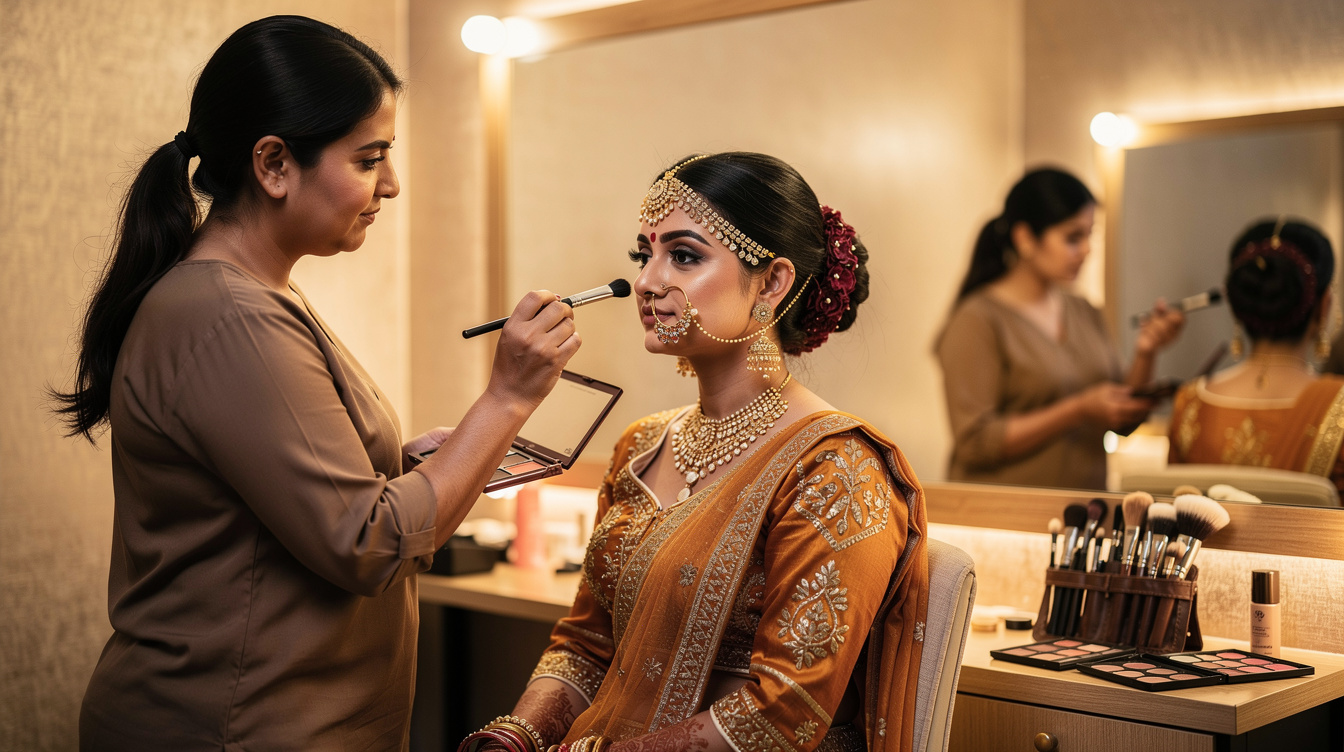
If you are about to invest a year of your life — and a meaningful chunk of money — in becoming a professional makeup artist, the question is not really can I learn this craft. The question, almost always, is the quieter one: how long will this career actually last me? Five years? Ten? A whole working life? We get this question every single week from women who walk into our Sector 16 studio in Faridabad to ask about the 20-Day Professional Makeup Course, and the honest answer is more nuanced than the Instagram highlight reel suggests.
Here is the truth as we have lived it: makeup artist career longevity in India is wildly bimodal. Some artists burn out in 18 months and quietly slip into a different industry. Others — the ones who plan deliberately — are still raising rates, still booking destination brides, still teaching, fifteen years in. The difference between those two outcomes is almost never raw talent. It is structure, body, business model and community. That is exactly what we want to walk you through in this long-form piece, written from the perspective of an active bridal MUA who has been on the floor since 2012, has put 1,000+ brides into bridal lehengas, and now teaches the next generation through our Basics to Advanced course in Faridabad.
Whether you are a 22-year-old freelancing out of your bedroom, a corporate professional thinking about a career switch at 34, or somewhere in between, the patterns we describe below are the same. Burnout is a craft hazard, not a personal failing. And longevity, in this industry, is a skill you build on purpose.
What ‘career length’ even means in this industry
The first honest thing we have to say is this: there is no single number. “Career length” for a makeup artist is not like a corporate job where you serve thirty years and collect a pension. It is closer to the trajectory of a working photographer, a chef or a freelance designer — your career has phases, and each phase has its own demands and its own exit ramps.
For working purposes, we categorise makeup artist career length into four overlapping phases. Phase one is the apprenticeship year — months 1 through 12, where you are post-course, taking on small parties, family functions, the occasional engagement, and learning what your hand actually does under pressure. Phase two is the booking ramp — roughly years two through four — where you are slowly raising rates, doing your first ten or fifteen brides, building an Instagram body of work, and starting to say no to ₹3,000 party bookings. Phase three, which most artists never reach, is the stability phase — years five through ten — where you have a recognisable signature, a referral pipeline that no longer depends on Instagram algorithms, and a price point that lets you choose your work.
Phase four is what we are most interested in for this article: years ten and beyond. This is the phase where you either pivot — into teaching, studio ownership, brand collaborations, content — or you quietly slow down. Internationally, you can find working makeup artists in their sixties on film sets and behind the chair. In the Indian bridal market specifically, the pattern is that the artists who are still actively doing brides at year fifteen have almost always built a second income stream by year seven. The pure freelancer who only does weddings and never builds anything else is the one most at risk of leaving the industry around year four or five.
Realistic burnout patterns for new artists
Let us talk about makeup artist burnout properly, because this is the part the marketing brochures skip. Burnout in this industry is rarely about loving the work less. It is about the body, the calendar and the cash flow refusing to keep up with each other. We see four very specific burnout patterns in artists during their first three years.
Pattern one: the wedding-season collapse. Indian bridal seasons cluster — November through February, and a smaller burst around April-May. A new artist will say yes to twenty-six weddings in three months because the money is finally arriving. By function fifteen they are sleeping four hours a night, doing 4 AM trials, eating one meal a day in a banquet hall green room, and standing on their feet for ten-hour stretches. The body breaks before the season does. Lower back, wrists, and shoulders are the first to go. We have personally watched promising artists vanish from the industry by their second wedding season because nobody told them how to pace.
Pattern two: the Instagram comparison spiral. Newer artists scroll Instagram between bookings, see what looks like nonstop bridal work from peers, and conclude they are failing. Most of those reels are six months of work compressed into a 30-second edit. The artist starts undercutting their own rates to chase volume, exhausts themselves servicing low-paying clients, and resents the craft within eighteen months. This is creative burnout dressed up as economic burnout — and it is preventable with even basic mentorship.
Pattern three: the skin-and-eye burnout. Constant exposure to pigments, glitter dust, false lash adhesives, hairspray, setting sprays and studio lighting will absolutely take a toll on your own skin and your eyes if you do not protect them. We have artists in our network who developed contact dermatitis on their hands by year three because they never wore gloves during prosthetics or strong-pigment work. This is a quiet burnout — it does not look dramatic on Instagram, but it is the reason a lot of artists slow down at year five or six.
Pattern four: the cash-flow crash. Wedding-season income is feast-or-famine. Artists who do not build off-season revenue (parties, editorials, courses, content collaborations, retail counter freelancing) will hit a March slump every year, panic, and either start undercharging or take a part-time corporate job that quietly swallows their MUA career. We address this head-on inside the 20-Day Professional Makeup Course because it is genuinely the single biggest predictor of who is still working at year five.
How active artists stay long-term
The artists we know personally who are still booking brides at year ten and year fifteen are not lucky. They have done specific things, on purpose, that look mundane until you connect the dots.
They protect their hands and shoulders like an athlete protects a knee. That means a non-negotiable stretching routine before a 6 AM bridal call, ergonomic stools instead of standing for the entire face, and an honest conversation with themselves about hand fatigue. We use weight-balanced brush sets in the studio for exactly this reason — a brush that is too short or too heavy at the ferrule will ruin your wrist over a decade.
They invest in product literacy, not product hoarding. A long-career MUA can describe exactly why MAC Pro Longwear performs differently from NARS Sheer Glow on oily skin, why Laura Mercier translucent powder photographs cleaner than a tinted alternative under tungsten light, and when a Charlotte Tilbury Hollywood Flawless Filter is doing the heavy lifting versus when a Dior Forever base is the right call. They use Huda Beauty palettes for warm bridal eyes when the brief calls for it, reach for Fenty Beauty’s deeper foundation range when working with skin tones the older brand pyramids historically ignored, and lean on Haus Labs for HD-friendly long-wear formulas. Brand fluency is what lets you raise rates at year five without losing clients.
They diversify revenue early. A pure-bridal MUA in Delhi NCR is at the mercy of the calendar. Artists with longevity have at least two of the following running parallel by year three: a teaching arm (private students or short workshops), an editorial / content arm (working with photographers on shoot days), a brand collaboration arm (UGC, masterclass partnerships), or a retail arm (consultations, masterclasses for clients). Diversification is not greed — it is what stops the March slump from killing your career.
They schedule recovery aggressively. The artists we admire most block out the Tuesday and Wednesday after a Sunday wedding. No client calls, no trials, no reels filming. The body is allowed to actually reset. This sounds obvious until you realise how few artists in their first three years do it.
They never delegate the bride. This one is personal for us. Shivangi Verma personally leads every single bridal appointment — never a junior, never a substitute. Counterintuitively, this is also a longevity strategy. Artists who try to scale by sending juniors to brides almost always lose their reputation within five years, because reviews follow the chair, not the brand. Reputation compounds; delegation dilutes.
The transition from solo MUA to studio owner / trainer
Somewhere between year five and year eight, every serious artist faces the same fork. You can keep being a solo freelancer, in which case your income is permanently capped by the number of faces your two hands can do per week. Or you can transition into one of two more durable models: studio owner, or trainer-academy founder.
The studio model means a permanent address — in our case, the first-floor studio at Booth No 70-71, Sector 16 Huda Market, Faridabad — where clients come to you instead of you racing across NCR with a kit. It compounds neighbourhood reputation. It stabilises overhead because you are not paying per-booking travel. And it gives you a physical space that doubles as a teaching environment when you are ready for that step.
The trainer-academy model is the longest-tail income stream available to a working MUA. Done right, your batches teach themselves out as your alumni become referral engines. Done wrong — by hiring strangers to deliver your curriculum — it cannibalises the brand that took you ten years to build. The artists who make this transition successfully tend to teach personally, in small batches, with honest feedback. That is exactly the architecture of Shivangi Verma’s makeup course: ten students per batch, twenty days, 12 PM to 5 PM, every session led by Shivangi herself, no outsourced sessions.
For anyone looking ahead at this transition five or seven years from now, the practical advice is to begin documenting your process from year one. Photograph your kit setups. Write down what you tried and why. Keep a private trial-to-final lookbook for every bride. By year five you will have the raw material for either an academy or a content business — and that documented process is what you will eventually monetise.
Why the 20-Day Course alumni network matters at year 5
Here is the part of makeup artist career longevity that almost nobody talks about in academy brochures: who you train alongside matters more than which curriculum you cover. Five years from now, the women who sat next to you in your batch will be your second-shooter on overflow weddings, your referral source when you are double-booked, your honest critic when an Instagram post is not landing, and your business sounding board when you are trying to decide whether to raise rates.
The structural reason our 20-Day Professional Makeup Course caps every batch at 10 students is exactly this — a small group becomes a real network. You learn each other’s strengths, you exchange product picks for the rest of your career, and the WhatsApp group from your batch quietly becomes the most valuable professional asset you own. Lifetime alumni support is part of how the course is structured precisely because we know that the year-five problem (How do I price a destination Goa wedding? Should I accept this brand collab? My laser-treated bride is breaking out a week before the wedding — what now?) needs an answer from someone who has actually been there.
And while we are being honest about value: this is also where we want to address the biggest fear we hear from prospective students. “I’ll spend a lakh on this course and learn nothing useful.” We hear that one weekly, and it is the right fear to have. The reason our course addresses it is the structure itself — twenty full days, capped at ten students, every session taught personally by Shivangi (an active bridal MUA, not a retired one), specially curated training products provided so you actually practise on premium formulations, a professional brush kit yours to keep, certification on completion, a final assessment shoot with a professional model so you walk away with portfolio images, and lifetime alumni support that keeps paying off years after the course ends. The early-bird investment for this is currently Rs. 1,50,000 + GST → Rs. 80,000 + GST, a saving of Rs. 70,000 for a strictly limited window. If you are weighing it up seriously, the right next step is to either send us a quick WhatsApp at +91 9354888093 or Fill the inquiry form so we can talk you through the upcoming batch dates honestly.
The course covers HD Makeup, Airbrush, Glass Skin and Bridal Techniques alongside the business side — client handling, pricing conversations and the kind of small-business hygiene that almost nobody teaches but absolutely determines whether you have a career at year five or not.
20-Day Professional Makeup Course · Sector 16 Faridabad
Become a Professional Makeup Artist — Basics to Advanced
Hands-on training on real skin, only 10 students per batch, taught personally by Shivangi Verma — an active working bridal MUA with 14+ years and 1,000+ brides. Products, professional brush kit, certification and final assessment shoot all included.
Rs. 1,50,000 + GST → Early Bird: Rs. 80,000 + GST (save Rs. 70,000 — limited time)
💬 WhatsApp +91 9354888093 | Fill Inquiry Form | View Course Page →
FAQ
What is the realistic average career length for an Indian makeup artist?
From what we have observed in Delhi NCR over the last decade, the median active career sits between four and seven years for solo freelancers who never diversify, and fifteen-plus years for artists who add teaching, studio ownership or brand work by year five. There is no industry-wide statistic, but the pattern is clear: longevity correlates with revenue diversification, not with raw talent.
Will the 20-Day course really prepare me for a career?
The course is designed as Basics to Advanced precisely so you leave with the technical foundation (HD, airbrush, glass skin, bridal looks) plus the business literacy (pricing, client handling, portfolio building) needed to take real bookings. You also leave with a portfolio shoot, a professional brush kit, certification and access to our lifetime alumni network — which is what tends to matter most at year three and year five when you actually need to call someone.
How do I avoid burnout in my first wedding season?
Cap your bookings honestly — it is better to do twelve weddings well than twenty weddings barely. Schedule mandatory rest days after big functions, hydrate aggressively, treat your wrists and lower back like an athlete would, and price high enough that you do not need to chase volume. Most first-season burnout is a pricing problem disguised as a stamina problem.
Am I too old to start a makeup career at 32?
No — and this is a question we get often from career changers. Brides actually trust mature artists more, not less. Coming in at 32 with prior corporate or client-facing experience is an advantage on the business side of the career, where most freelance MUAs struggle. The course is designed for complete beginners through advanced learners, and we have had students in their thirties and forties go on to build full bridal practices.
What happens if I don’t get clients after the course?
This is the second most common fear we hear, after the cost question. The course addresses it directly by including portfolio building, Instagram strategy, pricing, and the basics of running a freelance practice — not just makeup technique. Combined with the alumni network and ongoing mentorship, students typically start booking small functions within their first month post-course and build from there. Bookings come from a combination of portfolio quality, local visibility and consistent client experience — all of which are deliberately built into the twenty days.
How is Shivangi Verma’s course different from the larger chain academies?
Three structural differences. First, every session is taught personally by Shivangi — an active working bridal MUA with 14+ years, 1,000+ brides, international training from Makeup Studio Netherlands and a 5-star rating across 62 Google reviews — not by rotating instructors. Second, the batch is capped at 10 students for genuine hands-on attention. Third, the lifetime alumni network is built into the model, so the course keeps paying off years after you finish. The studio is at Sector 16 Huda Market, Faridabad, and the most efficient way to ask follow-up questions is a quick WhatsApp at +91 9354888093.
If you have read this far, you are already taking your career planning more seriously than most people who walk through our door. The next concrete step is a five-minute conversation about whether the upcoming batch of our professional makeup course in Faridabad is the right fit for where you are right now. WhatsApp us at +91 9354888093, or use the inquiry form linked in the CTA above. We will give you an honest read — including telling you if we think you should wait six months and gather more on-skin practice first.