
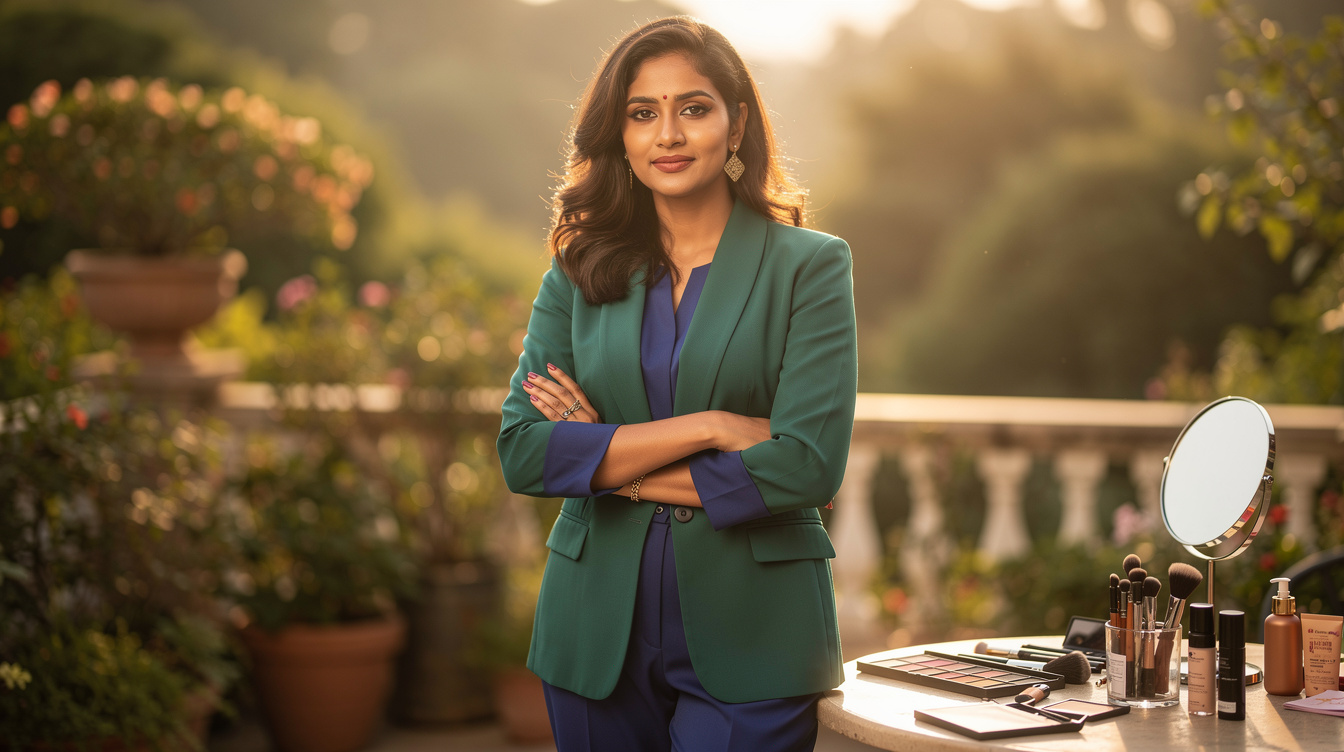
The semester ends, the last submission is uploaded, and suddenly there’s a stretch of two long months where the only timetable is the one you set yourself. For a particular kind of college student — the one who already restocks her makeup kit before her wardrobe, who watches eye-look tutorials at 2 AM, who has done makeup for half her hostel block before formals — that empty summer is the most useful window the college calendar will ever offer. We see her every June at our Sector 16 Faridabad studio: a girl in a college hoodie, a mother holding a polite list of questions, and a quiet certainty that this isn’t a hobby anymore.
The question they ask is almost always the same. Is summer break really long enough to learn professional makeup — or is this just an expensive way to delay the real answer until after college? We’ve been training students at this studio since 2012, and the honest reply is that summer break is, mathematically, one of the only times a serious learner actually has the bandwidth to do this properly. You don’t have it during semester exams. You don’t have it during placement season. You have it now.
This guide walks through what a college student can realistically achieve over a summer or winter vacation — short weekend workshops, full-format programs, and the structured route we run ourselves through the 20-Day Professional Makeup Course. We’ll talk honestly about budgets, what’s worth paying for and what isn’t, and how a course you finish in June can start paying for itself by the time the bridal season opens in October.
Why summer or winter break is the right window
A serious makeup course is full-time work. Not in the corporate sense — in the artistic one. You’re standing for hours, working on real faces, learning to clean a brush properly, learning the small grammar of skin types and base products and undertones that doesn’t exist in YouTube comment sections. It’s exhausting in the best way. And it is genuinely difficult to attempt while you’re carrying a 7 AM class, a tutorial submission, and the social cost of disappearing from your hostel for three weeks.
Summer and winter breaks remove that conflict. June, July, December and January are the windows where a college student can show up at 12 PM, work until 5 PM, go home and practise on a willing roommate, sleep, and come back the next day with the muscle memory developing properly. Trying to do this around lectures rarely works — the brain switches contexts too often, the hands never settle, and what should have become reflex stays effortful.
There is a second reason summer specifically is useful, and it is the reason we push enrolment hardest in May and early June. The Indian wedding market is heavily seasonal — most weddings cluster between October and February. A makeup artist who finishes training in late June has a clear runway: July and August to build a portfolio with friends and family, September to set up Instagram and pricing properly, and the entire October-to-February peak to take real, paid bookings. A student who finishes a course in November is, frankly, late for that year’s season and waiting another nine months. For a final-year college student in particular, that timing difference is the difference between graduating with a working side income already in motion and graduating with only a certificate.
Short-term workshop vs full 20-day course
The first decision a college student makes is format, and the market makes this confusing. There are weekend workshops that promise glass skin in two days. There are month-long programs that promise to make you a celebrity artist. There are six-month diplomas that cost more than an undergraduate degree. None of these are inherently bad — they answer different questions.
A short-term workshop (typically two to four days) is the right shape for someone who already has foundational skills and wants a single specific upgrade — a particular eye technique, a contour philosophy, a way of approaching draping for South Asian skin. It is not the right shape for someone learning makeup from scratch, no matter how the brochure is worded. Two days of class time is roughly twelve to sixteen working hours; that is roughly enough to meaningfully practise one base on one face. It is not enough to build a working artist.
The full 20-day format we run is built for the opposite case — a complete beginner, or a part-time enthusiast who wants to convert into a professional. Twenty working days at five hours a day is a hundred hours of structured studio time, plus the practice you put in at home. That covers the entire arc that matters for paid work — skin preparation, foundation matching across Indian skin tones, HD makeup, airbrush, glass skin, soft glam and the bridal techniques that drive most paying bookings, hair coordination basics, and the unglamorous parts that are actually what separates working artists from the rest: kit hygiene, client management, pricing conversations, handling a nervous bride at 4 AM. We deliberately don’t publish a literal day-by-day breakdown — the pace flexes around the batch and what each student needs more time on. What we will tell you is that nobody leaves having only learned theory.
This is also the place to address the most common student fear directly. The biggest objection we hear from parents — and from students themselves, quietly — is some version of what if I spend a lakh and learn nothing useful? It is a completely fair fear, and the honest answer is that it depends entirely on whether the course is hands-on or theoretical. Ours is hands-on every single day, on real faces, with the trainer in the room. The fee buys studio time, products, and a person standing next to you correcting the angle of the brush — not a recorded video library you could have bought for a tenth of the price.
Budget-friendly options for college students
Money is the part of this conversation nobody enjoys, and the part that matters most. Let’s lay it out plainly.
The regular fee for our 20-Day Professional Makeup Course is Rs. 1,50,000 + GST. The current early-bird rate, while we’re filling our June batch, is Rs. 80,000 + GST — a saving of Rs. 70,000 against the regular fee. The early-bird is a limited-time entry price designed specifically to bring serious students into the start of a new batch cycle; it is not the standard rate, and it will not stay open indefinitely.
What that fee actually covers is the part students should evaluate carefully. The 20-day course includes specially curated training products that you’ll use throughout the program (yours during the course), a professional brush kit that is yours to keep when you finish, certification on completion, a final assessment shoot with a professional model so you leave with portfolio-grade images, and lifetime alumni support — meaning you can come back to us with questions long after your batch has graduated. When you stack the early-bird fee against the cost of buying a starter pro kit retail — even a sensibly mid-tier mix of MAC, NARS, Laura Mercier, Charlotte Tilbury and a handful of Huda Beauty or Fenty staples adds up to anywhere between Rs. 40,000 and Rs. 80,000 on its own — plus a single bridal-makeup workshop elsewhere, the maths becomes obvious.
For genuinely tight student budgets, our practical advice is the same one we give every parent who calls. Don’t stretch for a six-month diploma if a focused 20-day program does the same job for one-third the cost. Don’t pay for theory you can read for free. Don’t buy a celebrity-trainer brand premium when the named lead trainer never actually teaches the batch. The fee should buy you contact time with someone who is still working in the industry — not just teaching it. Talk to us on WhatsApp at +91 9354888093 if you’d like a frank conversation about what your specific goal needs and what it doesn’t.
How a course pays for itself by the next bridal season
The second-most-common student fear is the one nobody says out loud at the consultation: what if I finish the course and never get clients? Instagram is saturated, every salon offers makeup, and the market looks crowded from the outside. We understand that fear because we hear it every batch. The honest answer is that finishing the course is not the same as having a career — but the course is engineered to give you the things that turn into one.
Run the numbers for a moment. Mid-tier party and family makeup in Delhi NCR sits roughly in the Rs. 6,000 to Rs. 10,000 range per face. Engagement looks start around Rs. 20,000 to Rs. 25,000. A first-year solo bridal MUA, working primarily through Instagram and word-of-mouth, can realistically book between fifteen and thirty paid jobs across their first October-to-February peak. We’re not promising those numbers — every student’s pace differs, and the artists who push hardest at portfolio building in the months immediately after the course tend to be the ones who pull the biggest seasons — but the maths means the early-bird fee can recover inside a single peak season for a student who treats the work seriously after graduation.
That’s why we don’t only teach makeup. The course covers the parts of being a working artist that actually move the needle on bookings — building a usable portfolio (which is exactly why the final assessment shoot exists), understanding pricing, handling client conversations, managing trials, scheduling, and the basics of how to set yourself up as a small business. None of these are glamorous. All of them are the difference between someone who can do beautiful makeup and someone who can support themselves doing it.
Sector 16 Faridabad batch dates that fit student calendars
Our studio sits at Booth No 70-71, First Floor, Sector 16 Huda Market in Faridabad — twenty minutes from south Delhi, accessible by metro and direct cabs from most colleges across Delhi NCR. Students from Gurgaon, Noida, central Delhi and Faridabad itself train with us in roughly equal numbers each batch.
The June batch begins at the start of the month and runs across twenty working days, 12 PM to 5 PM. The afternoon timing is deliberate — it lets students who travel from Gurgaon or Noida arrive without rushing through morning traffic, leaves the evenings free for self-practice and recovery, and matches well with how working bridal MUAs actually structure their day during the season. Each batch is capped at ten students, and we hold that cap firmly. Hands-on training stops being hands-on at the moment a class is too large for the trainer to physically reach every face during a working session, and our entire pedagogy depends on that not happening.
If your college break starts later than June 1, or if June clashes with results week or a family wedding, talk to us about the next batch window before you write off the whole summer. We’ll be honest about whether the timing actually works for the kind of student you are. The fastest way to check fit is the Course inquiry form, or a direct WhatsApp on +91 9354888093 — both routes go straight to Shivangi or our front-desk team, not into a sales pipeline.
One practical note for parents reading this with their daughter. The trainer is Shivangi Verma — the founder, an active working bridal makeup artist with 14+ years in the industry, 1,000+ brides served, and 62 Google reviews at a 5-star rating. She personally teaches every batch. The course is not handed to junior trainers once enrolment closes. That is not a marketing claim; it is the structural reason the batch is small, the timing is what it is, and the alumni keep coming back years after graduating.
Frequently asked questions
Will a 20-day course really prepare me for a career as a working makeup artist?
For a beginner who shows up every day and practises seriously between sessions, yes. The course covers basics through to advanced bridal techniques across roughly a hundred hours of studio time, plus the business and client-handling pieces that actually convert technique into income. What 20 days will not do is turn anyone into a celebrity artist overnight — that is the work of years after graduation, regardless of where you train.
I’m a complete beginner. Will I be left behind in the batch?
The course is explicitly designed for complete beginners through to intermediate learners. Many of our students arrive having only ever done makeup on themselves. Because the batch is capped at ten and the trainer is in the room every day, the pace adjusts to the actual class — not a generic syllabus. We start with skin science and base product fundamentals, and only escalate when the foundations are genuinely solid.
What is included in the Rs. 80,000 + GST early-bird fee?
The fee includes specially curated training products you’ll use throughout the course, a professional brush kit that is yours to keep, certification on completion, a final assessment shoot with a professional model for your portfolio, and lifetime alumni support — meaning you can return with questions or quick clarifications well after the batch ends. The regular price is Rs. 1,50,000 + GST; the early-bird rate of Rs. 80,000 + GST is a limited-time entry price for the current batch, saving Rs. 70,000.
How do you compare with the larger chain academies?
The honest difference is who teaches you. We are a working bridal studio first and an academy second. Shivangi has been an active wedding-day MUA since 2012, with international training from Makeup Studio in the Netherlands and over a thousand brides on her record. Larger chains often have stronger marketing and bigger campuses; the trade-off, in our experience, is class size and how much time the named lead trainer actually spends with each student. Our entire structure — ten-student cap, in-room trainer, lifetime alumni access — is built around that single trade-off.
I’m in third year and unsure if I want to do this full-time. Should I still enrol?
This is one of the most useful conversations to have on WhatsApp before you commit. Plenty of our alumni began as part-time freelance artists during college and converted to full-time only after their first peak season; many continue to do makeup as a serious side income through their corporate years. The course doesn’t require you to choose between makeup and a degree — it just gives you a real, certifiable skill on top of the degree. If you’d like a frank assessment of fit before you enrol, message us at +91 9354888093 and ask.
Where exactly is the studio, and how do I reach it from Delhi or Gurgaon?
The academy is located at Booth No 70-71, First Floor, Sector 16 Huda Market, Faridabad, Haryana 121002. From south Delhi, the studio is roughly 25 to 40 minutes by car depending on traffic; from Gurgaon, around 45 minutes; the Old Faridabad metro station on the Violet Line is a short cab ride away. Most of our students from outside Faridabad travel daily for the duration of the batch.
20-Day Professional Makeup Course · Sector 16 Faridabad
Become a Professional Makeup Artist — Basics to Advanced
Hands-on training on real skin, only 10 students per batch, taught personally by Shivangi Verma — an active working bridal MUA with 14+ years and 1,000+ brides. Products, professional brush kit, certification and final assessment shoot all included.
Rs. 1,50,000 + GST → Early Bird: Rs. 80,000 + GST (save Rs. 70,000 — limited time)
💬 WhatsApp +91 9354888093 | Fill Inquiry Form | View Course Page →
If you’ve read this far, you’re already past the part of the decision most students get stuck at. Summer break is short, and the gap between deciding and starting tends to expand to fill the entire vacation if you let it. The fastest next step is a five-minute WhatsApp conversation about whether our Basics to Advanced course fits your specific calendar, your budget, and the kind of work you want to do after college. We’ll give you a straight answer either way — and if the timing isn’t right for this June, we’ll tell you that too.