
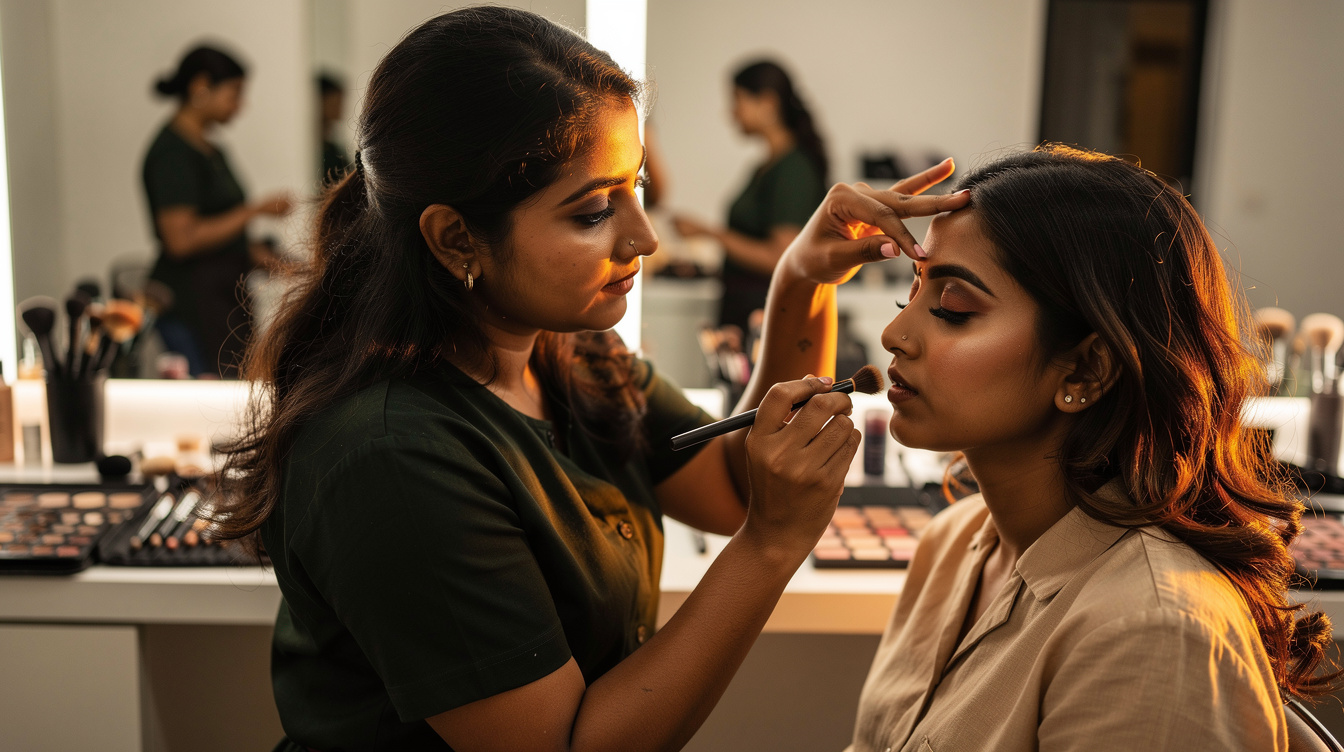
If you are preparing for a government job — SSC, banking, UPSC, state PCS, or any of the dozens of competitive exams that quietly run a parallel economy across Delhi NCR — you already know the rhythm. Coaching from morning, mocks on weekends, mains revisions in the evening, and a year (or three) of waiting for results that do not always arrive on schedule. We work with a lot of women who fit this exact profile, and the question they ask us most often is not about contouring or airbrush — it is about money. Specifically, how to earn something honest and self-respecting while the exam attempts continue. This piece is our long-form answer, written for the aspirant who is not ready to drop her preparation but is also tired of asking parents for rent. A skill like makeup, taught properly through our 20-Day Professional Makeup Course, is one of the cleanest answers we know.
We want to be honest up front — we are not promising a shortcut, and we are not selling the fantasy of quitting prep to chase Instagram fame. What we are proposing is something quieter and more durable. A weekend skill. A booking or two a month that covers your coaching fee. A portfolio that compounds while your prep continues. And, if the exam result eventually does not go the way you hoped, a real career waiting on the other side instead of a void. The aspirants we have trained at our Faridabad studio largely fall into this bracket, and the structure of our Basics to Advanced course was shaped, in part, by listening to what they actually needed.
Before we go deeper, the practical frame: we run the course for 20 days, 12 PM to 5 PM, at our studio in Sector 16 Huda Market, Faridabad. Batches are capped at 10 students because beyond that, real hands-on attention starts to thin out. Everything you need — the curated training products you will use during the course, a professional brush kit you take home, certification on completion, a final assessment shoot with a professional model, and lifetime alumni support — is built into the fee. We will get to the numbers later in this article; right now, let us talk about why this skill, in particular, is suited to the person who is preparing for a government job.
Why a makeup skill provides reliable side income
The reason we keep recommending makeup specifically — over the dozens of “part-time career” ideas that float around in aspirant circles — comes down to four things: predictable demand, weekend-shaped work, low overheads, and rupee-strong unit economics. Each of these matters when your primary identity is still “student” and your timetable is non-negotiable.
Predictable demand first. Weddings, engagements, sangeets, mehendis, receptions, family functions, baby showers, anniversary parties, and corporate events run on a calendar that does not care about exam season. In Delhi NCR — and we are seeing this very clearly in Faridabad, Greater Faridabad, South Delhi, Noida, Gurugram and the surrounding belt — the number of family functions per saturated weekend has only grown since 2022. People who six years ago would have done their own makeup with a kohl pencil and a single lipstick are now booking professionals for engagement parties and pre-wedding shoots. That demand is not a fad. It is structural.
Second, the work is weekend-shaped. Bookings cluster around Saturdays and Sundays, with occasional Friday evenings and pre-dawn bridal calls. This is almost suspiciously well-aligned with how an aspirant’s week is structured: weekdays for coaching, mocks, current affairs and revision; weekends, for many candidates, are the most under-monetised hours in the schedule. We are not asking you to give up your prep — we are pointing out that the calendar already has white space.
Third, low overheads. You do not need a shopfront, a GST registration on day one, employees, or even a vehicle of your own initially. A trained artist with a quality kit can run a fully home-based bridal practice from a small apartment, taking bookings on WhatsApp and travelling to client locations. The barrier between “trained” and “earning” is unusually thin in this profession compared to almost any other side-income path.
Fourth, the rupee unit economics are favourable. A single party-makeup booking in Delhi NCR can earn a beginner anywhere from Rs. 3,000 to Rs. 8,000 once she has a real portfolio. Engagement and sangeet bookings push higher. Bridal work, once you have a year of experience and a portfolio, settles into a different income bracket entirely. We will get into specific weekend math in the next section, but the key point is that one well-handled booking can equal a week’s worth of part-time tuition fees.
For the aspirant, this combination — predictable demand, weekend-shaped work, low overheads, strong unit economics — is the closest thing to a sane side-income that we have seen. And unlike most options pitched to students, this one builds an actual career on the side, not just cash.
How weekend bookings stack up against monthly costs
Let us put this in numbers, because vague reassurance helps no one. We will model a conservative weekend-only practice for someone six months out from completing our course — the kind of artist who is still preparing for an exam, has built a small portfolio of around 20-25 real clients, and is taking bookings primarily through Instagram, WhatsApp referrals, and one or two listing platforms.
A realistic monthly target at this stage is two party makeups per weekend (so eight a month) plus one engagement or sangeet booking per fortnight. Party rates settle around Rs. 5,000-Rs. 8,000 per face once your portfolio is solid; engagement-tier work pulls Rs. 12,000-Rs. 20,000. Even at the lower end of these bands, the monthly arithmetic looks like this: eight party bookings at an average of Rs. 6,000 is Rs. 48,000, and two engagement bookings at Rs. 14,000 is Rs. 28,000 — a monthly top line of around Rs. 76,000. That is not a stable salary; it is a side-income, and it will fluctuate. But against the typical aspirant’s monthly cost stack — coaching fee of Rs. 8,000-Rs. 15,000, books and test series of Rs. 2,000-Rs. 4,000, paying-guest rent in NCR of Rs. 8,000-Rs. 14,000, food, transport, mocks — it covers the essentials with margin to spare.
The first three months are slower. Most of our alumni report something like Rs. 15,000-Rs. 25,000 in their first full month of taking bookings, mostly from family-network party makeups. By month four or five, when the Instagram portfolio has 30-40 posts and word has started to circulate in your immediate circle, the number begins to firm up. By the time you cross the one-year mark — even working only weekends — many of our aspirant-students are pulling Rs. 60,000-Rs. 1,20,000 a month, with peaks during wedding season (October to February in North India) and quieter periods during summer.
Here is the part that matters: the cost stack of a weekend practice is genuinely small. Travel to client locations is the largest variable cost; product replenishment is next. A working artist refreshes consumables — foundations, concealers, lipsticks, lashes, primers — every two to three months, with a typical replenishment budget of Rs. 8,000-Rs. 15,000 depending on how many bookings she is taking. Premium product brands like MAC, NARS, Dior, Huda Beauty, Fenty Beauty, Laura Mercier, Haus Labs and Charlotte Tilbury form the practical core of a working kit, and once your initial kit is built, you are mostly replacing what you use up. There is no rent, no salaries, no inventory in the warehouse sense.
So even on conservative numbers, the monthly side-income comfortably exceeds the monthly preparation cost for almost every aspirant we have trained. That is the whole proposition. You do not have to ask anyone for money for your prep, your rent, or your mocks. And the money is honest — paid in cash or UPI by happy clients for a real, visible service.
Workshop vs course — which to choose first
This is the question that comes up in almost every academy-inquiry call we take from aspirants: should I do a one-day or three-day workshop first to test the waters, or should I commit directly to a full course? The honest answer depends on what you are trying to accomplish.
Workshops are useful for two specific things. First, if you genuinely have no idea whether you enjoy the craft and want to spend a weekend touching brushes and products before committing to anything bigger, a short workshop can answer that question. Second, if you are already a working artist and want to learn one specific technique — a glass-skin finish, a particular eye-makeup style, a draping skill — a focused workshop fills the gap. We respect that.
But for the person whose goal is side-income from real bookings, workshops have a structural problem: they do not give you the breadth of skill, the portfolio assets, or the credibility to start charging confidently. A three-day workshop will teach you one or two looks. A bride does not book “one look.” She books a person who can read her skin, her outfit, her venue’s lighting, her photographer’s preferences, and decide, with some authority, what is going to make her look beautiful in person and in photographs. That decision-making capacity is built through 20 days of structured practice on real skin, not three days of demo-watching.
For the government-job aspirant in particular, we usually recommend skipping the workshop layer altogether and committing directly to the professional makeup course in Faridabad. The reasoning is simple — your time is the scarcest resource you have. You cannot afford to spend three weekends on a workshop, then six months wondering if you should have done more, then another month on a longer course. Compress the decision: pick the format that actually leads to bookings, complete it once, and move into earning. That is what side-income from this craft demands.
And we will name the fear that almost every aspirant carries into this conversation — the worry that a serious course fee is money you might “waste and learn nothing useful.” It is the single biggest enrolment hesitation we hear, and it is a fair concern. Our answer is structural: every day of our course is hands-on training on live models, you complete a portfolio shoot with a professional model as your final assessment, the curated products you train on are yours during the course, and the teaching itself is led personally by Shivangi every batch — not delegated to a junior. The course is built so that the value you take home is concrete, photographable, and immediately usable in client conversations.
20-Day Professional Course as the foundation
Our flagship offering for someone in this situation is the 20-Day Professional Makeup Course — Basics to Advanced. The format is intentional. It runs five hours a day, 12 PM to 5 PM, six days a week, for 20 days. That structure is doable for an aspirant who is willing to take a focused break from prep for three weeks, or who is between exam attempts. It is also doable for someone in the gap between mains and interview, or between two coaching cycles. The hours are deliberately not 9-to-9, so you still have evenings free for self-study, mocks, or rest.
The curriculum spans the full bridal-grade toolkit — HD Makeup, Airbrush, Glass Skin, and modern bridal techniques — alongside the parts of the craft that nobody else teaches: client handling, consultation, pricing, kit management, and the basic business skills that turn a trained artist into a profitable one. We deliberately do not publish a day-by-day breakdown publicly because the sequence adapts to each batch’s pace and skill spread, and because the difference between a graduate who earns and one who does not often lies in the unscripted sessions — the ones where Shivangi works through a real bride’s brief in front of the batch and answers questions in real time. If you want to know exactly what week two looks like for a typical student, ask us on WhatsApp.
What is included is straightforward and we want it to be transparent: specially curated training products that you use throughout the course; a professional brush kit that is yours to keep; certification on completion; a final assessment shoot with a professional model that becomes the first real piece of your portfolio; and lifetime alumni support — meaning when you have your first paid bridal booking six months later and you want a second opinion on a colour choice or a contouring decision, you can WhatsApp Shivangi. That last part is, in our experience, what alumni come back to thank us for most.
The instructor matters here. Shivangi Verma’s makeup course is taught by Shivangi herself — an active working bridal MUA with 14+ years in the industry, 1,000+ brides served, certified from Makeup Studio Netherlands, and rated 5 stars across 62 Google reviews. She is not a teacher who stopped doing brides to run an academy — she is doing weddings the same week she is teaching, and that current-practice perspective filters into every session. The questions a student asks in batch are answered with reference to a wedding she did last Saturday, not a curriculum slide from three years ago.
On fees, we want to be clear and not buried in fine print. The regular course fee is Rs. 1,50,000 + GST. For aspirants who enrol in the current intake, the early-bird rate is Rs. 80,000 + GST — a saving of Rs. 70,000, available for a limited window only. We are running this rate because we want serious, motivated students in the room, and price is one filter that tends to attract them. If you would like to talk through the fit, the easiest first step is to Fill the inquiry form or message us directly on WhatsApp at +91 9354888093. We will tell you honestly whether this is the right fit for your situation.
Realistic earnings for part-time bridal artists
Let us close the loop with a clear-eyed look at what part-time bridal income actually looks like in Delhi NCR for a trained artist who keeps her preparation as her primary commitment. We are going to break this into three honest stages because pretending the trajectory is linear would be misleading.
Stage one — the first three months after the course. This is the slow build. You are putting up portfolio content from your final assessment shoot and from practice sessions on friends and family. You are taking your first paid party-makeup bookings, mostly through your immediate circle. Realistic monthly income at this stage is Rs. 12,000-Rs. 30,000. You will have weekends with no bookings. You will have weekends with two. The fluctuation is normal and not a sign of failure — every working artist we know went through this exact stretch.
Stage two — months four to twelve. The portfolio compounds. Word of mouth begins to do real work. You start taking engagement and sangeet bookings, which are higher-ticket and more enjoyable to deliver. By month six or seven, you might book your first full bridal — a single bride, paid as her primary MUA. This is a milestone moment, and it is also the point at which most aspirants we train report that the side-income is decisively covering their full preparation cost. Monthly income in this band typically lands somewhere between Rs. 30,000 and Rs. 75,000 depending on how aggressively you market and how the wedding-season calendar falls.
Stage three — beyond year one. You are now a known quantity in your immediate area. You have repeat clients — younger sisters of brides you did, friends of friends, colleagues’ families. You have a clearer sense of your own niche (some of our alumni discover they love nude / no-makeup looks, others gravitate toward heavy traditional bridal, others toward soft glam). Pricing firms up. Many part-time artists at this stage are pulling Rs. 75,000-Rs. 1,50,000 in good months, with quieter summer numbers. If at this point your government-job result has not gone the way you hoped, you have something real to lean into. If it has, you have a side-income that few salaried positions in your batch will match.
One real-client pattern we want to share, paraphrased from reviews of Shivangi’s bridal work: clients consistently say they felt heard and that their face still looked like theirs at the end of the makeup, just a more luminous version of it. That is the philosophy we teach in the course — natural beauty enhancement, not mask-making. It is also, in our experience, the single biggest driver of repeat referrals. Brides recommend you to their friends not because your eyeliner was sharper than the next artist’s, but because they felt like themselves on the most photographed day of their life. That instinct, taught well, is what carries a side-income practice from a good first year into a sustainable five-year run.
And we want to gently address one more concern that aspirants in their late twenties or early thirties sometimes carry — the worry that they are too old to start something new. We have trained students at every life stage. The craft does not care how many exam attempts you have behind you. What it asks for is patience, an honest interest in faces, and the willingness to spend 20 days learning properly. The rest follows.
FAQ
Will the 20-Day course really prepare me for a side-income career?
Yes — the format is designed precisely for this outcome. Twenty days of five-hour sessions adds up to 100 hours of structured, hands-on training on real skin, capped at 10 students per batch so you actually get personal attention. You leave with a professional brush kit, a certification, a portfolio shoot with a real model, and lifetime WhatsApp access to Shivangi for ongoing questions. That combination is built to take you from beginner to bookable.
I am preparing for a government exam — can I really balance this with my preparation?
The course itself runs 12 PM to 5 PM for 20 days, leaving mornings, evenings and one day a week free. Most aspirants take the course during a planned three-week prep break — between mains and interview, between coaching modules, or during a planned reset. After the course, weekend bookings sit naturally outside study hours. We will not pretend it is effortless, but the schedule is designed to be compatible with serious preparation.
What if I do the course and still cannot get clients afterward?
This is the fear we hear most often, and it is fair. The course explicitly covers portfolio building, client consultation, pricing, kit management, and basic business skills — not just technique. You graduate with a real shoot to post on Instagram, a structured approach to family-network outreach, and lifetime alumni support so you can WhatsApp Shivangi when you are stuck on a pricing or positioning question. That is intentionally not the same as being handed a certificate and wished good luck.
Is the academy genuinely reputable enough that the certification will count?
Shivangi is an active working bridal MUA with 14+ years in the industry, certified from Makeup Studio Netherlands, with 1,000+ brides served, a 5-star rating across 62 Google reviews, and listings across WedMeGood, WeddingWire, Sloshout, JustDial and MagicPin. She personally teaches every batch. The reputation is built on continuing client work, not on academy-only credentials, which is exactly what gives the certification weight.
I am a complete beginner — am I too inexperienced to start?
The course is named Basics to Advanced for a reason. We start from the foundations — skin prep, colour theory, brush handling — and build up to advanced bridal techniques, glass-skin finishes and airbrush. Students join us from completely diverse backgrounds (engineering, teaching, civil-services prep, homemaking) and the curriculum is paced to bring everyone up to a working bridal standard by the final assessment shoot.
How much can I realistically earn in my first six months as a weekend artist?
Realistic monthly earnings in the first three months sit around Rs. 12,000-Rs. 30,000, mostly from party makeups in your immediate network. By months four to six, as your portfolio compounds and word of mouth picks up, that range typically firms up to Rs. 30,000-Rs. 60,000 with the addition of engagement and sangeet bookings. Wedding season (October-February in North India) accelerates this; summer is quieter. These are the bands we see from our own alumni in the Faridabad and wider Delhi NCR market.
If you have read this far and are seriously weighing this as your side-income path, the next step we would suggest is to view the full course page and then either fill the academy inquiry form or send us a message on WhatsApp. We will spend the time to talk through your specific situation — your exam timeline, your weekend availability, your budget — before either of us commits.
20-Day Professional Makeup Course · Sector 16 Faridabad
Become a Professional Makeup Artist — Basics to Advanced
Hands-on training on real skin, only 10 students per batch, taught personally by Shivangi Verma — an active working bridal MUA with 14+ years and 1,000+ brides. Products, professional brush kit, certification and final assessment shoot all included.
Rs. 1,50,000 + GST → Early Bird: Rs. 80,000 + GST (save Rs. 70,000 — limited time)
💬 WhatsApp +91 9354888093 | Fill Inquiry Form | View Course Page →
For the government-job aspirant who has read this far — we will be honest one more time. We do not know whether your next attempt will go the way you hope. No one does. What we do know is that walking into your next exam with a side-income that covers your prep, a portfolio that proves a real skill, and a fallback that is not actually a fallback but a respectable career — that is a very different psychological state from walking in with everything riding on the result. If that frame resonates, the next batch of Shivangi Verma’s makeup course in Faridabad has a small number of seats open. WhatsApp us at +91 9354888093 or fill the academy inquiry form, and we will take it from there.