
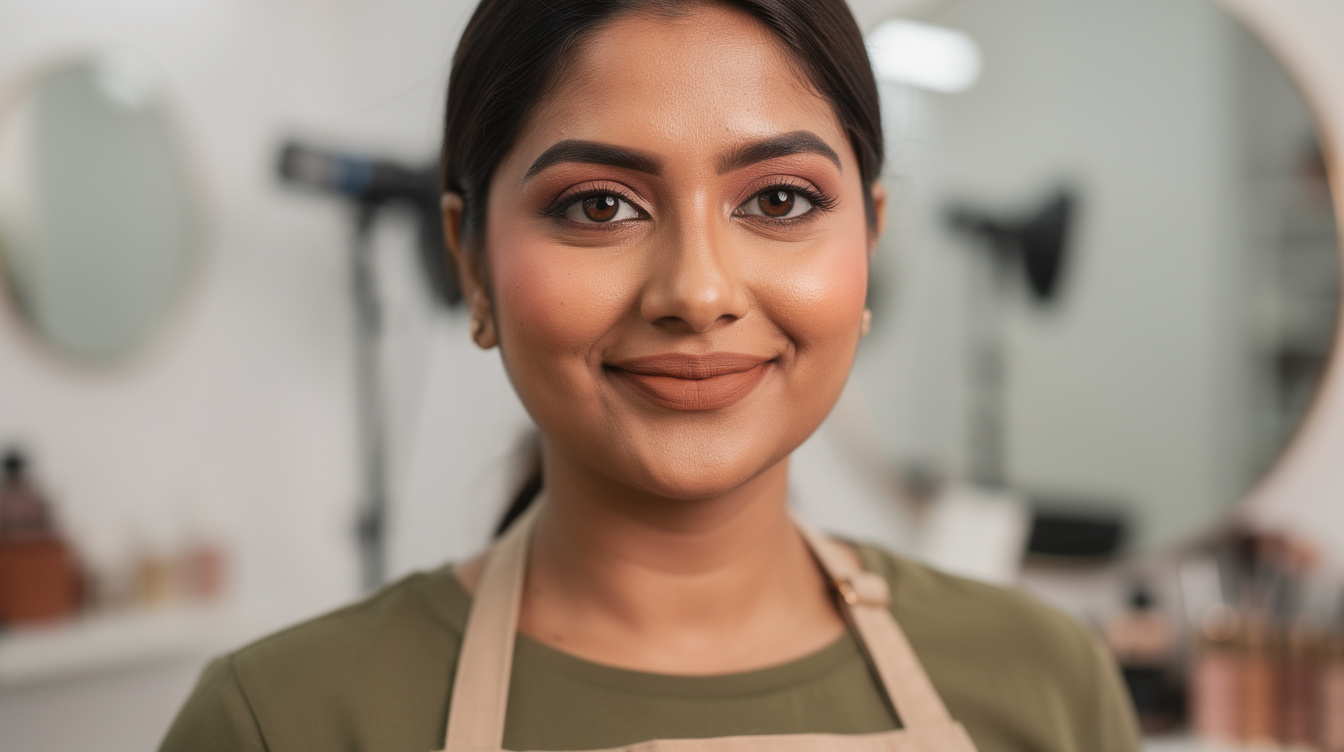
The moment a course ends, the panic begins. You have a certificate, a head full of techniques, a portfolio shoot to your name — and suddenly the very real question of what to put inside the black trolley you carry to your first paying bride. The makeup kit after course question is the one we get asked more than any other at our Sector 16 Faridabad studio, often within hours of a final assessment shoot. And it deserves a serious answer, because the wrong kit will quietly sabotage the career a good course just built for you.
We have watched this play out for fourteen years now. A confident graduate, a beautiful bride waiting in a Faridabad farmhouse, and a kit assembled from whichever YouTube influencer happened to be loudest that month. By the second hour, the foundation has gone grey on flash, the cream blush has lifted the base, and a brush that cost three hundred rupees has shed a bristle onto a tear-line. None of that was a technique problem. It was a kit problem. This is why students of our 20-Day Professional Makeup Course spend almost as much classroom time on product hierarchy as they do on application — because in the field, your kit is your reputation.
So this is the guide we wish we had been handed in 2012. No affiliate links, no brand loyalty disguised as advice, no twenty-thousand-rupee “starter” lists that exist only to inflate someone’s commission. Just the honest, tested, working-MUA breakdown of what to put in your kit in 2026, in what order, and why.
Why your starter kit choice matters more than your course
This will sound counterintuitive coming from a working academy, so let us say it plainly. The course gets you to a baseline of competence; the kit is what carries that competence into a paying client’s home. We have seen brilliantly trained artists fold inside six months because their first three brides walked away with patchy skin on photographs. We have also seen graduates with modest technique build five-figure month-on-month businesses purely because their kit was professional, hygienic, and consistent.
The fear we hear most from new artists — and one we addressed in detail when designing our our Basics to Advanced course — is the worry of spending a lakh on training only to walk out unprepared for the real world. A poorly chosen kit is the single fastest way to make that fear come true. Because clients do not know your certificate. They know the photograph that surfaces three weeks later in their cousin’s WhatsApp group.
Here is the framework we teach. A professional kit has three layers — Tier 1 non-negotiables that you build before your first paid booking, Tier 2 expansion that you earn through your first ten clients, and Tier 3 specialist purchases you should not even think about until you are six months in. Most graduates fail because they invert this. They buy a beautiful Charlotte Tilbury palette before they own a single corrective concealer. Glamour before infrastructure. We are going to do it the other way around.
Tier 1 essentials — non-negotiables for your first paying bride
Tier 1 is the kit you must own before you accept money. Not before your trial shoot, not before your portfolio expansion — before you take a rupee from a stranger. This is roughly eighteen to twenty-two products plus brushes, and on the Delhi NCR market in 2026 it will cost you somewhere between forty-five thousand and seventy-five thousand rupees depending on how aggressively you shop.
Skincare prep (three products). A hydrating toner, a lightweight gel moisturiser for oily Faridabad-summer skin, and a richer cream for drier winter conditions. Skip the influencer-favourite ten-step routine. Brides have not slept; they want speed and glow, not a facial.
Primers (two). One mattifying silicone-based primer for T-zone control and one hydrating, illuminating primer for cheekbones and dry areas. Mixing zones on the same face is more useful than buying any single “miracle” primer.
Foundations (minimum five shades, ideally seven). This is where new artists save money and pay for it later. You need a range that covers fair Punjabi skin through to deep South Indian and North-East tones, with at least two olive-leaning shades because Indian skin rarely sits cleanly on pink or yellow undertones alone. Two foundation finishes — one luminous, one second-skin matte — and you must own at least one HD-grade or airbrush-compatible base.
Concealers (two formulas, four shades each). A brightening under-eye concealer and a corrective full-coverage concealer for blemishes. Both in a shade range, not single tubes.
Colour correctors. Peach, orange, and green. Non-negotiable for Indian skin. You will neutralise more under-eye pigmentation in a year than you ever thought possible.
Setting powders. One translucent loose powder for the under-eye, one finely milled pressed powder for touch-ups. The loose powder must not flash white. Test it under bounce flash at home before you take it into a function.
Eyeshadow palette (one good one). Warm-neutral, twelve to eighteen shades, with at least four shimmers that actually adhere when pressed wet. This single palette will cover ninety percent of Indian bridal looks for your first year.
Eyeliners. One liquid liner with a fine brush tip, one waterproof kajal pencil, one gel pot in deep brown for soft smoke.
Mascara and lashes. A high-quality waterproof mascara and at least three pairs of lashes — natural daytime, full strip bridal, and a wispy half-lash for engagement looks. Plus glue. Black glue, not white.
Blush and bronzer. Powder formulas only for now. Cream blush is a Tier 2 purchase because applying it cleanly on top of a heavy bridal base is a separate skill.
Highlighters. One powder champagne, one liquid for body work on backless cholis.
Lip kit. Five liquid lipsticks in browns, mauves and reds, plus a clear gloss and a tinted balm. Lip liners in three universal shades.
Setting spray. The single most underrated product in any kit. Two bottles — a working spray to layer powders, and a finishing spray for that nine-hour wedding lockdown.
Brushes. This is the line where graduates of our professional makeup course in Faridabad have an unfair advantage — every student leaves with a curated professional brush kit that is theirs to keep, so the largest single line-item in a starter budget is already handled. If you are building from scratch elsewhere, do not buy a twenty-five-piece brush set. Buy twelve excellent brushes — two foundation, one buffing, three eyeshadow (flat, blending, smudger), one angled liner, one fluffy powder, one contour, one fan highlighter, one blush, one lip. Synthetic for liquids, natural fibre for powders.
Hygiene infrastructure. Brush cleaner, alcohol spray, disposable wands, palette plates, a sturdy trolley, ring light, and a fold-away director’s chair if you are doing in-home bookings. Clients see your kit before they see your work. Make it look like a workplace, not a vanity.
Tier 2 nice-to-haves — what to add by month 3
Once you have completed roughly eight to twelve paid bookings and your Tier 1 kit is repaying itself, you start expanding. The Tier 2 list is where personality enters your work — these are the products that make your makeup look like yours rather than a textbook reproduction.
A second eyeshadow palette in cool tones — smoky blues, taupes, charcoals — to handle the engagement and sangeet looks that the warm palette cannot. A small collection of pressed glitters and loose pigments, which we use sparingly but transformatively for reception and cocktail looks. Two cream contour shades for sculpting jawlines under HD flash. A second waterproof mascara because one will always run out mid-function. An additional concealer in a salmon-pink corrector tone for deeper under-eye work.
Crucially, this is the point at which you upgrade your foundations rather than adding new ones. Replace your weakest base, do not stack a sixth one onto the trolley. Your kit must remain transportable — a working bridal kit that cannot fit into a single trolley wheeled into a Gurgaon hotel lift is not a working kit. We say this to every student because we have lugged enough of them in and out of farmhouses in Faridabad and Jaipur to know exactly where the breaking point sits.
Tier 2 also includes the soft-skill infrastructure new artists routinely ignore — a printed price list, a contract template, a deposit invoice format, a branded WhatsApp business profile, and a clean Instagram grid with at least fifteen real edited portfolio shots. None of these sit in the trolley, but they are what convert the second enquiry of your week into a booking. Money spent on infrastructure at month three returns more than money spent on a fourth highlighter.
Brand-by-brand breakdown — MAC, NARS, Huda, Charlotte Tilbury
Brand choice is where graduates burn the most money on regret. Every brand has products that earn their kit slot and products that absolutely do not, and the influencer economy makes it impossibly hard to tell which is which. So here is the working artist’s view, brand by brand, as it stands in 2026.
MAC. Still the backbone of a kit. The Studio Fix Fluid foundation range covers Indian skin tones better than most premium imports, the pro-pan refill system saves real money once you stop buying full eyeshadow compacts, and the matte lipstick formula has not been bettered in two decades. What we would skip from MAC — the cream blushes (acceptable but outperformed), the prep+prime sprays (overpriced), and the brow pencils (replaceable). Allocate roughly 20–25% of your Tier 1 spend here.
NARS. Two non-negotiables — the Sheer Glow foundation (still one of the best luminous bases for HD flash on warm undertones) and the Light Reflecting setting powder for translucent finish without flashback. The bronzers are good; the blushes are stunning but optional for Tier 1. The lip pencils outperform almost everything in their price range. Skip the eye palettes unless one specific shade story matches your aesthetic — they are beautifully made but rarely justify the slot.
Huda Beauty. The brand has matured significantly. The Faux Filter foundations now handle deeper Indian skin tones with proper undertone variation, and the Easy Bake setting powders are kit staples for hot Delhi summers. The eyeshadow palettes — particularly the warm-neutral and rose-gold formulations — are workhorses for Indian bridal eyes. The lashes are honest value. Skip the highlighters unless you specifically work with very fair brides; the brand’s signature golds tend to read disco on medium-deep skin.
Charlotte Tilbury. Premium-tier and worth it for the right slots. The Magic Cream and the Airbrush Flawless Setting Spray genuinely elevate finished work — both are in our personal kit, both stay. The Pillow Talk lipstick range is beloved for a reason; it photographs beautifully on Indian skin. We are cooler on the foundations (shade range still lags), and the eyeshadow quads, while gorgeous, are too narrow in colour story to earn a Tier 1 slot. Buy two Charlotte Tilbury products at Tier 2 stage, not eight at Tier 1.
Worth a mention. Dior Forever foundation for very HD-sensitive shoots; Fenty Beauty for unmatched depth-of-shade range, particularly Soft’Lit and Pro Filt’r; Laura Mercier translucent powder still leads its category; Haus Labs Triclone Skin Tech for problem skin coverage with skincare benefits. Build around these gradually, not at launch.
How the 20-Day Course covers product training
One of the most genuine fears we hear from new students — the one that keeps people scrolling instead of enrolling — is the worry that they will spend money on a course and still walk out unsure of what to buy. We built our training format specifically to close that gap. The course runs across twenty days, twelve to five each day, at our Sector 16 Huda Market studio in Faridabad, with batches capped at ten students so every learner gets hands-on time with every product category we cover.
Throughout the programme students work with specially curated training products — actual professional brands, not academy-grade dupes — and those products are theirs to use throughout the course. The professional brush kit you build with is yours to keep when you leave, which solves the single largest line-item in a starter budget. By the time of the final assessment shoot with a professional model, every student has handled enough product variety to know what their hand prefers, what their eye reads cleanly, and what their wallet can afford to invest in first.
Equally important is what is not on the syllabus — we deliberately do not publish a day-by-day breakdown because the work moves at the pace of the batch in front of us. What we will say is that the course covers HD Makeup, Airbrush, Glass Skin and bridal techniques, alongside client handling and the business skills that turn a certificate into a paying career. You can Fill the inquiry form for the full breakdown, or message us directly on WhatsApp at +91 9354888093.
The course is taught personally by Shivangi Verma — fourteen-plus years on the floor, more than a thousand brides, an active working bridal MUA whose 62 five-star Google reviews come from clients she did the makeup for herself last week, not a decade ago. Students also receive certification on completion, a final assessment shoot for their portfolio, and lifetime alumni support — which in practice means the kit-building conversations of the kind you are reading right now do not end on graduation day. They continue on a private alumni WhatsApp group for as long as you want them.
20-Day Professional Makeup Course · Sector 16 Faridabad
Become a Professional Makeup Artist — Basics to Advanced
Hands-on training on real skin, only 10 students per batch, taught personally by Shivangi Verma — an active working bridal MUA with 14+ years and 1,000+ brides. Products, professional brush kit, certification and final assessment shoot all included.
Rs. 1,50,000 + GST → Early Bird: Rs. 80,000 + GST (save Rs. 70,000 — limited time)
💬 WhatsApp +91 9354888093 | Fill Inquiry Form | View Course Page →
Frequently asked questions
How much should a starter makeup kit cost in 2026?
A professional Tier 1 kit assembled honestly in Delhi NCR in 2026 costs roughly Rs. 45,000 to Rs. 75,000, depending on brand mix and whether your brushes are sourced separately. Anything below Rs. 35,000 is a hobby kit, not a working one — it will fail you in the field. Students of our 20-Day Course leave with the professional brush kit and access to specially curated training products already covered, which compresses the gap significantly.
Will the 20-Day course really prepare me for a career?
This is the fear we hear most, and we take it seriously. The course is structured around hands-on practice on real skin every day, with a batch size capped at ten so nobody hides at the back. It includes a final assessment shoot with a professional model so you leave with portfolio work, business and client-handling modules so you know how to convert enquiries, and lifetime alumni support so the conversation continues long after Day 20. The honest answer is yes — if you show up.
Do I need to buy MAC and Charlotte Tilbury on day one?
No. MAC earns its place at Tier 1; Charlotte Tilbury is a Tier 2 brand for most working artists. Buying premium brands too early is the single most common mistake new MUAs make. Build the infrastructure first — foundations, brushes, hygiene, lighting — then add aspirational brands as your bookings fund them.
Can I build a kit if I am a complete beginner with no industry contacts?
Absolutely. Most of our students start with zero contacts. The course is designed for complete beginners as much as for advanced learners, and the brand training, kit guidance and alumni network exist precisely so that day-one ownership of an industry-grade kit is achievable for someone whose only credential when they walked in was curiosity.
Where is the academy located and how do I enrol?
The studio is at Booth 70–71, First Floor, Sector 16 Huda Market, Faridabad, Haryana 121002. Course timings are 12 PM to 5 PM across twenty days. The simplest way to enrol — or just ask a question — is to WhatsApp +91 9354888093 directly. The early-bird fee is Rs. 80,000 + GST against the regular Rs. 1,50,000 + GST, a limited-time rate.
What happens if I do not like one of the brands I buy?
Welcome to working artistry — it happens to all of us. The advantage of buying tier by tier is that mistakes are small. A single foundation that does not work on your hand costs three to four thousand rupees, not thirty. We teach students to rotate trial-size purchases through their first three bookings before committing to a full-size restock, which is how every working artist refines their kit over time.
Your kit will keep evolving long after the course ends — every great working artist we know is still tweaking theirs in year fifteen. What the right training does is give you the judgement to evolve it deliberately rather than expensively. If that is the kind of foundation you want for the career you are about to build, talk to us about Shivangi Verma’s makeup course directly on WhatsApp at +91 9354888093, and we will walk you through exactly what your first six months can look like.