
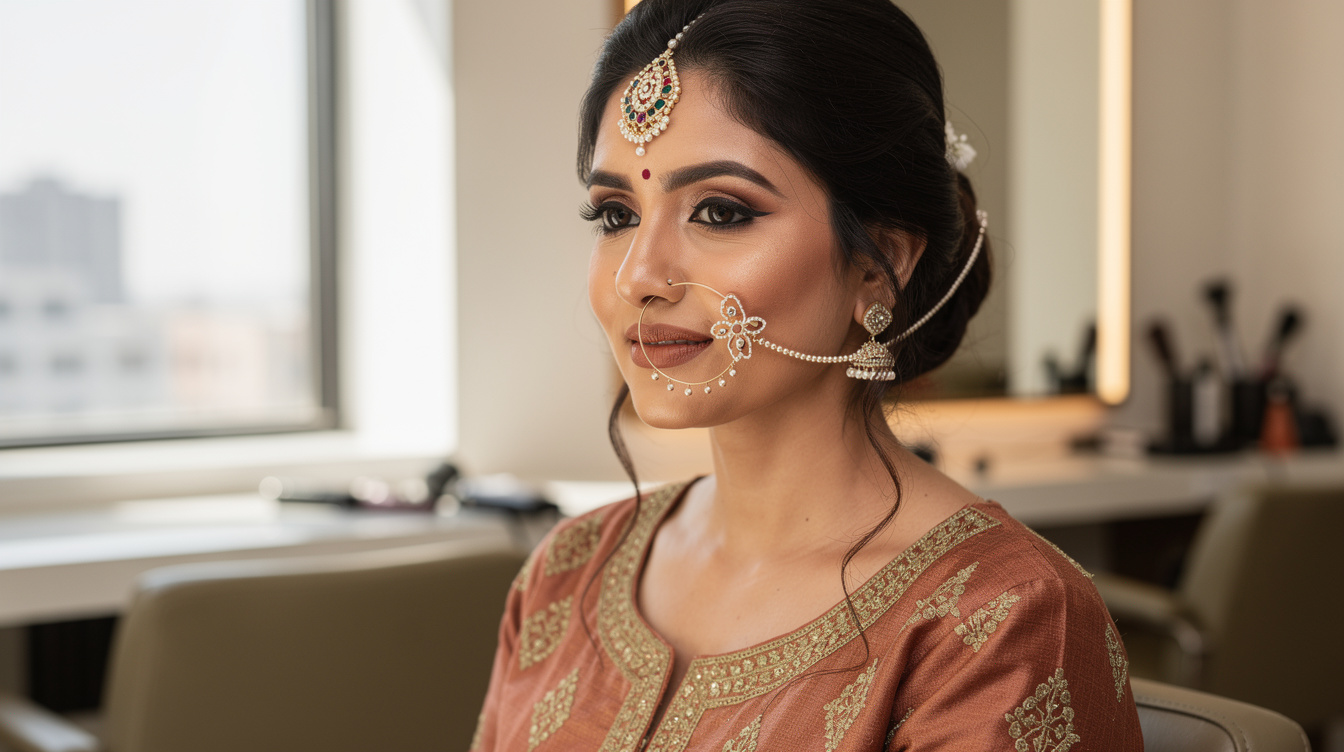
Your bridal hairstyle carries the weight of every photograph, every ritual, and every glance from your guests across a sixteen-hour wedding day. For the modern Indian bride, choosing the right look is no longer about copying a saved Instagram reel — it is about commissioning a hairstyle engineered for your face, your lehenga, your jewellery, and the heat of an Indian celebration. The most beautiful bridal hairstyles Indian brides wear today live at the intersection of heritage and finesse, where a classic maang tikka meets airbrushed glam and a tightly woven braid disappears into a cascade of fresh jasmine.
We have styled more than a thousand brides since 2012, and the same truth holds across every wedding from Faridabad farmhouses to forts in Udaipur — your hair will be looked at, hugged, photographed, and crowned with heavy jewellery for longer than you imagine. In this guide, we walk you through five Indian wedding hairstyles we return to again and again, why they work, how to wear them, and how to choose the one that flatters you specifically.
Why Your Bridal Hair Deserves the Same Care as Your Makeup
Beautiful bridal makeup can fall apart visually if your hairstyle is the wrong scale, the wrong texture, or the wrong silhouette for your features. A heavy gold maang tikka on a flat centre parting reads very different from one nestled into volume; a backless choli demands a very different nape than a high-collared cut. Hair is structural — it shapes your face on camera, balances the weight of your dupatta, and signals the mood of every function.
The brides who consistently look serene and luminous in their wedding albums are the ones who treated hair as a non-negotiable rather than an afterthought. We work with a dedicated in-house hairstylist on every appointment, and we plan your hair brief alongside your makeup brief — never separately.
1. The Sculpted Low Bun With Fresh Florals
If there is a single Indian wedding hairstyle that has earned its place in the hall of fame, it is the low chignon dressed with fresh roses, jasmine, and orchids. Worn at the nape, it photographs beautifully from every angle, never fights with chunky jhumkas or matha pattis, and holds up under hours of pheras and phototime. It also frames the back of a classic red lehenga in a way no high updo can.
Best for
- Brides with medium to long hair (extensions blended in for shorter lengths)
- Heavy maang tikka or matha patti looks
- Traditional red, maroon, or pastel lehengas with structured dupattas
- Outdoor functions where wind can disturb loose styles
How we style it
We start with a clean centre or side parting depending on the shape of your forehead, build a soft volume crown for balance, and braid the hair internally before coiling it at the nape — this gives the bun its sculpted weight without bulk. Real florals (gajra strings of jasmine, baby roses, and orchids) are pinned in only after the makeup is set so colour does not transfer onto the skin. Premium setting sprays and flexible-hold polymers lock the silhouette for a full sixteen-hour day.
2. The Maharani Side Braid With Embroidered Hair Vines
The side-swept braid is the bridal hairstyle that transforms a simple lehenga into a regal silhouette. It carries echoes of Rajasthani and Punjabi bridal heritage, drapes elegantly across a heavily embroidered choli, and gives photographers a long, sweeping visual line that looks staggering in close-up. We dress it with embroidered hair vines, paranda tassels, or strung pearls woven through the plait.
Why brides choose it
It frames the collarbone, lengthens the neck on camera, and sits beautifully against backless or low-cut blouses. For brides with thinner hair, we add discreet matching extensions that thicken the braid without weighing down the scalp — a craft we have refined over thirteen-plus years of bridal work. Couples who choose dramatic outdoor venues — palaces, beach resorts, fort weddings — often gravitate to this style because it photographs beautifully against architecture.
Pair it with
- A statement matha patti or jadau maang tikka
- Chaandbalis or long jhumkas — never both at maximum volume
- Brick red, ivory, deep emerald, or wine lehengas
- Soft Glam or HD Glass Skin makeup, never anything overly matte
3. Soft Romantic Curls With a Centre-Set Maang Tikka
For brides who want their hair to feel personal rather than performative — younger, lighter, more “her” — open hair styled in soft curls is having a strong moment, particularly for engagement, sangeet, and reception nights. The look is romantic without being undone, and it allows your jewellery to do the heavy lifting.
The technique
We use heat-protected wand curling to build loose, ribbon-like waves rather than tight ringlets, then break them up with our fingers for movement. A small, deliberate volume at the crown keeps the silhouette regal. We secure the curl pattern with humidity-resistant sprays — non-negotiable for Delhi NCR summers and for destination weddings in coastal cities like Goa where humidity will fight you all night.
This is also the hairstyle we recommend most often for brides choosing pastel lehengas, ombre dupattas, or contemporary cuts where a heavily traditional silhouette would feel mismatched. Pair it with our signature HD Glass Skin or Skinlike Finish makeup for a lit-from-within bridal portrait that holds up under HD and Ultra HD photography.
4. The Floral Crown Updo With Gajra Veil
South Indian brides have known the power of a gajra veil for generations, and North Indian brides are increasingly borrowing it for haldi, mehendi, and even the wedding day itself. The floral crown updo is layered, textural, and unapologetically opulent — heavy strings of mogra and roses arranged into a wreath that sweeps from one ear, around the nape, and back up to the crown.
When it shines
- Mehendi and haldi mornings — fresh, fragrant, photogenic
- South Indian and intercultural ceremonies
- Daytime outdoor functions where natural light catches the petals
- Brides whose lehenga or saree work is intricate and demands a softer hair counterpoint
We have styled this look for brides at destination ceremonies in Jaipur, Goa, and Udaipur, and at international weddings in Sri Lanka and Canada — fresh florals are always sourced locally on arrival so the gajra is at peak fragrance and freshness when you walk in.
5. The Half-Up, Half-Down Veil-Friendly Style
The half-up, half-down look is the most flattering hairstyle we know for brides who want the structure of an updo and the softness of open hair in a single silhouette. The crown is sectioned and twisted into a discreet knot or braid, while the lengths fall in waves down the back. It works beautifully under a dupatta worn over the head, because the front never collapses when the dupatta is shifted for rituals.
Why we love it for the wedding day
It allows your maang tikka and chooda to remain centre stage while still giving you the fullness of long hair in your portraits. It is also the most transformable hairstyle we offer — the same base can be reshaped into a low bun for the reception with under fifteen minutes of restyling, saving you a complete hair reset between functions on the same day.
How to Choose the Right Bridal Hairstyle for You
The most flattering Indian wedding hairstyles are not the ones trending — they are the ones tailored to your face shape, your hair density, your jewellery, and the silhouette of every outfit across your wedding week. We walk every bride through this decision in person at the trial, with reference images and live styling on her own hair so she can see, not just imagine, the final look.
A short framework we use with our brides
- Match scale to face shape. Round faces benefit from height at the crown; long faces benefit from softness at the temples.
- Match silhouette to outfit. Heavy, structured cholis pair best with sleek hair; lighter, flowing fabrics pair beautifully with volume and texture.
- Match style to jewellery. Matha pattis and rani haars demand a strong base; minimalist jewellery looks best with romantic, undone hair.
- Match technique to climate. Open hair in 40°C summer humidity will fight you — sealed updos are kinder.
- Match function to day. Save your most intricate hairstyle for the function with the longest photoshoot, not necessarily the wedding itself.
Hair Prep in the Weeks Before Your Wedding
The hairstyle is only as good as the hair underneath. We ask our brides to begin a focused hair-care window six to eight weeks before the wedding — and never to start a brand-new product or chemical service in the final fortnight. This is a non-negotiable rule we have refined across thirteen years and over a thousand brides.
- Weekly nourishing oil massage with cold-pressed coconut, almond, or argan oil
- Hydrating mask once a week, especially if you colour or straighten your hair
- Cut and trim four weeks before — never the same week as the wedding
- Avoid bleach, balayage, or keratin in the final three weeks unless your stylist has approved it
- Sleep on silk or satin pillowcases to reduce breakage and frizz
Why Brides Across Delhi NCR Choose Us for Bridal Hair
We hear the same fear from almost every bride who walks into our Sector 16 Faridabad studio — “I don’t want to look like someone else on my wedding day.” It is the most legitimate concern in bridal beauty, and it is the reason every appointment is led personally by Shivangi rather than delegated to a junior. Our brides consistently tell us, in their own words, that we understood their vision and made them look pretty without overdoing it. That is the philosophy: enhance, never mask.
Across 1000+ brides served, a 5.0 rating on WedMeGood, certified training from Makeup Studio in the Netherlands, and 49 portfolio items with 215+ photos in the public domain, we have built a record on natural-beauty bridal looks where the hair, makeup, draping, and photography all sit on a single creative brief. Our team — hairstylist, drapist, photographer, assistant — travels together on every destination wedding, from Jaipur and Udaipur to Goa, Jim Corbett, Kashmir, Sri Lanka, and Canada.
You can browse a full bridal lookbook in our portfolio, or read what real brides have written in our reviews. If you are a Delhi NCR bride comparing artists in Faridabad, Noida, Gurgaon, or central Delhi, we would love to walk you through a consultation in person.
Frequently Asked Questions
Will my bridal hairstyle still look good after eight hours of rituals?
Yes — when the foundation is built correctly. We use professional-grade setting products, internally braid weight-bearing sections so the silhouette never collapses, and choose humidity-resistant finishing sprays calibrated to the climate of your venue. Real reviews from our brides describe makeup and hair as intact till late hours, even after long ceremonies, vidaai, and reception duties.
Will I still look like myself on the wedding day?
This is the most important question we hear, and we take it seriously. Our entire approach is natural beauty enhancement — we work with your features, your hair texture, and your skin tone rather than against them. Brides regularly tell us we made them look pretty without overdoing it, and the trial is designed precisely so you can see, photograph, and approve the final look before the wedding day.
Can you match the hairstyle from my Pinterest reference exactly?
We can recreate any reference, but our honest counsel is to use it as direction, not destination. Pinterest brides usually have different hair density, face shape, jewellery, and outfit silhouette — replicating the look pixel-for-pixel rarely flatters a different bride. We bring the spirit of your reference into a version that suits you, and you see exactly how it will look on the trial day.
Do you travel for destination weddings in India and abroad?
Yes. The full team — Shivangi, hairstylist, drapist, and photographer — travels together so the visual brief stays consistent end to end. We have already styled brides at destination weddings in Jaipur, Goa, Jim Corbett, Udaipur, Chandigarh, and Kashmir within India, and internationally in Sri Lanka and Canada. WedMeGood-listed outstation pricing starts at ₹50,000 per function, with a custom quote shared on WhatsApp once the dates and venue are finalised.
How early should I book my bridal hair and makeup?
For peak season weddings between October and February, we recommend booking three to six months in advance — this is also when most Delhi NCR brides finalise their lehengas, so the timeline aligns naturally. Off-season weddings can sometimes be booked closer to the date, but the trial slot still needs to be locked at least four weeks before the wedding.
Book Your Bridal Makeup Consultation
Shivangi Verma brings 13+ years of expertise to make your special day unforgettable. Based in Sector 16 Faridabad, serving brides across Delhi NCR and destination weddings worldwide.
📞 +91 9873048267 | 💬 WhatsApp Us | 📍 Booth 70-71, First Floor, Sector 16 Huda Market, Faridabad