
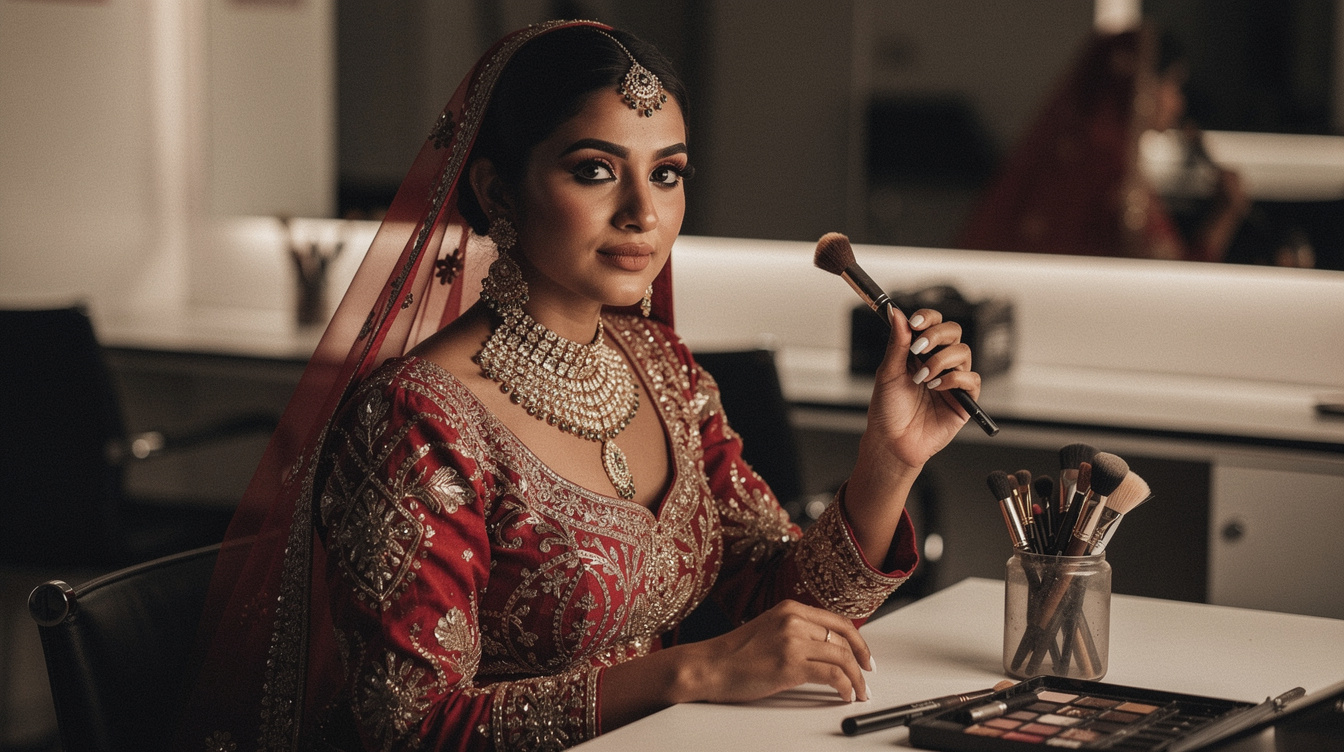
At a bridal appointment in peak Delhi NCR summer — lehenga already pinned, photographer setting up, the chai going cold on the dressing table — the brush in our hand is what decides whether the foundation reads as skin or as a layer sitting on top of skin. After 14+ years of working as a bridal makeup artist and over 1,000 brides served from Faridabad to Kashmir, we can say this with certainty: hand any working artist the most expensive foundation in the world, and if her brush is wrong, the result will be wrong. Bridal makeup brushes are not an accessory. They are the actual craft.
This is the brush kit conversation we have on the very first day of every batch of our 20-Day Professional Makeup Course at the Sector 16 Huda Market studio in Faridabad. Aspiring artists arrive overwhelmed — Rs. 500 brush sets on Instagram reels, Rs. 3,000 single brushes at department-store counters, YouTube reviewers swearing by twelve different things. We will cut through that noise. By the end of this 2026 buying guide, you will know exactly which 12 brushes a bridal MUA actually uses, which brands earn their price at each tier, and how to make a kit last for years instead of months.
We will also walk through how the professional brush kit included with our course fits into a working artist’s bag, how to clean and store brushes properly, when to replace them, and the questions students and brides ask us most often. None of this is theoretical. Every recommendation is filtered through 1,000+ bridal appointments, destination weddings from Jaipur and Udaipur to Sri Lanka and Canada, and the daily wear-and-tear of running a working studio.
Why brush quality matters more than product quality on real skin
Bridal makeup is judged in 4K. Photographers shoot in HD, families revisit the album for years, and Instagram sees every pore. The single biggest variable in whether a finish reads as “skin” or as “makeup” is not the foundation brand — it is the application tool. A Rs. 6,000 luxury foundation pushed around with a synthetic brush from a Rs. 500 multipack will streak, lift edges, and pick up too much product on the high points of the face. The same foundation buffed in with a properly weighted, densely packed brush will set into the skin like it belongs there.
There are three properties of a good bridal brush that we ask every student to feel before buying anything: density, taper, and bristle memory. Density decides how much product the brush picks up and releases — too sparse and the brush deposits unevenly; too packed and you fight to blend. Taper is the shape — a flawless powder brush is not just “fluffy,” it has a specific dome that lets you graduate pigment instead of slapping it on flat. Bristle memory is how the brush returns to its shape after washing, which is what separates a Rs. 400 brush from a Rs. 4,000 brush after six months of professional use.
On Indian bridal skin in particular — often more pigmented, sometimes oilier, almost always sitting under hot wedding lights and being touched by relatives, photographers and dupatta — brush choice is what holds a finish for 12 hours of ceremony versus letting it break down by the time the bride reaches the mandap. We have done destination weddings in 42°C Jim Corbett summers and 4°C Kashmir winters; the kit is what travels with us, and the kit is what holds up. Product trends change every season. Brush technique does not.
The 12 brushes every bridal MUA needs
A working bridal kit does not need 60 brushes. It needs 12 well-chosen ones. Anything beyond this is preference, not necessity. Below is the kit we teach every batch.
1. Flat foundation brush (paddle). For initial product placement on a clean canvas. Synthetic, densely packed, slightly tapered. We use it for the first pass with HD or airbrush-style foundations, especially around the perimeter of the face where blending tends to get sloppy.
2. Round buffer brush (kabuki). The workhorse of any bridal kit. After placement, this brush buffs foundation into skin and gives that lit-from-within finish brides ask for. Synthetic, densely packed, dome-shaped. If you are going to spend on one expensive brush, this is the one.
3. Concealer brush (small, flat, tapered). For under-eye, around the nose, and the chin shadow. Synthetic, flexible enough to bend into hollows, firm enough to deposit pigment without sheering it out. Most working artists carry two — one slightly larger, one fine.
4. Powder brush (large, fluffy dome). For setting powder. The single brush most amateurs get wrong — it must be soft enough to sweep away excess without disturbing the foundation underneath. Natural goat-hair brushes shine in this category; Charlotte Tilbury and MAC both make iconic options.
5. Setting / baking brush (small, fluffy). For pressing translucent powder under the eyes during the bake step before sweeping. Smaller than the powder brush, denser bristle, often with a flat profile.
6. Contour brush (angled, dense). For the hollow under cheekbones, the jawline, and temple shadow. Angled cut so it follows the bone naturally. We prefer slightly stiffer bristle for control on Indian bone structure.
7. Blush brush (round, slightly fluffy). Softer than contour, smaller than powder. Lays down pigment without dragging it. The way you angle this brush is half the technique — we drill it on real models in class.
8. Highlight brush (fan or small dome). For the high points — cheekbone, brow bone, cupid’s bow, inner corners. A sparse fan gives a glow; a small dome gives a more concentrated highlight. Most working artists carry both.
9. Eyeshadow base brush (flat, paddle). For laying down lid colour. Synthetic, dense, with a flat edge. This is what packs pigment without losing it on the way to the lid.
10. Eyeshadow blending brush (fluffy, tapered). For the crease and outer-V transition. The single most important eye brush in any kit. We tell students: if you can only afford one premium eye brush, this is it. NARS, MAC and Hakuhodo all make tear-inducing versions.
11. Eyeliner / detail brush (fine, angled or pointed). For gel liner, brow correction, and lash-line precision. Synthetic, very fine bristle, with enough spring to hold a clean line for a full bridal eye look.
12. Lip brush (small, flat or tapered). For precision lip lining and ombré effects on the bride’s lip — especially important for traditional looks where lip definition is heavy and the camera will catch every wobble.
That kit — twelve brushes — is what we teach. With these, a working artist can deliver any look in our repertoire: HD Glass Skin, Ultra HD, Soft Glam, Nude / No-Makeup, Airbrush, full traditional bridal — start to finish, with no excuses about missing tools.
Brand options by tier (budget / mid / premium)
We get asked constantly which brand to buy, especially by students setting up their first kit. The honest answer is “depends on your tier, which depends on how soon you are taking real bookings.” Here is how we segment it.
Budget tier (full kit Rs. 3,000–Rs. 8,000)
Indian and Korean brands like Praush, Boddess, Daily Life Forever52, Insight Cosmetics, and a handful of well-reviewed Amazon-stocked imports give serviceable starter kits. Bristles are mostly synthetic, ferrules aluminium, handles wood or plastic. A working artist can absolutely start here. We tell our students: budget tier is fine for the first six months while you are still learning angles and pressure. Once you are taking real Rs. 15,000+ bookings, the budget tier starts holding you back — colour pickup gets inconsistent, and bristle memory fails after 30–40 washes.
Mid tier (full kit Rs. 8,000–Rs. 25,000)
This is where Real Techniques, e.l.f. Studio, Morphe Pro, Sigma Beauty, and Wet n Wild’s higher ranges live. Better-engineered ferrules, much better bristle memory, much better consistency between repeats of the same brush. Most of our alumni who have been working independently for one to three years run on a mid-tier kit and supplement with one or two premium pieces — usually a powder brush and a crease blender.
Premium tier (Rs. 25,000+ for a kit, or Rs. 3,000–Rs. 8,000 per single brush)
MAC Pro, NARS, Charlotte Tilbury, Hakuhodo, Suqqu, Wayne Goss, Fenty Beauty Pro, Laura Mercier, Dior, Huda Beauty, and Haus Labs. These are brushes you keep for years if you maintain them. Hakuhodo and Suqqu are Japanese, hand-bound, and arguably the global gold standard in natural-bristle work. MAC’s #150 powder brush, NARS’s Yachiyo, and Charlotte Tilbury’s Powder & Sculpt range are individually iconic. Charlotte Tilbury and Laura Mercier powder brushes in particular are loved across our team for fair-to-medium Indian skin tones.
A practical rule we share with every batch: spend the most on the brushes you use the most. The buffer, the powder, the crease blender, and the contour brush earn premium money. Spend less on the brushes that come out twice per wedding — fan brush, lip brush, fine detailers. Build the kit piece by piece, never all at once. The fastest way to lose Rs. 50,000 is to buy a full premium set in one shopping trip before you know how you actually use them.
How the 20-Day Course’s included brush kit fits in
This is one of the most-asked questions on WhatsApp before students enrol — what exactly is in the included kit and is it any good — so we will be specific.
Our course is the Basics to Advanced format: 20 days, 12 PM to 5 PM, run from our Sector 16 Huda Market studio in Faridabad with batches capped at 10 students. Small-batch hands-on attention is the entire point of the format — you cannot teach brush technique on real skin in a 40-student lecture hall. Every student receives a professional brush kit at enrolment that is theirs to keep at the end of the course. Not rented. Not loaned. Yours.
The kit covers the 12 essentials we listed above, in a configuration we have refined over years of teaching working artists. It is not the cheapest kit on the market, and it is not the most luxurious. It is the kit that lets a fresh graduate walk out of our studio and start booking real clients without an extra Rs. 15,000 brush spend on day one. Combined with the specially curated training products you use during the course (yours to work with for the full 20 days), the certification on completion, the final assessment shoot with a professional model, and lifetime alumni support, the package is engineered to take a complete beginner from zero to portfolio-ready.
For aspiring artists worried about the fear we hear most often — “I’ll spend a lakh and learn nothing useful” — the included kit is part of how we answer that. You do not just leave with a certificate. You leave with the actual tools, the products you have practised on for 20 days, real shoot images for your portfolio, and a network of working alumni who refer each other. The early-bird fee is currently Rs. 1,50,000 + GST → Rs. 80,000 + GST (saving Rs. 70,000 — limited time), specifically because the June batch is filling fast and we want to reward early commitment. To check current availability, message us on WhatsApp at +91 9354888093 or Fill the inquiry form.
Trainer details, since students always ask before parting with course fees: Shivangi Verma personally leads every batch. 14+ years as a working bridal MUA, certified from Makeup Studio in the Netherlands, 1,000+ brides served, 62 Google reviews at 5.0, and an active booking calendar — not a retired teacher who left the chair five years ago.
Care, replacement, and longevity
A premium brush, looked after well, lasts five to seven years of professional use. A budget brush, looked after well, lasts 18–24 months. Looked after badly, both die in three months. Care matters more than spend. Here is what we teach.
Daily care (between clients)
Spritz the brush with a 70% isopropyl alcohol brush cleanser, wipe firmly on a clean microfibre towel, and lay flat to dry. This kills bacteria between brides at back-to-back appointments. A working artist does this five to eight times in a single bridal day. Skipping this step is how breakouts end up in your reviews — and reviews drive bookings in Faridabad and Delhi NCR more than any ad ever will.
Deep clean (weekly for working artists)
Wash with a gentle brush shampoo or a baby shampoo. Swirl on a textured silicone cleaning mat under cool running water — never hot, hot water dissolves the glue inside the ferrule. Rinse until the water runs completely clear. Reshape the bristle with your fingers while it is still wet. Lay the brush flat on a towel or hang upside-down to dry. Never store wet brushes upright in a cup. Water seeps into the ferrule, dissolves the glue, and the bristle falls out within months. This single mistake kills more brushes than anything else. We have seen students lose Rs. 4,000 brushes to it.
When to replace
A brush is finished when the bristles splay permanently and no longer return to shape, when shedding becomes constant during use (one or two strands is normal; ten is not), or when the ferrule loosens visibly from the handle. For powder and buffer brushes, expect to retire and rotate annually if you are doing 3+ weddings a week. Finer detail brushes — eyeliner, lip, fine concealer — last longer because they see less product and less water.
Storage and travel
A roll-up canvas or leather case is non-negotiable for destination wedding work. We have flown kits to Sri Lanka, Canada, Goa, Udaipur, Jaipur, Jim Corbett, Chandigarh, and Kashmir, and the only brushes that arrive in usable shape are the ones that travelled in a structured roll. Loose in a duffel bag, even a Hakuhodo will arrive bent. For everyday studio work, a standing brush holder is fine — just make sure it is clean and dry.
Frequently asked questions
Will the 20-Day course really prepare me for a career as a working bridal MUA?
Yes — but with realistic expectations. The course is intensive: 20 days × 5 hours of hands-on practice equals 100+ hours on real models, plus the curated product set, the included professional brush kit, and the final assessment shoot for your portfolio. What it gives you is a strong foundation, a working kit, real images for Instagram, certification, and lifetime alumni support. What it cannot do — for anyone, anywhere — is replace the next 12 months of taking real bookings, building Instagram, and learning client management. We are honest about that. The course gets you to the starting line in a hireable state.
Is investing in a premium brush kit worth it for a beginner?
No, not on day one. Buy a mid-tier or budget kit, learn your angles, learn pressure, learn how to clean brushes properly. Then upgrade piece by piece — buffer first, then powder, then crease blender. A beginner with a Rs. 40,000 kit and weak technique still produces weak makeup. A beginner with a Rs. 6,000 kit and strong technique can deliver beautifully. Spend on training first, brushes later — that is the order that pays back.
How do I tell if a brush is good quality before I buy it?
Three quick tests. First, run the bristle across the back of your wrist — it should feel soft but firm, never scratchy or shedding. Second, press the bristle gently against your palm and release — the brush should snap back to its original shape immediately. Third, tug lightly on the bristle — nothing should come away in your fingers. If you can do these in person at a counter (MAC, NARS, Charlotte Tilbury, Huda Beauty in Indian malls all permit this), do. Online, stick to brands with strong return policies.
Should bridal brushes be natural hair or synthetic?
Both, depending on the role. Natural hair (goat, squirrel, sable) holds powder beautifully — it is why traditional powder, blush, and crease brushes are often natural. Synthetic bristle is ideal for cream and liquid products — foundation, concealer, gel liner, lip — because it does not absorb the product into itself, which means cleaner application and easier washing. Most modern bridal kits are mixed, and that is correct.
How often should I deep-clean my brushes?
Working artists, weekly minimum. Daily quick-clean with isopropyl spray between clients is non-negotiable. Students practising on themselves can deep-clean every 7–10 days. Cleaner brushes give cleaner makeup and prevent the kind of skin reactions that end up in bad reviews — and in a market like Delhi NCR, one bad review can cost you 10 bookings.
20-Day Professional Makeup Course · Sector 16 Faridabad
Become a Professional Makeup Artist — Basics to Advanced
Hands-on training on real skin, only 10 students per batch, taught personally by Shivangi Verma — an active working bridal MUA with 14+ years and 1,000+ brides. Products, professional brush kit, certification and final assessment shoot all included.
Rs. 1,50,000 + GST → Early Bird: Rs. 80,000 + GST (save Rs. 70,000 — limited time)
💬 WhatsApp +91 9354888093 | Fill Inquiry Form | View Course Page →
The kit is the craft. After 14+ years of working as a bridal MUA and personally training every batch through our Basics to Advanced course at Sector 16 Faridabad, we have seen too many students sabotage strong technique with weak tools and weak care habits. Do not be that student. Start with the 12 essentials, choose a tier honest to your stage, clean obsessively, replace strategically, store with care. The brides in your chair will feel the difference. So will their photographers. So, eventually, will the bookings.