
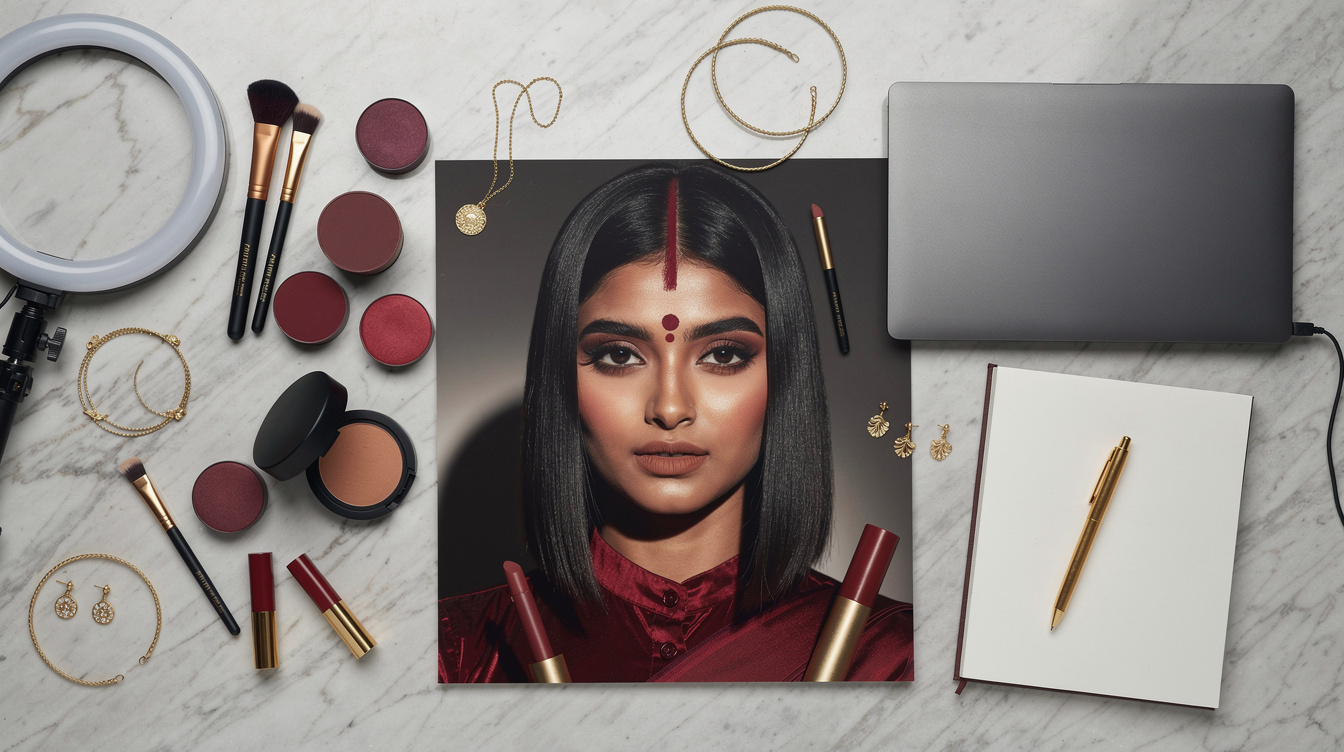
If you have spent the last six months scrolling reels of glass-skin transformations and bridal reveals, the same question has probably circled back more than once — should you train as a makeup artist, or build a beauty creator profile and chase brand deals? The two paths look almost identical on a phone screen. The economics behind them are not. In 2026 India, one path pays you for skill the moment you finish training, the other pays you for attention months or years after you start. Choosing well begins with understanding how each one actually earns.
We get this question almost every week from students enquiring about the 20-Day Professional Makeup Course at our Faridabad studio. Riya, a recent enquirer from Sector 21, framed it perfectly — “if I post good content for a year, can I earn what a working MUA earns? And if I train, will I still need Instagram?” The honest answer is that both paths work, both are crowded, and both reward foundations far more than algorithms. Numbers in this article come from real Delhi-NCR pay scales, real bridal-season bookings, and real conversations with our alumni — not from inflated social-media folklore.
Before we break down income models, one thing worth saying upfront — most of our 2024–2025 alumni who now book ₹25,000–₹40,000 weddings did not start out as creators. They started by enrolling in our Basics to Advanced course, finishing the certification with an assessment shoot, and only later building a content presence around the work they were already paid for. That order matters, and it is the single biggest reason we keep recommending skill-first over reach-first to anyone serious about a long career.
Income models — bookings vs sponsorships vs commissions
The fundamental difference between a working makeup artist and a beauty influencer is the unit of sale. A makeup artist sells time and skill on a paying client’s face — bookings. An influencer sells access to an audience — sponsorships, affiliate commissions, and platform monetisation. The two business models look glamorous from outside but they reward very different behaviours.
Booking income is what a certified MUA earns per assignment — bridal functions, engagements, party makeup, editorial shoots, runway calls, destination weddings. The pay is direct, the timeline is short (often same-day or 50% advance plus balance on completion), and the ceiling depends on your portfolio, location and reputation. Real Delhi-NCR rates in 2026 sit between ₹8,000 for a party makeup and ₹50,000-plus for an outstation bridal function. Wedding-season MUAs working through November to February can clock 25 to 60 paid functions in a single season.
Sponsorship income is what a beauty influencer earns when a brand pays for placement — a reel, a story carousel, a YouTube integration, an event appearance. India’s nano-influencer rate (1k–10k followers) ranges from ₹2,000 to ₹8,000 per reel; micro tier (10k–100k) commands ₹8,000 to ₹40,000 per reel; mid-tier (100k–500k) ranges ₹40,000 to ₹2,00,000. Numbers above that are real but rare — they cluster around creators who were either celebrities first or have been posting consistently for four-plus years.
Commission income sits underneath both — affiliate links, Amazon Associates payouts, Myntra and Nykaa creator programs, MAC and NARS pro-card discounts that you pass through, plus YouTube AdSense once monetisation kicks in. Commissions are slow money. Even strong beauty creators report affiliate revenue at 8 to 18 percent of their total earnings, with sponsorships carrying the rest. The compounding rewards loyalty over reach — a 30k-follower creator who actually drives sales often out-earns a 200k creator who only entertains.
Realistic income ranges for both paths
Here is where most career articles oversell. We will not. The pay distribution for both paths is heavily skewed — a small top slice earns most of the money, and the median figure is far lower than the visible top. Treat the ranges below as observed bands across Delhi NCR for 2025–2026, not promises.
Year-one MUA, certified, working full-time: ₹3,00,000 to ₹6,00,000 annual gross. This assumes a structured portfolio built during training, 8 to 15 paid bridal functions in the first wedding season, regular party-makeup work, and a few editorial or pre-wedding shoots. The bottom of this band is real and common. The top of this band is real and earned by artists who hustled during the off-season instead of waiting for inquiries.
Year-three MUA with consistent bookings: ₹8,00,000 to ₹18,00,000. By this point a working artist has 60 to 200 brides on their portfolio, an established price point in the ₹20,000–₹35,000 per-function band, repeat client referrals, and at least one or two destination weddings each season. Outstation bookings at ₹50,000-plus add meaningful upside. Some of our alumni cross ₹25,00,000 by year five — and they are usually the ones who treated client management and pricing as seriously as makeup technique.
Year-one beauty influencer, posting consistently: ₹0 to ₹1,50,000 annual. The honest median sits near the bottom of that band. Most year-one creators in 2026 are still building follower count, brand-deal inboxes are nearly empty, and the ones who do convert audiences this fast already had video skill, photography skill, or a niche credential before they started.
Year-three beauty influencer with 50k–150k engaged followers: ₹4,00,000 to ₹15,00,000. This is real. It is also rare. Industry surveys we trust suggest fewer than one in twelve creators who start in any given year are still posting at month thirty-six. The path is non-linear, the audience is unforgiving when posting frequency drops, and the income is lumpy — five-figure months alongside near-zero months. Most creators who hit the ₹15,00,000 line have either monetised a parallel skill (technique-led tutorials, paid masterclasses, affiliate-heavy product reviews) or signed annual ambassador deals with two or three brands.
The mathematics is uncomfortable but worth saying once — across 2026 India, the median certified working MUA earns more in year one than the median beauty creator earns in year three. The exceptions are loud, and that is exactly why the average aspirant overestimates the influencer path.
Time-to-income — which path pays sooner
If you need a paycheque in 2026, not 2028, the answer is unambiguous — the trained makeup artist starts earning first. Our 20-day course at the Sector 16 Huda Market studio runs 12 PM to 5 PM with a hard cap of 10 students per batch, and finishes with a final assessment shoot on a professional model that goes straight into the student’s portfolio. Within roughly four to ten weeks of completion, most graduates start taking party-makeup bookings at ₹6,000–₹10,000, family-function gigs through referrals, and pre-wedding photoshoot calls in the ₹8,000–₹15,000 band.
The first bridal booking usually lands inside three to seven months — fast for course graduates because the assessment shoot, brush kit, and certification act as proof points before any social-media following exists. Many of our alumni take their first ₹25,000–₹35,000 bridal function inside their first wedding season after training. Compare that with the typical influencer timeline — most beauty creators report twelve to eighteen months of consistent posting before the first paid brand collaboration above ₹10,000, and three to four years before the income approaches what a year-two MUA already earns.
There is a cash-flow point hidden inside this difference. MUAs collect 50 percent advance on confirmation and balance on the function date. Influencers collect on net-30, net-45, and increasingly net-60 from agencies, and chase invoices for months. If your decision is partly about supporting yourself or your family while you build, the booking model is dramatically more forgiving in the first two years.
If you are weighing options seriously, drop a message on WhatsApp +91 9354888093 — we will share batch dates, what is included, and an honest read on whether the path is right for where you are.
Combined paths — when alumni do both
The strongest careers in 2026 India are not pure-MUA or pure-influencer — they are hybrids. The pattern we see across our alumni network is consistent. Train first. Book paying clients for nine to twelve months. Document the work — every bridal trial, every destination function, every backstage pre-wedding shoot — with consent and styled posts. Then layer a content presence on top of an already-paid skill.
This sequencing changes the economics dramatically. A working MUA with 12k Instagram followers and a real bridal portfolio is taken more seriously by brands than a 60k-follower creator who has never charged for makeup on a real face. Nykaa Network, MAC India seeding lists, and bridal-publication features all favour artists with bookable skill. Sponsorship rates for working MUAs at micro-tier follower counts often match or exceed pure creators at twice the audience size — because brands trust technique-driven posts to convert.
Alumni who run the hybrid model effectively report combined incomes 30 to 60 percent higher than pure-bookings peers in year three, with sponsorship income smoothing the wedding-season cash-flow valleys. Real product brands you will work with on these collaborations include MAC, NARS, Dior Beauty, Huda Beauty, Fenty Beauty, Laura Mercier, Haus Labs, and Charlotte Tilbury — exactly the kits we already train students to use during the course.
The reverse path — start as influencer, then learn makeup — is harder. Audiences built on entertainment do not always convert to clients who book paid bridal trials. Audiences built on technical credibility almost always do.
Why a structured course foundation helps either path
Riya’s biggest fear when she first messaged us was the one most aspiring artists carry quietly — “I’ll spend a lakh on a course and learn nothing useful.” It is a fair fear. Many short-format and online programmes hand out certificates without ever putting a brush in your hand on a real face. We hear it often enough that we built our 20-day programme specifically to answer it. Every student works on live models every day, the kit you receive is the same calibre we use on paying brides, and Shivangi personally leads each batch — there is no junior-trainer handoff.
The course covers HD Makeup, Airbrush, HD Glass Skin, soft glam, nude finishes, and bridal techniques — alongside the parts students underestimate until it is too late, like client handling, pricing your own work, package construction, and the business basics that turn a skill into an income. The included specially curated training products are yours to use during the course, the professional brush kit is yours to keep, and certification on completion comes paired with a final assessment shoot on a professional model — that shoot becomes the first portfolio asset you carry into both bookings and content posts.
Lifetime alumni support is the part that quietly compounds. Course alumni from earlier batches still message Shivangi for advice on pricing destination weddings, handling difficult clients, or navigating their first sponsorship contract — three years after their training ended. That continuity is what separates a useful credential from a paper one. If the structured route fits where you are, the Course inquiry form is the simplest starting point — we respond personally within a working day.
For full transparency on fees — the regular course price is Rs. 1,50,000 + GST, and the current early-bird rate of Rs. 80,000 + GST is a limited-time offer that saves Rs. 70,000 against the standard price. Trainer credentials matter here too — Shivangi Verma is an active working bridal MUA with 14+ years of experience, 1,000+ brides on her portfolio, 62 Google reviews at a five-star rating, and a real bridal calendar that runs alongside teaching. The course is taught by someone who works with real clients every week, not someone who only teaches.
Frequently asked questions
Will the 20-day course really prepare me for a paying career?
Yes — the format is intensive, full-time, and structured for real industry handover. Twenty days of 12 PM to 5 PM sessions, capped at 10 students, working on live models daily, with portfolio shoot and certification at the end. Most alumni take their first paid party or pre-wedding booking within four to ten weeks of completing the programme. The course also covers pricing and client handling, not only technique.
If I become a makeup artist, will I still need Instagram?
You will benefit from a content presence, but you do not need it before you start booking. Many of our alumni take ten to twenty paying clients before their first reel goes live. A simple, well-shot portfolio grid is enough to convert serious bridal inquiries — the algorithm-chasing reel cycle is optional, not mandatory.
Do beauty influencers really earn more than working MUAs?
Top-tier influencers do, but the median working MUA earns more than the median beauty creator at every comparable career stage in the first three years. The visible top one percent of creators distorts public perception of the average. Bookings income is more predictable, faster, and easier to scale through skill than audience size.
What if I am a complete beginner with no makeup background?
The course is designed for beginners through to advanced learners. We have trained students from finance, teaching, and homemaker backgrounds with no prior makeup experience — the foundation modules cover skin preparation, colour theory, and product chemistry from first principles. Small batch size means you get personal correction on every technique before moving forward.
Can I do both — train as an MUA and build a beauty creator profile?
Yes — and this is increasingly the strongest career model in 2026. Train first, book real clients, document the work professionally, and only then layer a content presence on top of demonstrated skill. Most of our alumni who run hybrid careers earn 30 to 60 percent more by year three than peers who picked only one path.
What is included in the course fee?
The fee covers 20 days of hands-on training at our Sector 16 Huda Market studio, specially curated training products for use during the course, a professional brush kit that is yours to keep, certification on completion, the final assessment shoot with a professional model for your portfolio, and lifetime alumni support for ongoing career questions. The early-bird rate of Rs. 80,000 + GST is a limited-time offer against the regular Rs. 1,50,000 + GST price.
20-Day Professional Makeup Course · Sector 16 Faridabad
Become a Professional Makeup Artist — Basics to Advanced
Hands-on training on real skin, only 10 students per batch, taught personally by Shivangi Verma — an active working bridal MUA with 14+ years and 1,000+ brides. Products, professional brush kit, certification and final assessment shoot all included.
Rs. 1,50,000 + GST → Early Bird: Rs. 80,000 + GST (save Rs. 70,000 — limited time)
💬 WhatsApp +91 9354888093 | Fill Inquiry Form | View Course Page →
The choice between training as an MUA and building an influencer profile is really a choice about what you want to sell — skill or attention. Both work. Skill pays sooner, scales steadier, and travels further when the algorithm shifts. If your decision is leaning toward the structured route, the simplest next step is the professional makeup course in Faridabad page for the full programme breakdown, or a direct WhatsApp message at +91 9354888093 — we will tell you honestly whether the next batch is the right fit for where you are.