
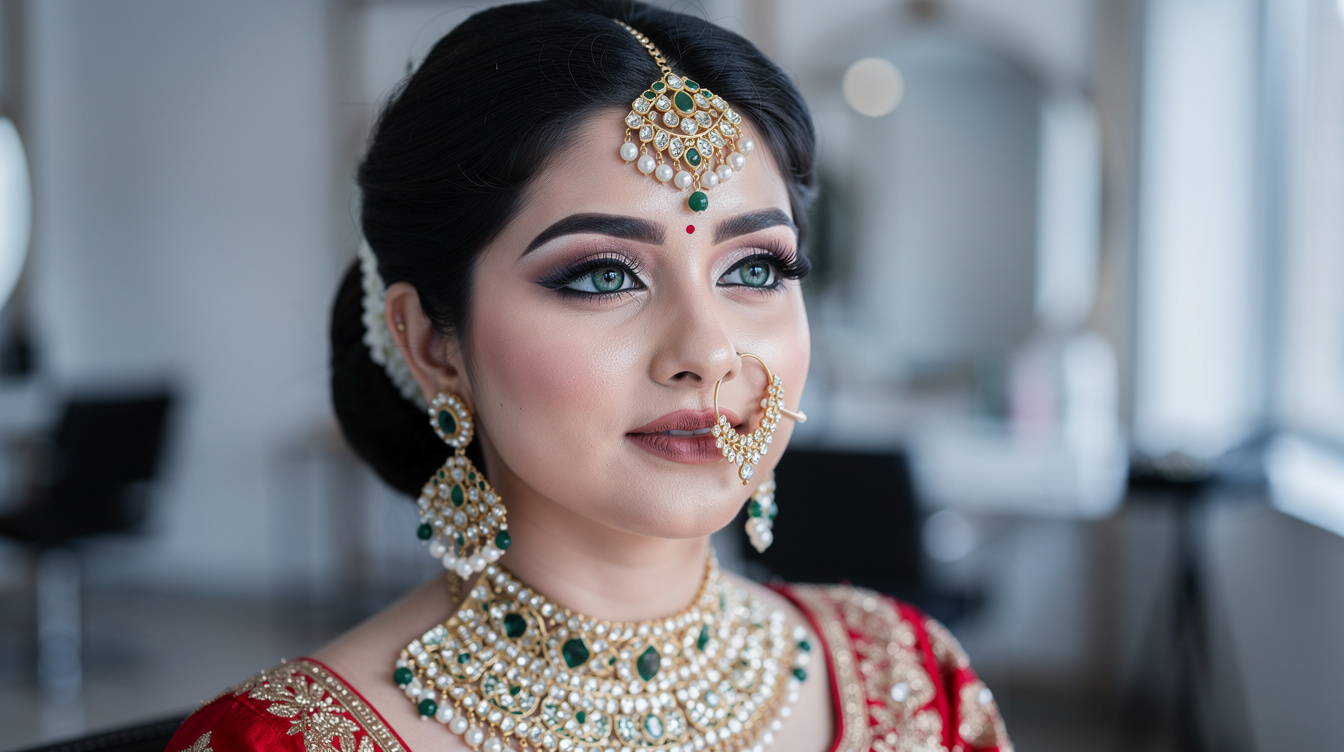
Few wedding looks carry the gravitas of Bengali bridal makeup. The red Banarasi saree, the tiered gold jewellery, the crimson alta on the feet, and — most unmistakably — the white sandalwood chandan dots that trace a bride’s forehead, temples, and cheeks. It is tradition distilled into pigment. For a Delhi NCR bride planning her wedding over the next three to six months, the question is not whether to honour this heritage, but how to translate it for HD cameras, long ceremonies, and a face that still looks like yours at 2 a.m. after the vidaai. This is our working guide — drawn from thirteen years of bridal work and more than a thousand brides prepped in our Faridabad studio.
We are Shivangi Verma Makeovers. We have styled Bengali brides in Kolkata-rooted families across Delhi, Noida, Gurgaon, and Faridabad, and carried the look to destination weddings in Udaipur, Jaipur, Goa, Jim Corbett, Kashmir, Chandigarh, Sri Lanka, and Canada. What follows is the technique, the product logic, and the honest conversation a bride deserves before she books.
What Makes Bengali Bridal Makeup Distinct
The Bengali bridal aesthetic is built on contrast. White sandalwood motifs against a luminous complexion. A deep red lip against a softly flushed cheek. Kohl-heavy eyes balanced by the glow of the skin beneath. It is one of the few regional bridal looks in India where the artistry is as much on the forehead and temples as it is on the eyes. That shifts how we plan the face — base, brows, and eyes must anchor, not compete with, the chandan work.
The Three Signatures
- Chandan dots and motifs — intricate white sandalwood patterns drawn across the forehead, from brow to hairline, and fanning down the cheeks and temples.
- The red bindi trail — a central red circle flanked by fine dotted lines running up into the parting, often paired with a teardrop at the chin.
- Bold kohl and winged liner — the eye work is unapologetically dark, designed to hold against the brightness of the jewellery and the saree.
How It Differs From Other Regional Looks
A Punjabi bridal look typically leans into a smoked, blended eye and a softer lip. A South Indian bridal look tends to be temple-gold-led with warmer, coral-rooted lips. Bengali bridal makeup is cooler-toned at the lip, graphic at the eye, and ornamental at the skin — the chandan is treated as part of the face, not as an accessory pasted on top. When we style a Bengali bride, we plan the base tone, highlighter, and forehead space knowing white motifs will sit on it for eight to sixteen hours.
Building the Base: Skin Prep for an HD Bengali Bride
The chandan dots only sit cleanly on a base that is smooth, hydrated, and non-slippery. Over-oiled skin will bleed the sandalwood edges within an hour. Over-powdered skin will look flat in close-up photographs. We work in a middle lane we call skin-first bridal prep — glow where it flatters the bones, matte where it anchors the motif work.
Our Prep Sequence
- Double cleanse, then a gentle enzyme exfoliation two nights before the wedding — never day-of.
- Cold-compress de-puff on the morning of, followed by a hydrating sheet mask while hair is being set.
- A lightweight primer on the face, a grip primer only on the T-zone and around the brows where chandan will sit.
- Foundation matched to the neck and chest — never a shade lighter. We work with MAC, NARS, Dior, Huda Beauty, Fenty Beauty, and Laura Mercier depending on the bride’s undertone and finish preference.
- Targeted concealing, cream blush pressed in before powder, and a fine micro-setting with a translucent powder only where we need longevity.
This is where our bridal makeup approach is consistent across every region we style: the base serves the bride, not the trend. A Bengali bride with glass-skin-prone texture gets our HD Glass Skin protocol. A bride with reactive or combination skin gets a skin-like finish that still photographs cleanly under flash.
The Chandan Work: Technique, Not Stencil
Modern Bengali bridal makeup has quietly split into two camps — traditional freehand chandan and stencilled motif work. We prefer a hybrid. A very fine stencil guide for symmetry, finished by hand so the dots do not look printed. The pigment matters: a true sandalwood paste is romantic but inconsistent; a high-pigment white liner or liquid liner gives us the crisp opacity that HD cameras demand, without turning chalky under flash.
Where the Motifs Go
- Forehead — a central red bindi, flanked by fine white dotted lines running vertically into the parting.
- Temples — soft fan-shaped dots that widen towards the hairline, framing the face.
- Cheeks — a small half-moon or teardrop cluster just below the outer corner of the eye.
- Chin — a single teardrop or small bindi, traditional in many Bengali families.
We always plan the motif layout with the bride’s dupatta and mukut in mind. If the crown sits low on the forehead, the chandan work is compressed and denser. If the parting is wide and the mukut is tall, we let the vertical lines breathe.
Eyes, Brows, and the Red Lip
The Eye
The Bengali bridal eye is dramatic without being heavy-handed. We usually build a warm, bronze-toned smoke with a deeper outer corner, a crisp inky wing, and generous kohl on the waterline. Lashes are layered — a natural individual base with a fuller strip on top — to hold up against heavy jewellery at the ears and forehead. For brides worried about flashback in photos, we avoid high-bismuth shimmers and lean on Charlotte Tilbury and Haus Labs powders that read clean on camera.
The Brows
Bengali bridal brows are groomed, never overdrawn. They sit in proportion to the chandan work above them. We use fine, hair-like strokes rather than a pomade block, because an overly sculpted brow competes with the forehead motifs and makes the face look busier in close-ups.
The Red Lip
The classic Bengali bridal lip is a deep, blue-red — not orange-red, not brick. We overline very slightly at the cupid’s bow for camera balance, then pack pigment in with a brush and blot. A long-wear liquid base with a satin topper gives us eight hours of wear without the crack that matte-only formulas produce by dinner. For brides with naturally pigmented lips, we neutralise first to keep the red true on film.
Will It Last? The Longevity Question
This is the fear we hear most often. A Bengali wedding day runs long — gaye holud at dawn, the shubho drishti under the canopy, hours of photographs, and then the reception. Brides tell us they are afraid of chandan smudging after the first hug, the red lip migrating, or the base breaking around the nose by the time dinner is served. This is a real fear, and it deserves a real answer.
Our reviews consistently note that the makeup and hair held intact into late hours. We get there through product architecture, not a single miracle product. Waterproof and transfer-resistant bases. Airbrush application where humidity is high — Kolkata-side weddings, Goa destination weddings, summer Delhi venues. A sealed chandan layer using a fine mist of setting spray before the final motifs go on. A touch-up kit, paired to your exact shades, handed to your sister or closest friend with a two-minute briefing.
You can see the endurance of the finish in real bridal work across our portfolio — on-face shots under mandap lighting, late-night reception photographs, and outdoor summer ceremonies.
Choosing Between HD, Ultra HD, and Airbrush
This is the single most-searched comparison by Delhi NCR brides, and it matters specifically for Bengali bridal makeup because the chandan work is photographed up close. Here is the honest breakdown.
- HD makeup — fine, buildable coverage designed to look natural under 1080p photography. Ideal for intimate indoor weddings and brides who want to look like a refined version of themselves.
- Ultra HD makeup — finer milled pigments and more translucency; built for 4K and close-up cinematography. Better for brides being filmed heavily.
- Airbrush makeup — sprayed micro-droplets, naturally waterproof, excellent in humidity and heat. Our default for destination weddings and long outdoor ceremonies.
For a traditional Bengali look, we most often pair Ultra HD on the skin with airbrush reinforcement on the chest and neck where sweat settles. The chandan is always hand-finished over the top.
Trials, Timelines, and What to Bring
A trial is not optional for Bengali bridal makeup — it is how we lock the motif layout, test the red lip formula on your specific pigmentation, and confirm that the base does not flashback under the photographer’s flash. We recommend your trial six to eight weeks before the wedding, with your jewellery and dupatta in hand.
Bring to the Trial
- A high-resolution photograph of your wedding saree and dupatta.
- At least one piece of your actual jewellery — ideally the mukut or the forehead-adjacent tikka.
- Any skincare product you have reacted to in the past.
- A few reference images — not to copy, but to give us a feel for how bold or understated you want the motif work.
Pricing and What Is Actually Included
Bridal pricing should not be a mystery. Our starting reference rates, publicly listed on WedMeGood, are ₹28,000 per bridal function, ₹25,000 for engagement, ₹8,000 for party or family makeup, and ₹50,000 for outstation per function. These are starting ranges — final quotes are customised to the look, the hair, the draping, the travel, and the team size. We confirm every number over WhatsApp before you commit, so there are no surprise charges on the wedding morning.
Shivangi personally leads every bridal appointment — never delegated to a junior. The full wedding-day team includes a hairstylist, a drapist for your Banarasi saree, a photographer, and an assistant, and the whole team travels together for destination weddings.
Frequently Asked Questions
Will I still look like myself with a traditional Bengali bridal look?
Yes — and this is the line we hold most firmly. Our approach is natural beauty enhancement, not transformation. Brides consistently describe the finish as light, comfortable, and recognisably them, even with the full chandan and red-lip styling. The signature elements are bold, but the base is restrained and matched to your own skin tone, not lightened or darkened.
How long will the chandan motifs and red lip last in Delhi NCR summer heat?
With waterproof products, airbrush base, and a sealed motif finish, the look holds cleanly through an 8 to 16-hour ceremony. Real reviews from our brides specifically mention makeup and hair staying intact into late hours. We also send you home from the studio with a touch-up kit matched to your exact shades for the reception.
How is HD Glass Skin different from regular bridal makeup for a Bengali bride?
Regular bridal makeup leans on full-coverage foundation and heavy powder, which can read flat on HD cameras and make white chandan motifs look chalky. HD Glass Skin uses finer pigments, more translucency, and strategic luminosity so your skin reads dewy and dimensional on film while the motif work stays crisp on top. It is our most requested finish for photography-heavy weddings.
Can you travel for a Bengali destination wedding outside Delhi NCR?
Yes. We have already styled weddings in Jaipur, Udaipur, Goa, Jim Corbett, Chandigarh, and Kashmir within India, and internationally in Sri Lanka and Canada. The full team — makeup, hair, drapist, photographer — travels together, and outstation pricing starts at ₹50,000 per function before travel and stay.
How do I know the trial will match the actual wedding day?
Because Shivangi personally does both — the trial and the wedding. There is no handover to a junior artist on the big day. We photograph the trial under flash and daylight, document the exact products and motif layout, and replicate it on the wedding morning. You see what you are getting, in writing and in pictures, well before the ceremony.
Book Your Bridal Makeup Consultation
Shivangi Verma brings 13+ years of expertise to make your special day unforgettable. Based in Sector 16 Faridabad, serving brides across Delhi NCR and destination weddings worldwide.
📞 +91 9873048267 | 💬 WhatsApp Us | 📍 Booth 70-71, First Floor, Sector 16 Huda Market, Faridabad