
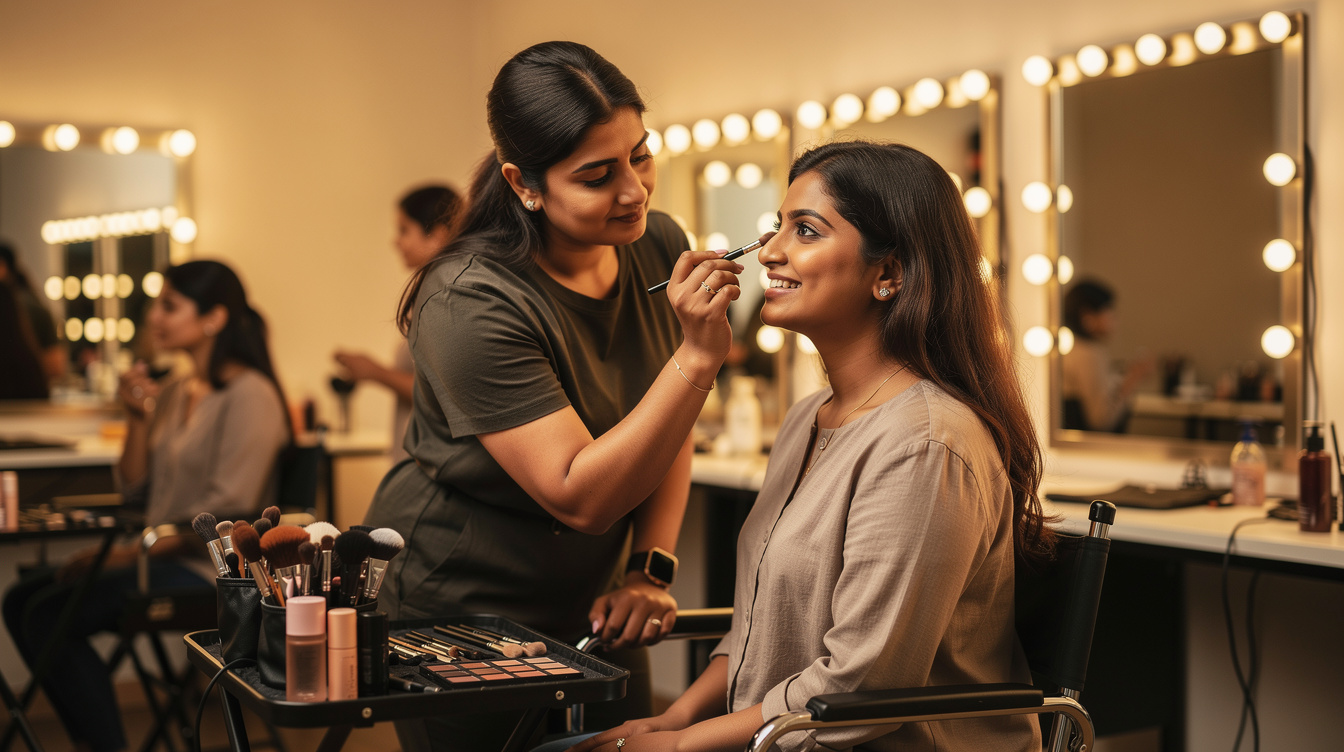
Every aspiring makeup artist we meet in 2026 is asking the same question, just phrased differently. Some call it “finding a mentor.” Some call it “shadowing a senior MUA.” Some have already paid for a generic certificate course and feel stuck — they can do a smoky eye on a mannequin head, but the moment a real bride sits in the chair, the hands freeze. The honest answer we give them is this: makeup artist mentorship and a structured course are not competitors. They are two halves of the same career, and the order in which you do them decides whether you get bookings in your first year or spend three years figuring out why you’re not.
This is a long read because the decision is a long-term one. We run the 20-Day Professional Makeup Course at our Sector 16 Huda Market studio in Faridabad, and we also offer lifetime alumni mentorship to every student who graduates. So we’re going to be transparent about what each format actually does, where mentorship-only routes break down, and how to layer the two so you don’t waste a year of your career — or a lakh of your savings — on the wrong sequence.
If you are reading this from anywhere in Delhi NCR — Faridabad, Gurugram, Noida, South Delhi — and weighing your 2026 options, the framework below applies whether you eventually pick our Basics to Advanced course or someone else’s. The principles travel.
What ‘mentorship’ actually means without a course foundation
The word “mentorship” has been stretched so thin in the makeup industry that it now covers everything from a single paid one-hour Zoom call to a full year of structured shadowing. Before you pay for any of it, you need to understand what you are buying.
In its purest form, mentorship is a relationship — not a syllabus. A working artist agrees to answer your questions, review your work, occasionally let you assist on a real bridal job, and pull you out of mistakes you cannot yet see. There is no fixed curriculum. There is no guaranteed coverage of HD makeup, Airbrush, glass skin, or bridal techniques. There is no certification at the end. What you get is access to someone who has already solved problems you have not yet encountered, and a willingness on their part to share the solution when you ask the right question.
That last clause is where most beginner mentorship arrangements collapse. To ask the right question, you must already know roughly where you are stuck. A student who has never colour-matched a foundation under tungsten lighting cannot ask their mentor a useful question about flashback in wedding photos — they don’t yet know that flashback is the problem. They will look at a slightly grey jawline in a flash photo and assume the camera was wrong, or the lighting was wrong, or the bride was wrong. The mentor can only help with what the mentee can articulate, and articulation requires a base of structured knowledge.
This is why “makeup mentor India” searches that promise to skip formal training and go straight to learning from a working artist tend to disappoint. The mentor is real. The access is real. But without the technical scaffolding underneath, the student cannot extract value from the relationship at the speed they assumed they would.
Why mentorship without course basics rarely works
We see this pattern at least once a month. A young artist messages us on +91 9873048267 saying they have been “assisting” a senior artist for six or eight months, sometimes longer. They have carried kits, set up lighting, handled the bride’s chunni, packed brushes at 2 a.m. — and they want to know why they still cannot run their own job. The answer is almost always the same. Assisting is exposure, not education. Watching someone do a blended cut crease for the hundredth time does not teach your hands to do it; it teaches your eyes to recognise it.
The second failure mode is product fluency. A bride asks “is this MAC or NARS?” and the assistant has no answer because they have only ever handled the senior’s kit, not built and rationalised one of their own. Knowing why a Laura Mercier setting powder behaves differently from a Huda Beauty one under HD video — or when a Charlotte Tilbury cream blush will lift better than a powder — is the kind of knowledge that has to be drilled in a structured environment with deliberate practice, not absorbed by osmosis on a wedding floor where the senior MUA does not have time to explain.
The third failure mode is the one that costs students the most money: they are afraid of wasting a lakh on a course that teaches them “nothing useful.” We hear this fear honestly and we want to acknowledge it — it is the single biggest reason promising artists delay enrolment. But the irony is that the mentorship-only route, with no fixed end date and no guaranteed skill checklist, often consumes far more time and money than a structured course would have. Six months of assisting at modest stipends, plus product purchases made without guidance, plus the opportunity cost of not being bookable yet, regularly exceeds the fee of a serious professional course.
The fourth issue is credibility. When you walk into a consultation with a paying bride and her mother, certification matters less than your portfolio — but the absence of any recognised training shows up in the questions you cannot answer about your own process. A structured course does not just teach; it creates a vocabulary that lets you sell.
How alumni mentorship from active MUAs accelerates careers
Now flip the order. You complete a structured course first, walk out with foundations, certification, a portfolio shoot in your hand and a brush kit you understand intimately — and then you plug into ongoing mentorship from the same artist who taught you. This sequence works because the mentor is no longer answering beginner questions on borrowed time; the mentor is now a senior colleague helping you scale.
The mentor’s value compounds when they are still actively working in the field. A makeup educator who stopped taking bridal jobs in 2019 cannot tell you how a 2026 bride in Faridabad is asking for her base — what she has seen on Instagram that morning, which finish she is rejecting, which influencer’s contour she is bringing as a reference. An active working MUA can. That immediacy is the difference between mentorship that ages well and mentorship that becomes a museum tour of techniques nobody is booking anymore.
It also matters that the mentor has lived through the business side recently. Pricing, packaging, dealing with last-minute cancellations, handling group bookings for a sangeet of fifteen people, deciding whether to take a destination job in Jim Corbett or Udaipur or Sri Lanka, building a team that includes a hairstylist, a draping expert and a photographer — these are not theoretical questions. They are this-month questions. The artist who is still solving them in real time can transmit the answer in two sentences. The artist who solved them five years ago will give you a five-year-old answer.
For some context on who is teaching you in our setup: Shivangi Verma has been operating since 2012, has 14+ years of experience, holds international certification from Makeup Studio in the Netherlands, has personally worked on 1,000+ brides, and currently sits at a 5-star rating across 62 Google reviews. That track record is not a marketing line. It is the working track record of the artist who will be answering your alumni questions on WhatsApp in 2027 and 2028.
How the 20-Day Course’s lifetime alumni access functions
Here is what the structure looks like in practice, so you can compare it apples-to-apples with any mentorship-only offer you are considering. Shivangi Verma’s makeup course is a 20-day intensive that runs from 12 PM to 5 PM at our Sector 16 Huda Market studio in Faridabad, capped at 10 students per batch so every face in the room gets personalised attention. The format is unapologetically hands-on — covering HD Makeup, Airbrush, Glass Skin and Bridal Techniques, plus client handling and business skills, all on real skin rather than mannequin heads.
Every student receives specially curated training products that are theirs to use throughout the course, a professional brush kit that is yours to keep when you graduate, certification on completion, and a final assessment shoot with a professional model so you walk out with portfolio-grade images on day twenty itself. We are not going to publish a day-by-day breakdown — that is a deliberate choice we make because course pacing depends on the batch’s progress, and we want to keep the conversation high-level and personal rather than turning it into a checklist.
Where this matters for the mentorship discussion is what happens after day twenty. Lifetime alumni support is included. That means once you graduate, you stay in the loop with Shivangi for the rest of your career — not as a paid retainer, not as a tiered “premium” upsell, but as a graduate of the studio. When you have a real bride, a real problem, a real lighting nightmare on the morning of a wedding, you have someone to message who already knows your hands, your kit, your weaknesses and your strengths because she taught you.
On pricing — and we want to be transparent because cost is a legitimate part of the decision — the regular fee for the course is Rs. 1,50,000 + GST, and the current early-bird rate is Rs. 80,000 + GST, a saving of Rs. 70,000 for a limited time. We mention it not to pressure you but because the per-rupee comparison with mentorship-only arrangements is part of the honest picture. If you would like to talk through eligibility, you can WhatsApp us at +91 9873048267 or Fill the inquiry form and we will get back to you the same day.
When to seek a separate mentor on top of a course
None of the above means a single course plus alumni access is the entire answer for everyone. There are specific points in your career — and we want to flag them honestly — when seeking a second mentor, on top of your course training, makes sense.
The first is when you want to specialise hard into a niche your primary trainer does not focus on. If you finish your course and decide your future is editorial fashion shoots in Mumbai, or theatrical SFX, or a very specific regional bridal style outside the trainer’s geography, finding a second mentor who lives inside that niche is sensible. Your foundational artist is unlikely to be territorial about that — the strong ones welcome it.
The second is when you start scaling a team and need business mentorship distinct from technical mentorship. Hiring your first assistant, deciding whether to register a studio, navigating GST and contracts — these are entrepreneurial problems that may benefit from a mentor whose strength is the business side rather than the brush.
The third is geographical. If you are a Faridabad-based artist suddenly booking destination work in Goa, Udaipur, Kashmir, Jaipur, Chandigarh, Sri Lanka or Canada, finding a contact in those markets — even informally — speeds up your logistics learning curve. We have shot in all those places and the lessons in each were specific.
The shared thread across all three scenarios is that secondary mentorship works best on top of a foundation, not in place of it. The students who try to skip the foundation and go straight to a niche specialist tend to slow themselves down, because the specialist has to keep filling in basics that should have been resolved in a structured course.
FAQ
Will the 20-Day course really prepare me for a career, or do I need a separate mentor afterwards?
The 20-day intensive is designed to take a complete beginner to working-professional level, with hands-on practice on real skin, a final assessment shoot, certification and your own brush kit. Lifetime alumni access to Shivangi is included, which functionally serves the role most external mentorship would. A separate paid mentor is usually only needed if you specialise into a niche we don’t focus on, or scale into a business problem distinct from technique.
I’m worried I’ll spend a lakh and learn nothing useful — how do I know this won’t happen?
This is the most legitimate fear we hear and we want to address it directly. The course runs entirely on live models, not mannequin heads. Shivangi personally teaches every batch — there is no junior trainer running the room. Premium training products are provided so you are practising with the same calibre of products you will use professionally. The portfolio shoot on the final day means you walk out with images, not just a certificate. If you would like to speak with a recent alumna before deciding, we will connect you on WhatsApp.
What if I don’t get clients after the course — isn’t the market saturated?
The market is competitive but not saturated for artists who can deliver consistent quality and run a professional client experience. The course explicitly covers portfolio building, client handling, pricing strategy and business setup — not just makeup technique. We treat the business side as core curriculum rather than an afterthought, because the technical skill alone does not generate bookings. Many of our alumni begin booking party and engagement work within their first quarter post-graduation.
Is 20 days really enough to learn properly compared to a 3-month diploma?
The format is intensive and full-time — 20 consecutive days of hands-on training, 12 PM to 5 PM, in a small batch capped at 10 students. That density of practice on live models, with personal attention from an active working bridal MUA, is what compresses the learning curve. Longer diploma formats often dilute the same content over months with smaller daily contact. The decision is less about total weeks and more about how concentrated and hands-on the contact hours are.
Is the academy reputable enough — how does it compare with bigger chain brands?
Shivangi Verma has been operating since 2012, holds international certification from Makeup Studio in the Netherlands, has worked on 1,000+ brides, and currently holds a 5-star rating across 62 Google reviews. The studio is listed on WedMeGood, WeddingWire, JustDial, Sloshout and MagicPin. The differentiator from chain academies is that the trainer is an active working bridal artist — not a full-time educator who stopped taking jobs years ago — so the techniques and business advice you learn are current.
I’m a career changer in my thirties — am I too old to start makeup professionally?
No. We have students from a wide range of backgrounds and ages, and the 20-day format is explicitly designed for complete beginners through to advanced learners. Maturity tends to be an advantage in bridal work — clients are placing significant trust in their artist and often respond well to an artist who carries calm and life experience. Reach out and we will talk through your specific situation.
20-Day Professional Makeup Course · Sector 16 Faridabad
Become a Professional Makeup Artist — Basics to Advanced
Hands-on training on real skin, only 10 students per batch, taught personally by Shivangi Verma — an active working bridal MUA with 14+ years and 1,000+ brides. Products, professional brush kit, certification and final assessment shoot all included.
Rs. 1,50,000 + GST → Early Bird: Rs. 80,000 + GST (save Rs. 70,000 — limited time)
💬 WhatsApp +91 9873048267 | Fill Inquiry Form | View Course Page →
If you have read this far, you are taking the decision seriously — which is the right instinct. The choice between makeup mentorship and a structured course is not really either-or; the right sequence is foundation first, mentorship layered on top, ideally with the same active working artist on both sides. That is exactly how our professional makeup course in Faridabad is built. To talk through your specific background and goals, message us on WhatsApp at +91 9873048267 — Shivangi or our team will reply personally.