
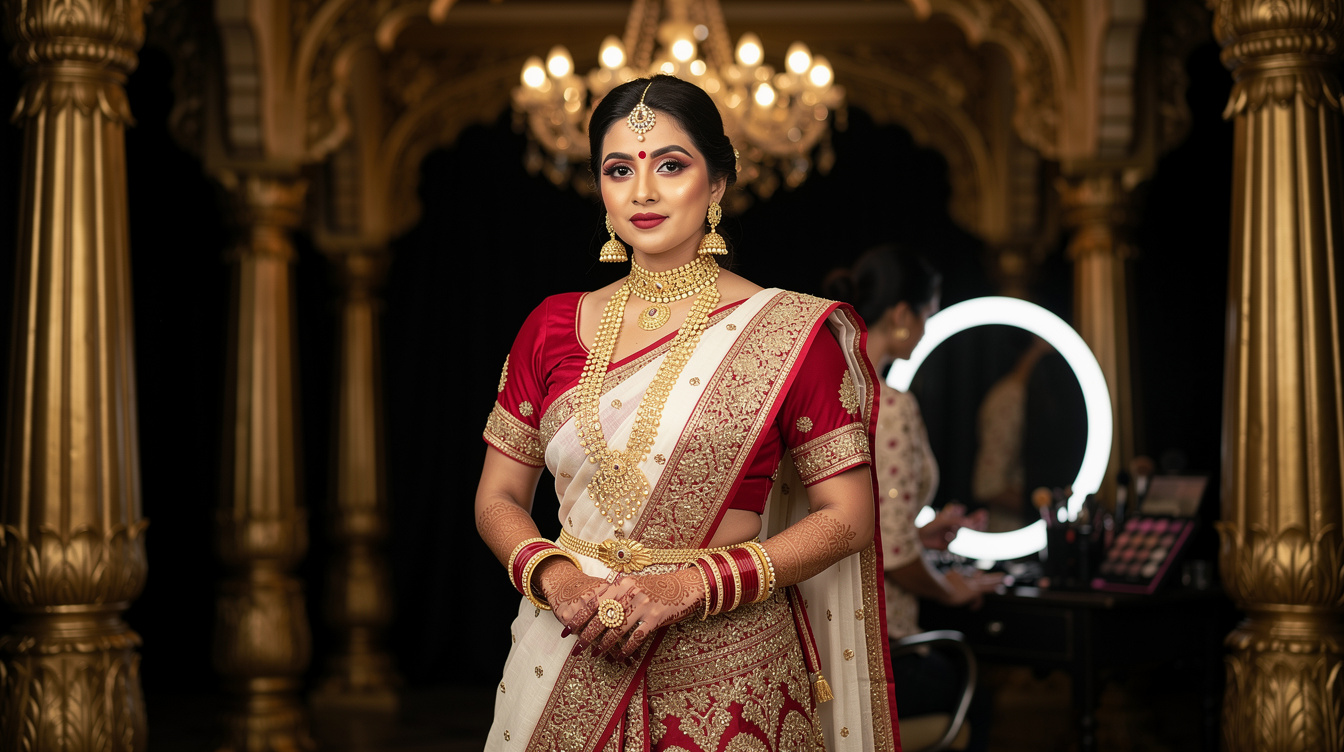
So you’ve finished Class 12, the marks are in, and the question hanging over every dinner-table conversation is the same — what now? If your answer has anything to do with brushes, lashes and the slow-burning thrill of watching a face transform under your hands, then the makeup industry is no longer a wild detour. It is one of the fastest-growing creative careers in India, and 2026 is genuinely one of the best years in a decade to begin.
We’ve spent more than thirteen years inside this industry — training in the Netherlands, building a studio in Sector 16 Faridabad, and working with over 1000 brides across India and destinations like Sri Lanka, Jaipur, Goa, Udaipur, Jim Corbett, Kashmir and Canada. So when we walk you through what a makeup course after 12th actually looks like in 2026, the salaries you can realistically earn, and the route from your first kit to your first paying client — we are not quoting from a textbook. This is what the work looks like from the inside.
Is Makeup Artistry a Viable Career After 12th?
The short answer is yes — and the long answer is more interesting. India’s beauty and personal-care market is projected to cross ₹2 lakh crore before 2027, and the wedding industry alone moves an estimated ₹4 lakh crore each year. Bridal makeup sits at the very heart of that economy. Beyond weddings, OTT productions, fashion editorials, brand campaigns and the explosion of beauty creators on social media have built dozens of new income streams that simply did not exist a decade ago.
For a student finishing Class 12 in 2026, this matters in three ways. First, there is no longer a stigma around choosing makeup as a serious profession — parents who once pushed BCom or BBA are increasingly aware of what working artists actually earn. Second, the entry barriers are unusually low compared with medicine, law or engineering: there is no NEET, no JEE, no four-year fee burden. Third, the ceiling is high. A senior bridal artist in Delhi NCR can comfortably earn between ₹50,000 and ₹2 lakh per booking during peak wedding season, and a focused freelancer can replace an entry-level corporate salary inside a single year.
But “viable” does not mean “easy”. The industry rewards consistency, craft and training — not weekend Instagram reels. The artists thriving in 2026 are the ones who took their education seriously, built a real portfolio, and learned the business side as carefully as the brushwork. That is the honest conversation we want to have in this guide.
Types of Makeup Courses Available (Certificate, Diploma, Degree)
Walk into any course-comparison conversation in 2026 and you will quickly realise the makeup education landscape is messier than it looks. Course names are not regulated, durations vary wildly, and the same fee can buy you something brilliant in one academy and something disappointing in another. Here is how the genuine options stack up.
1. Certificate Courses (1 to 12 weeks)
The most popular route after 12th. Certificate courses are intensive, focused, and built around a specific outcome — bridal, party, HD, airbrush. Fees range from around ₹25,000 for a basic 7-day programme to ₹1,00,000+ for a comprehensive intensive. Our own 12-Day Bridal Makeup Course sits in this category at ₹1,00,000 + 18% GST, designed to take a complete beginner from foundation theory through HD Glass Skin, Soft Glam, Nude/No-Makeup, Skin-like finish and Airbrush makeup in twelve full days of hands-on training on live models.
2. Diploma Programmes (3 to 6 months)
Diplomas are slower-paced and typically broader, covering bridal, party, HD, theatrical, special effects and sometimes hairstyling. Fees fall between ₹1.5 lakh and ₹4 lakh depending on the academy. Best suited to students who want to delay entering the freelance market and prefer a longer ramp into the industry.
3. Degree Programmes (BSc Cosmetology, 3 years)
Rare in India and not strictly necessary for a working career. A handful of universities offer BSc Cosmetology programmes that combine makeup, skincare and salon management. Useful if you eventually want to teach at the college level or move into product formulation, but overkill for a student whose goal is to become a working bridal or editorial artist.
4. International Certifications
Brands like Makeup Studio (Netherlands), where we ourselves trained, and major product houses such as MAC and Charlotte Tilbury run their own pro-artist programmes. These are usually pursued after a foundational course, once you are already working — they sharpen technique rather than teaching it from scratch.
The honest verdict: for most students walking out of Class 12, an intensive certificate programme of 4–12 weeks under a working artist will deliver more career value than a 6-month diploma at a generic institute. You learn faster when your teacher is still actively booking weddings.
Eligibility — No Special Qualifications Needed
This is the section every parent reads twice. The eligibility criteria for a serious makeup course are refreshingly simple, and refreshingly different from the rest of the higher-education landscape.
- Educational stream: No requirement. Science, Commerce, Humanities, Vocational — every stream is welcome. Makeup does not care whether you knew calculus.
- Marks: No minimum percentage. We have trained students who scored 90% in boards alongside students who scored 55%. Both have gone on to bookings.
- Age: Most reputable academies welcome 18+ students. Some accept 17+ with parental consent. There is no upper limit — career-changers in their 30s and 40s thrive in our batches.
- Prior experience: None required. A complete beginner who has never held a kabuki brush is exactly who a good intensive course is designed for.
- Equipment: A basic personal kit is helpful but not mandatory at most academies — premium products from MAC, NARS, Laura Mercier, Huda Beauty, Charlotte Tilbury and Fenty Beauty are typically provided during training.
What is genuinely required is harder to put on a form: a willingness to practise daily, to take feedback without bruising, and to study faces the way an architect studies buildings. The students who succeed are not the ones who arrived already “talented” — they are the ones who showed up to every session, swatched every product, and kept their portfolios moving every week after graduation.
Career Options After a Makeup Course
One of the gifts of choosing this industry is the variety of ways you can actually make a living. A makeup certificate is not a single-track ticket — it is a passport to at least five distinct career paths, and most working artists eventually combine two or three.
Freelance Bridal Makeup Artist
The largest single market in India. Bridal makeup alone supports thousands of full-time artists. A freelancer sets their own price, builds their own portfolio and travels for destination weddings. This is the path most students choose after our 12-day course — it offers the highest earning potential per assignment and the most creative freedom. It is also where 1000+ of our own brides have come from.
Salon or Studio Employment
If freelancing feels overwhelming in year one, salons and bridal studios offer a steady salary, a steady client flow, and on-the-job mentorship. Salaries start around ₹15,000–₹25,000 per month and rise quickly with experience. Many artists begin here, save up, build a portfolio, and break into freelance after 18–24 months.
Film, TV and OTT Makeup
The OTT explosion has multiplied production work across Mumbai, Delhi NCR and Hyderabad. Film makeup is technically demanding — continuity, HD camera, prosthetics — and usually requires you to start as an assistant for one to two years. Pay scales from ₹2,500/day for assistants to ₹15,000+/day for department heads, with department heads on big-budget productions earning significantly more on long shoots.
Fashion and Editorial
Magazine shoots, fashion week backstage, brand campaigns — the high-art end of the industry. Less consistent income than bridal, but enormous portfolio value. Editorial work is how many artists build the credibility that lets them charge premium bridal rates later.
Makeup Educator
After five to seven working years, many artists transition into teaching — running their own academies, conducting masterclasses, building online courses. Educator income tends to be stable and recurring, and it deepens your craft because nothing forces you to articulate technique like teaching it.
Salary & Earning Potential (₹15K to ₹1L+ per Month)
This is the section every student wants to read first and every parent wants printed and laminated. The truth is that makeup income in India is unusually elastic — it stretches enormously based on training, location, portfolio and the willingness to treat the work as a business rather than a hobby. Here is what realistic 2026 earnings look like.
Beginner (Year 0–1): ₹15,000–₹35,000 per month
A fresh graduate working at a salon or assisting a senior artist typically earns ₹15,000–₹25,000 monthly. Freelancers in their first year often book four to eight party-makeup or pre-wedding clients per month at ₹3,000–₹8,000 each, building toward bigger assignments and slowly raising rates with every fifth client.
Mid-Career (Year 2–4): ₹50,000–₹1,00,000 per month
Once you have a polished portfolio and your first 30–50 client testimonials, the numbers change quickly. A mid-career bridal artist in Delhi NCR earns ₹15,000–₹25,000 per bridal function, plus party, engagement and pre-wedding bookings. A focused freelancer at this stage easily clears ₹60,000–₹1 lakh in peak months between October and February.
Senior (Year 5+): ₹1,00,000–₹5,00,000 per month
Established bridal artists with strong portfolios charge ₹28,000–₹50,000 per function, with destination wedding rates from ₹50,000+ per day. Add hairstyling, draping and photography services and a single wedding can yield ₹1.5–₹3 lakh. Senior artists serving 8–12 brides during peak season comfortably cross ₹5 lakh in a single month.
Reference rates from our own studio (2026): Bridal per function ₹28,000 · Engagement ₹25,000 · Party / family makeup ₹8,000 · Outstation per function ₹50,000. Every quote is custom — these are starting reference ranges, and final pricing depends on functions, travel, team composition (hairstylist, drapist, photographer) and product preferences.
How to Start — Step by Step
If everything above sounds promising, the question becomes practical: how exactly do you go from “I just finished 12th” to “I have my first paying client”? Here is the honest sequence we have watched hundreds of students walk through.
Step 1 — Pick the Right Course (Month 1)
Choose by who is teaching, not by who is marketing. Visit the academy. Ask whether the lead instructor is currently booking weddings. Ask how many students are in each batch — small batch sizes (4–6) deliver dramatically more individual attention than 20-student factory rooms. Many of our students arrived asking the same fear out loud: will I waste a lakh and learn nothing useful? The honest test is whether the course includes daily live-model practice, a portfolio shoot at the end, and direct teaching by an active artist — not just lectures and theory. If the lead instructor cannot show you their portfolio of recent paid bookings, walk out.
Step 2 — Build Your Foundation Kit (Month 2)
You do not need ₹2 lakh of products on day one. A solid starter kit blends entry-level professional brands (NYX, Maybelline Pro, Colorbar) with a few key premium items where quality genuinely matters — a NARS or Laura Mercier foundation, a MAC translucent powder, a Charlotte Tilbury or Huda Beauty cream blush, and a Fenty Beauty highlighter. Premium products like Dior Forever or Haus Labs come later, once your bookings justify them. Spend on brushes early — cheap brushes are the single fastest way to make expensive products look amateur.
Step 3 — Practise on Real Faces, Daily (Months 2–4)
Recruit family, friends, neighbours. Offer free makeup in exchange for photos and feedback. Twenty different faces in twenty days teaches you what twenty months of theory cannot — undertones, eyelid shapes, oily-vs-dry skin behaviour, and how foundation moves under heat or studio light.
Step 4 — Build a Portfolio (Months 3–5)
Organise two or three test shoots with student photographers. Aim for variety — bridal, soft glam, editorial, no-makeup makeup, HD glass skin. A portfolio of 15 polished images is what unlocks paid bookings, and it is the single highest-leverage activity in your first six months.
Step 5 — Set Up Instagram and Pricing (Month 5)
A clean Instagram grid, a clear booking number, and transparent pricing. Do not undersell — the lowest-priced artist in any market is rarely the most-booked. Charge ₹3,000–₹5,000 for your first ten paid clients, then raise rates by ₹1,000 every five clients until you find the price your work commands.
Step 6 — Take Your First Booking (Month 6)
Most of our 12-day course graduates take their first paid booking within 30–60 days of completing the course. The earning curve is steep in year one, but every wedding season compounds. By the end of year two, most are earning more than they would have in a typical entry-level corporate role — and they are doing work they actually love.
Step 7 — Network and Keep Learning
The artists who plateau are the ones who stop learning after their first 50 clients. The artists who keep climbing attend masterclasses every year, swap notes with photographers, drapists and stylists in their region, and stay curious about new formulations from MAC, NARS, Dior, Huda Beauty and Charlotte Tilbury. Treat your education as ongoing — twelve days launches you, but the next decade is what builds the career.
One last thing on the fear we hear most often — is twelve days really enough to learn properly? Twelve days, when they are eight-hour days of live-model practice in a small batch with an active working artist, is roughly 96 hours of intensive hands-on training. That is more practical practice than many six-month diplomas deliver, because diploma hours are diluted by lectures, breaks and theoretical assignments. The skill that takes longer to build is judgement — and that comes from your first 30–50 paid clients, not from any course of any length.
Book Your Bridal Makeup Consultation
Shivangi Verma brings 13+ years of expertise to make your special day unforgettable. Based in Sector 16 Faridabad, serving brides across Delhi NCR and destination weddings worldwide.
📞 +91 9873048267 | 💬 WhatsApp Us | 📍 Booth 70-71, First Floor, Sector 16 Huda Market, Faridabad
Frequently Asked Questions
Do I really need a Class 12 certificate to enrol in a makeup course?
For most reputable academies in India, including ours, the firm requirement is that you are 18+ (or 17+ with parental consent). A Class 12 mark sheet is not strictly mandatory, though it helps for general background paperwork. Stream and percentage do not matter — Science, Commerce, Humanities and Vocational students are all welcome, and we have trained successful artists from every academic background.
Will the 12-Day course really prepare me for a career?
Yes — twelve full days of intensive training (roughly 96 hours of hands-on practice on live models) is more than enough to become bridal-ready, provided the format is genuinely intensive and the batch is small. Our 12-Day course covers HD Glass Skin, Soft Glam, Nude makeup, Skin-like finish and Airbrush, ending with a portfolio shoot. The skill that takes longer is judgement, which comes from your first 30–50 paid clients — that is true after any course of any length.
How much can a beginner makeup artist earn in India in 2026?
Realistic year-one earnings range from ₹15,000–₹35,000 per month for salon employment, or ₹20,000–₹60,000 per month for proactive freelancers in Delhi NCR who book 4–10 clients monthly. By year three, focused artists comfortably reach ₹1 lakh per month, and senior bridal specialists with full-service teams cross ₹5 lakh per month during peak wedding season.
Is freelance better than working at a salon for a fresher?
Both work — they are different paths to the same destination. Salons offer steady salary, mentorship and a steady stream of clients but a lower earning ceiling. Freelance offers full creative and pricing freedom but demands self-marketing, business setup and patience through an early income dip. Many of our students do salon work for 12–18 months, save aggressively, and then go freelance with a built portfolio. Both are valid choices.
How do I know an academy is reputable enough to invest in?
Three honest tests. First, is the lead instructor actively booking weddings — not just teaching? Second, are the batch sizes small enough for individual attention (ideally 6 students or fewer)? Third, does the course include real live-model practice and an end-of-course portfolio shoot rather than just lectures? Reputation built on years of real client work — for us, 1000+ brides since 2012, 5.0 ratings on WedMeGood, international training in the Netherlands — is more reliable than reputation built on advertising spend.