
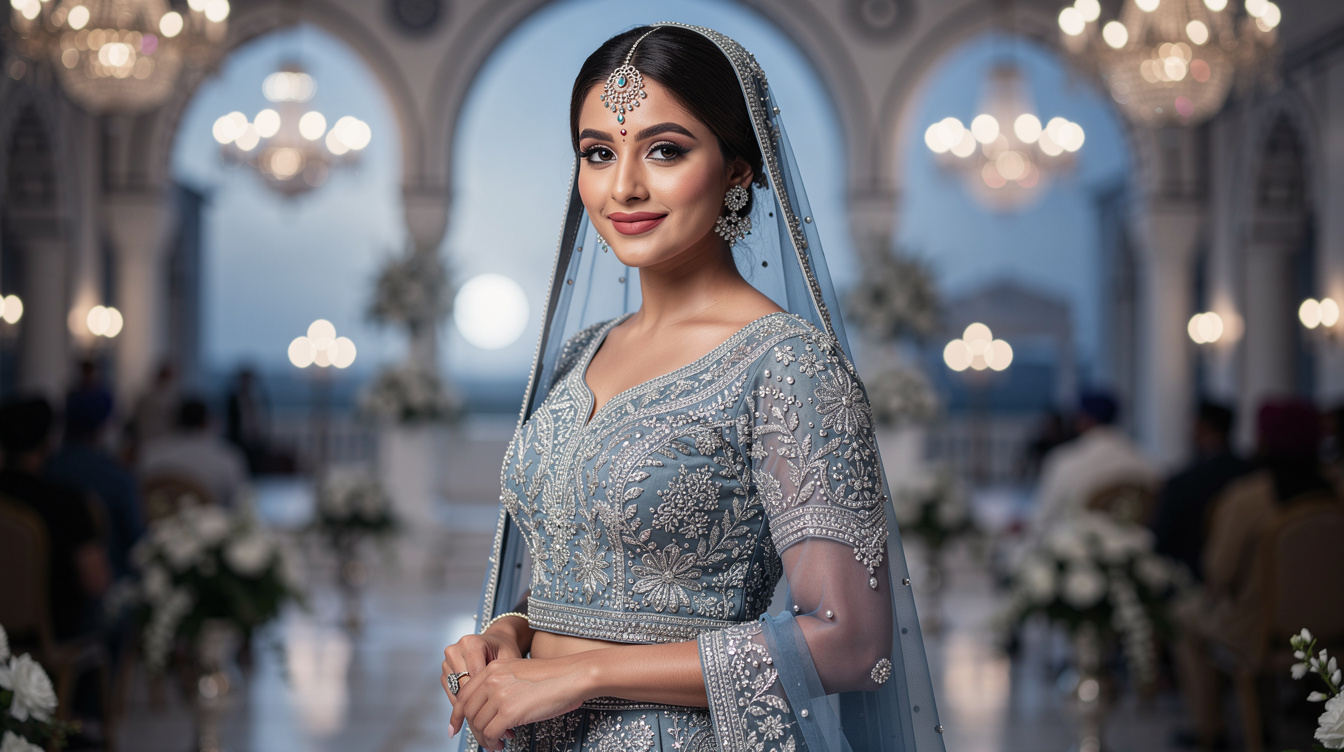
An Anand Karaj is unlike any other Indian wedding ceremony. The bride sits before the Guru Granth Sahib at dawn, walks four laavan around it, and her face is photographed from every angle as the morning light shifts through the gurdwara windows. Sikh Anand Karaj bridal makeup has to honour all of this — the sanctity of the setting, the soft natural light, the long sit, and the bride’s own face underneath the chunni. We have spent thirteen years preparing brides for exactly this ceremony across Faridabad, Delhi NCR, and at gurdwaras as far as Chandigarh and Jaipur, and the brief is always the same: she must look like the most luminous version of herself, not a stranger.
This guide walks you through everything we consider when designing a Sikh bridal look — from the skin prep that survives the four laavan, to the kalire and chunni placement that frames the face, to the products we trust under HD cameras at 7am. If you are an Anand Karaj bride researching your options, this is the conversation we would have with you in our bridal makeup consultation, written down.
What Makes Sikh Anand Karaj Bridal Makeup Different
Most North Indian wedding makeup is designed for evening receptions — heavy shimmer, warm tungsten lighting, deep contour. An Anand Karaj is the opposite environment. The ceremony usually begins between 7am and 10am inside a gurdwara, where lighting is cool, soft, and largely natural. The bride sits cross-legged for the kirtan, then walks four slow circles around the Guru Granth Sahib. Her chunni covers her head throughout, framing her face like a portrait.
This changes everything about the makeup approach. Heavy contour reads grey under cool morning light. Glittery eyeshadow looks dated in candid photographs taken at floor level. Bold lip colours fight with the traditional red or pink chunni. The look has to be quietly opulent — luminous skin, eyes that lift the face under the chunni’s shadow, a lip that complements rather than competes with the dupatta. We default to our HD Glass Skin or skin-like finish for almost every Sikh bride we work with, because both photograph beautifully in soft natural light and survive the long ceremony without going flat.
The Lighting Reality of a Gurdwara
Gurdwaras have large windows, white marble, and minimal artificial lighting during the day. This is flattering light, but it is unforgiving on heavy foundation, visible powder, and the wrong undertone. We always test products in natural light during the trial — never under ring lights alone. A foundation that looks perfect on Instagram can flashback white in a candid laavan photograph, and we are not willing to risk that on your wedding album.
Skin Prep: The Foundation of an All-Day Ceremony
Anand Karaj brides often have a packed schedule — milni and breakfast before the ceremony, the ceremony itself running two to three hours, lunch, and then often a reception or chooda ceremony later. The makeup needs to hold for ten to fourteen hours from the moment we finish at dawn. That endurance is built in skin prep, not in the foundation step.
We start with a deep cleanse, gentle exfoliation, and a hydrating mask the morning of. Laura Mercier’s translucent setting work is well-documented for skin-like finishes; we layer hydration with brand-agnostic discipline — usually a hyaluronic serum, a barrier cream, and then a primer chosen specifically for the bride’s skin type. Oily T-zones get a separate mattifying primer; dry cheeks get a luminous one. This dual-zone approach is one of the small details that lets a bride sit through three hours of kirtan without her foundation breaking apart at the smile lines.
- Cleanse and exfoliate — gently, the night before and morning of
- Hydrate in layers — serum, moisturiser, lip balm, eye cream
- Prime by zone — mattify the T-zone, luminise the cheeks
- Set strategically — only where shine will distract, never the high points
- Touch-up kit on hand — blotting paper, lip colour, kajal, our assistant on standby
The Signature Sikh Bridal Face: Building the Look
For Sikh Anand Karaj wedding makeup, we usually build around four anchor decisions: the skin finish, the eye, the lip, and the way the chunni frames everything. Each is chosen in the trial after we see the bride’s outfit, jewellery, and chunni colour in person.
The Skin: Glass or Skin-Like
For Sikh brides we lean heavily on HD Glass Skin or our skin-like finish. Glass skin gives the cheekbones a wet, lit-from-within glow that looks devotional under morning light — almost spiritual in photographs. Skin-like is the answer for brides who want the same luminosity but with slightly more coverage for blemishes or pigmentation. We build coverage in thin layers, using a mix of liquid foundations from the brands that perform reliably for us — Dior Forever, NARS Light Reflecting, and Fenty Beauty depending on undertone. Powder is used sparingly, almost never on the high points, because we want the cheekbones to catch light naturally.
The Eye: Soft, Lifted, Long-Wearing
Sikh bridal eyes are usually soft glam — warm browns, bronzes, deep plums, or rose-golds, lifted at the outer corner so the eye opens up under the chunni’s shadow. We avoid heavy black smokey eyes for morning ceremonies because they can read harsh in natural light and overwhelm the rest of the face when the chunni is draped low. A waterproof black or brown kajal, two coats of waterproof mascara, and the right pair of lashes is non-negotiable — vidaai tears are coming, and so are tears during the laavan if the bride is close to her family. Huda Beauty’s matte palettes and Charlotte Tilbury’s bronzed tones are workhorses for this look.
The Lip: A Complement to the Chunni
The chunni colour drives the lip. A traditional red Sikh bridal chunni pairs beautifully with a soft brick red or rose-mauve lip — never a competing tomato red. A pink or peach chunni opens up the option for a nude-rose or warm berry lip. We layer a long-wear liner with a creamy lipstick, blot, then lock with a fine layer of powder pigment for staying power through hours of langar and conversation. MAC’s classic liners are still our quiet favourites for this exact job.
Hair, Chunni Drape, and the Whole Picture
One of the things we built our team around is the fact that a Sikh bride’s chunni placement is half the picture. You cannot do bridal makeup well and then leave the drape to chance. Our team includes a dedicated drapist alongside our hairstylist and photographer, and the four of us work together from the moment the bride sits in the chair. The drapist times the chunni pinning to the moment the makeup is sealed; the hairstylist places the kalire and matha patti so the parting frames the forehead correctly.
For Anand Karaj brides specifically, we usually keep the hair low and secure — a sleek bun or a softly braided knot — because the chunni sits over the head for the entire ceremony. Volume on top creates an awkward chunni line. The matha patti or tikka is positioned so it stays visible even when the chunni shifts, which it inevitably does during the four laavan. These are details no bride should have to think about — that is what the team is for. You can see the range of looks in our portfolio, including several Sikh brides whose ceremonies we covered end to end.
Will I Still Look Like Myself? The Bride’s Biggest Fear
This is the fear we hear in almost every consultation, and we take it seriously. Sikh brides especially — surrounded by family from the moment of jago, photographed by aunts and uncles who have known you since you were a child — cannot afford to look like a stranger walking into the gurdwara. The horror stories from Instagram are real. We have seen brides come to us after a bad trial elsewhere, asking how to make sure it does not happen on the day.
Our answer is the philosophy we have built the studio around: enhance, never mask. The reviews our brides leave on WedMeGood — five-star ratings across twenty-six-plus reviews — repeatedly use phrases like "she understood my vision and made me look pretty without overdoing it" and "the makeup was so light, like I wasn’t wearing any, yet had great coverage." That is not an accident. It is the result of HD Glass Skin and skin-like techniques applied by someone who has done this for over a thousand brides since 2012. Shivangi personally leads every bridal appointment — there is no junior touch-up artist swapped in on the day. The face you see in the trial is the face you see at the gurdwara.
The Trial: Why It Matters More for Sikh Brides
An Anand Karaj happens at dawn. Most trials happen in the afternoon. This is a real disconnect, and we work around it deliberately. During the trial we discuss the gurdwara’s lighting, photograph the look in natural light by a window, and walk through the timing of the morning so the bride knows exactly when we will arrive and how long the entire process takes. A standard Sikh bridal session with us begins between 4am and 5am for a 7am or 8am ceremony, with the hairstylist and drapist working in parallel.
We also use the trial to confirm products against the bride’s skin’s real-world behaviour over a full day — sweat, oil, hugging, eating. The trial is not a sales pitch; it is a dress rehearsal. Brides who have done a trial with us frequently mention in their reviews that it removed the anxiety of the unknown. As one bride put it, "Shivangi knows her job very well — totally involved, dedicated and patient." Patience in the trial is what produces calm on the wedding morning.
Pricing, Travel, and Destination Anand Karaj Weddings
We publish starting prices openly because we believe brides deserve to plan without surprises. Bridal makeup per function starts at ₹28,000, with custom quotes for full-day combinations. Outstation bookings — gurdwaras outside Delhi NCR — start at ₹50,000 per function and include the team. We have already taken Sikh and Hindu bridal teams to Jaipur, Goa, Jim Corbett, Udaipur, Chandigarh, and Kashmir within India, and as far as Sri Lanka and Canada internationally. The whole team — Shivangi, hairstylist, drapist, photographer, assistant — travels together so the look stays consistent across every function from sangeet to vidaai.
We do not believe in hidden charges. If your Anand Karaj is at a gurdwara in Chandigarh, Amritsar, or anywhere in Delhi NCR, the easiest way to get a real, itemised quote is to message us on WhatsApp at +91 9873048267 with your dates, ceremony locations, and rough schedule. We typically respond within a few hours with a clear breakdown.
Frequently Asked Questions
Will I still look like myself in Sikh Anand Karaj bridal makeup?
Yes — that is the whole point of how we work. Our approach for Sikh brides is HD Glass Skin or a skin-like finish, both of which enhance your features rather than mask them. We confirm the look with you in the trial so there are no surprises on the morning of the ceremony. Brides consistently tell us in reviews that they looked like the best version of themselves, not someone unrecognisable.
How long will my Sikh bridal makeup last through the ceremony?
An Anand Karaj plus reception day usually runs ten to fourteen hours, and our makeup is built to hold that long. We use waterproof eye products, long-wear lip layering, and zone-specific priming so the skin does not break apart at the smile lines. Real client reviews confirm the makeup and hairstyle stayed intact till late hours, including through vidaai tears and hugs from a few hundred relatives.
Will my makeup flashback in wedding photographs?
This is a real risk if the wrong products are chosen. We test every foundation in natural light during your trial — exactly the lighting condition of a morning gurdwara — and use HD and Ultra HD techniques designed for close-up photography. Shivangi’s training at Makeup Studio in the Netherlands is grounded in camera-ready finishes, and our in-house photographer is part of the team for exactly this reason.
Can your team travel for an Anand Karaj outside Delhi NCR?
Yes. We have already done destination weddings in Jaipur, Goa, Jim Corbett, Udaipur, Chandigarh, and Kashmir, and internationally in Sri Lanka and Canada. The full team — makeup, hair, drapist, photographer, assistant — travels together. Outstation bookings start at ₹50,000 per function with custom quotes based on the schedule.
How is the trial structured for an early-morning Anand Karaj?
We schedule the trial well in advance of your wedding date, usually one to two months out. During the trial we test the look in natural daylight by a window to simulate gurdwara lighting, walk through the morning timeline, and finalise products against your skin’s behaviour. By the end you know exactly how the morning will run, what time we arrive, and what you will look like when you sit before the Guru Granth Sahib.
Book Your Bridal Makeup Consultation
Shivangi Verma brings 13+ years of expertise to make your special day unforgettable. Based in Sector 16 Faridabad, serving brides across Delhi NCR and destination weddings worldwide.
📞 +91 9873048267 | 💬 WhatsApp Us | 📍 Booth 70-71, First Floor, Sector 16 Huda Market, Faridabad